
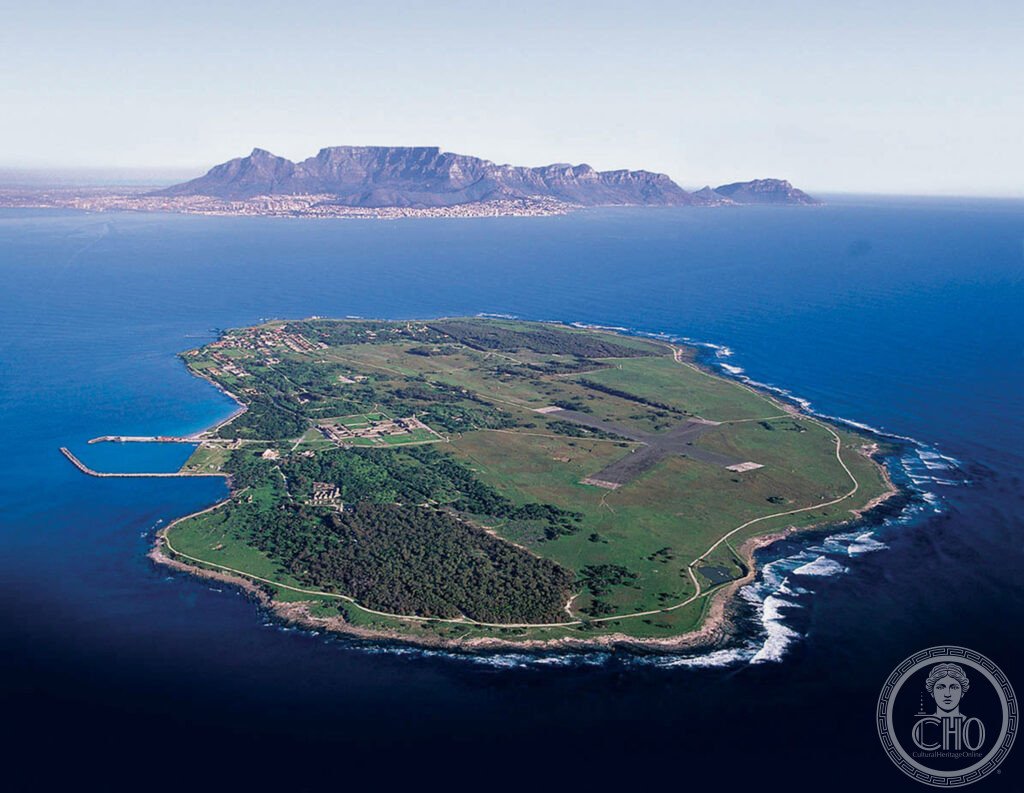
Robben Island
The most powerful monument to the struggle against apartheid — a flat, cold island 12 km off the Cape Town waterfront where the South African apartheid government imprisoned its most dangerous opponents, including Nelson Mandela (18 years, 1964–1982), Walter Sisulu, Govan Mbeki, and hundreds of other African National Congress, Pan Africanist Congress, and Black Consciousness Movement leaders; a place whose transformation from a maximum-security prison into a museum and a UNESCO World Heritage Site is the symbolic inversion of apartheid’s attempt to silence its opponents forever.
At a glance
Robben Island (Afrikaans: Robbeneiland, “Seal Island”) is a 5.07 km² island in Table Bay, approximately 12 km from the V&A Waterfront of Cape Town, Western Cape, South Africa. The island was used as a leper colony (1845–1931), a mental asylum (1846–1921), a military garrison (World War II), and finally as a maximum-security prison for political opponents of the apartheid government (1961–1991); it is now a museum, a UNESCO World Heritage Site, and a nature reserve. Nelson Mandela spent 18 of his 27 years of imprisonment on Robben Island (1964–1982; he was subsequently transferred to Pollsmoor Prison in Cape Town and then to Victor Verster Prison) before his release in 1990. UNESCO inscribed Robben Island in 1999.
Key facts
- Nelson Mandela’s cell (Section B, Cell 5): a 2 × 2.1-metre cell with no running water, no proper ventilation, and a thin sisal mat on a concrete floor; during the first years of imprisonment, African prisoners were not allowed a bed, a chair, or a table (only Indian and “Coloured” prisoners received these; the racial differentiation continued to affect food portions and clothing throughout the prison period); the cell is preserved as it was during Mandela’s imprisonment and is the centrepiece of the museum tour; former political prisoners (ex-prisoners who work as guides at the museum) take visitors through the cell block
- The limestone quarry: from 1965, political prisoners were required to work in the limestone quarry on the island — breaking rocks under the full force of the southern Cape sun; the reflected glare from the white limestone damaged the eyes of many prisoners permanently (Mandela’s tear ducts were permanently damaged, limiting his ability to cry in later life; his eye condition is documented in medical examinations during his imprisonment); the prisoners used their time at the quarry for political education — the quarry became known as “the University” because of the informal political and intellectual discussions that the prisoners held while working; the cave shelter at the quarry where Mandela is photographed is on the standard tour route
- The prisoners: among the political prisoners held on Robben Island were Nelson Mandela (ANC, sentenced to life imprisonment in 1964 for sabotage and conspiracy, the Rivonia Trial); Walter Sisulu (ANC, same trial as Mandela); Govan Mbeki (ANC, father of former President Thabo Mbeki); Ahmed Kathrada (ANC, same trial); Robert Sobukwe (PAC, founder of the Pan Africanist Congress — held in solitary confinement under a special law passed specifically to keep him isolated after his sentence ended); Steve Biko (Black Consciousness Movement leader — not held on Robben Island but arrested and tortured by the security police, dying in custody in 1977, whose death galvanised international opposition to apartheid)
- The Blue Slate Quarry: separate from the limestone quarry, this was the work area for the most dangerous prisoners; the slate was used as building material for the prison buildings themselves; prisoners worked here in silence under strict guard; the conditions were harsher than the limestone quarry and protest was met with solitary confinement or beatings
- The release and after: Nelson Mandela was released from Victor Verster Prison on 11 February 1990 after 27 years of imprisonment; he was elected President of South Africa in the first democratic election in 1994; Mandela explicitly chose reconciliation over retribution, and the selection of Robben Island as a UNESCO World Heritage Site (1999, five years after the end of apartheid) was part of the same deliberate policy of transforming the instruments of oppression into monuments to the struggle against oppression
- Heritage: UNESCO World Heritage Site, Robben Island, inscribed 1999
- GPS: 33.8063° S, 18.3662° E
History
Robben Island’s history as a place of exile and incarceration begins with the Dutch East India Company (VOC): from 1652 (the same year the Dutch established their victualling station at the Cape), the island was used as a place of banishment for political opponents, criminals, and the mentally ill from both the Cape Colony and the VOC’s Asian empire (exiled Javanese nobles and Muslim clerics — including Sheikh Yusuf of Macassar, 1694 — were held here in the 17th–18th centuries; their graves on the island are still Muslim pilgrimage sites). The British colonial period continued the pattern: the island served as a leper colony (1845–1931) and as a place of imprisonment for African chiefs including Makana (the Xhosa prophet who led the attack on Grahamstown in 1819 and drowned in 1820 trying to escape the island) and Langalibalele (imprisoned 1873).
The apartheid-era maximum-security prison (Category A, opened 1961) was designed to disappear political opposition by removing its leaders from South African society entirely; the prisoners’ families were denied information about the prisoners’ condition; visits were restricted to 30 minutes every six months (in the early years); letters were censored; the prisoners were denied access to newspapers; the political strategy behind the imprisonment was to break the leaders psychologically and socially isolate them from their movements. The strategy failed: the political discussions at the limestone quarry (“the University”) kept the movement’s intellectual life active; the prison became a unifying experience for three generations of South African liberation movement leaders; and the international campaign for Mandela’s release (from the mid-1970s, focused by Amnesty International and the Anti-Apartheid Movement) became one of the most effective human rights campaigns in history.
What you see
The island is accessible only by the official Robben Island Museum ferry (from the V&A Waterfront, Clock Tower precinct); the trip takes 25–30 minutes; the full tour (guided by a former political prisoner or a museum guide trained by ex-prisoners) lasts approximately 3.5 hours and includes the ferry crossing, a bus tour of the island (the limestone quarry, the Robert Sobukwe isolation house, the leper graveyard, the World War II coastal gun emplacements), and a guided walk through the maximum-security prison (Section B, the cell block where Mandela was held, with his cell preserved in its original condition, and the general cells, the punishment block, and the exercise yard).
The tour is emotionally demanding — many visitors (including the ex-prisoner guides themselves, who return to the place of their imprisonment daily to lead tours) find it an intense experience; the small scale of the cell, the physical proximity to the space where Mandela and his colleagues spent 18 years, is the central element. The ferry crossing gives clear views of Table Mountain and the Cape Town waterfront from the sea — a perspective that the prisoners would have had daily — and the return trip is the best moment for photography of the Table Mountain silhouette.
Practical information
- Admission: ZAR 750 (approximately €38) including the ferry return and the guided island tour; ferries depart from the Clock Tower precinct of the V&A Waterfront, Cape Town, at 9 am, 11 am, and 1 pm (additional departures in peak season); booking online well in advance is essential (the 9 am and 11 am ferries frequently sell out 2–3 weeks ahead in peak season, December–January and July); departures can be cancelled due to rough sea conditions (the crossing can be rough; the open Atlantic swell in the south cape is considerable)
- Getting there: Cape Town International Airport (CPT) is the hub for southern Africa; direct flights from London (British Airways, approximately 11.5 hours), Amsterdam (KLM), Frankfurt (Lufthansa), Doha (Qatar Airways), Dubai (Emirates), Addis Ababa (Ethiopian Airlines); from the airport, the V&A Waterfront is 25–30 km (40 minutes by taxi or Uber; approximately ZAR 300–400); from the Waterfront, the Clock Tower pier is a 5-minute walk
- Cape Peninsula circuit: Robben Island is most productively combined with the Cape Peninsula drive (Cape Point, Boulders Beach African penguin colony, Hout Bay) as a 2-day Cape Town programme; the Table Mountain Aerial Cableway (conditions permitting; cable car tickets sell out by 10 am on clear days in summer — book online) is the other essential Cape Town experience and is best combined with Robben Island on separate days
Getting there
Ferry from V&A Waterfront Clock Tower pier, Cape Town (25–30 min). Book online well in advance. Cape Town International Airport (CPT) 25 km from the Waterfront. GPS: -33.8063, 18.3662.
Nearby
- Table Mountain — the iconic flat-topped sandstone massif directly above Cape Town (1,085 metres); accessible by the Table Mountain Aerial Cableway (the rotating cable car floor gives 360-degree views during the 5-minute ascent) or on foot via several hiking trails (the India Venster route is the most accessible, 2.5 hours); the views from the top encompass Robben Island in Table Bay, the Cape Peninsula to Cape Point, and the Cape Flats; the cableway may be closed in high winds (frequent in the Cape); check conditions before booking
- Bo-Kaap (Cape Malay Quarter) — a 10-minute walk from the V&A Waterfront; the historic neighbourhood of Cape Town where enslaved people from Malaysia, Indonesia, and India were settled by the Dutch VOC in the 17th–18th centuries; the brightly painted houses (pink, yellow, blue, and green) on the cobblestone streets of Wale and Rose Streets are the most photographed streetscape in Cape Town; the Bo-Kaap Museum (in a Georgian house) documents the history of the Cape Malay community; the neighbourhood’s mosques (including the Auwal Mosque, the oldest mosque in South Africa, 1794) are active; the community maintains a distinct cultural identity (the Cape Malay cuisine, derived from the cooking of enslaved people from the Dutch East Indies, is one of the most distinctive regional foodways in South Africa)
- Cape Point and the Cape of Good Hope — 60 km south of Cape Town (1 hour by car); the southwestern tip of Africa (the most south-westerly point of the African continent, though not the most southerly — Cape Agulhas, 200 km south-east, is the actual southernmost point and the dividing line between the Atlantic and Indian Oceans); within the Cape Point Nature Reserve (entrance fee ZAR 372/adult); the cliff walk (or funicular) to the lighthouse gives the best views of the Atlantic from Africa; the nearby Boulders Beach (40 km back toward Cape Town) has a colony of 3,000+ African penguins that visitors can observe from within 1 metre
Sources
- Wikipedia, Robben Island; Nelson Mandela; Rivonia Trial, accessed June 2026
- UNESCO, Robben Island, WHS reference 916, inscribed 1999
- Nelson Mandela, Long Walk to Freedom, Little, Brown, 1994
- Harriet Deacon (ed.), The Island: A History of Robben Island, 1488–1990, David Philip/Mayibuye, 1996
Find it on the map
See this place and what’s around it →📷 Diventa un fotografo di Cultural Heritage Online
Condividi le tue foto dei luoghi: restano pubblicate con la tua firma come autore. Più vengono viste, più ti fai conoscere — e presto un concorso premierà le foto più apprezzate.
Accedi o registrati gratis per aggiungere una foto