
City of Bath
The only city in England built on a hot spring — a Roman sacred spring complex (Aquae Sulis, 1st–5th century AD) overlaid by the finest Georgian city in Britain, whose architects John Wood the Elder and John Wood the Younger in the 1730s–80s built the Royal Crescent, the Circus, and the Pump Room as a therapeutic resort that became the social capital of 18th-century England, the setting for Jane Austen’s novels, and the model for Georgian urban planning across the British Empire.
At a glance
Bath (Latin: Aquae Sulis) is a city of approximately 94,000 inhabitants in Somerset, south-west England, 155 km west of London, built on the only naturally occurring hot spring in Britain (water at 45°C, 1.25 million litres per day, rising from a geothermal fault 2,700 metres below the city). The city has been continuously inhabited since the 1st century AD and contains two exceptional heritage layers: the Roman sacred spring complex (Aquae Sulis, 1st–5th century AD, with the most important Roman bathing complex in northern Europe) and the Georgian planned city (18th century, with the finest ensemble of Georgian architecture outside London). UNESCO inscribed the City of Bath in 1987.
Key facts
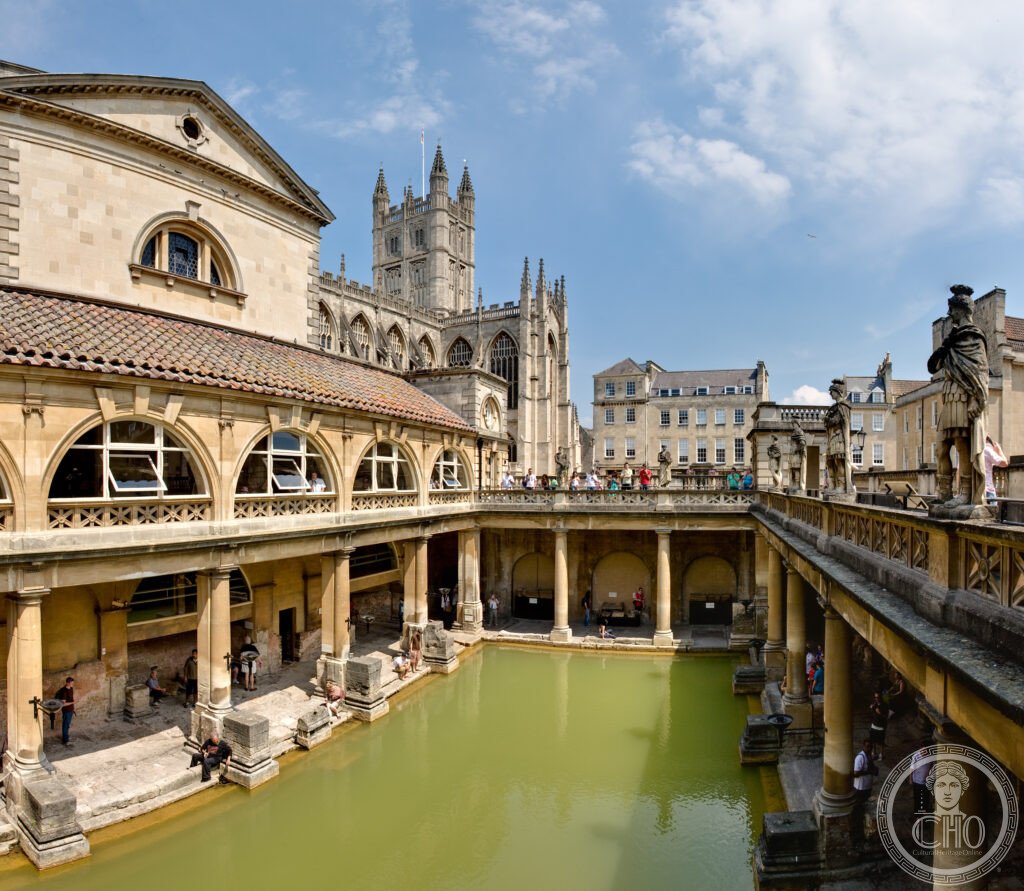
- The Roman Baths (Aquae Sulis): the Romans arrived in Bath approximately 60 AD and immediately built a temple and bathing complex over the natural spring; the temple was dedicated to Sulis Minerva (a conflation of the Celtic goddess Sulis, who presided over the spring, with the Roman Minerva); the complex grew over four centuries to include the Great Bath (a lead-lined rectangular bathing pool, still in use as a museum display), the Sacred Spring (the original hot spring, still rising at its natural temperature), a large swimming bath, and an elaborate drainage and heating system; the baths were buried under medieval sediment for approximately 1,000 years and rediscovered in the 1870s; the museum built over them (the Roman Baths Museum, opened 1897) is the most visited paid heritage attraction outside London in England
- The Gorgon’s Head: the most important Roman sculpture in Britain — a stone pediment relief from the Temple of Sulis Minerva showing a male Gorgon’s head (the standard Gorgon imagery, usually female, was adapted here as a male face with a wild beard, snaky hair, and prominent wings — the face of the local god Sulis combined with the classical Medusa type); displayed in the Roman Baths Museum; the quality of the carving and the sophistication of the iconographic synthesis represent the finest example of Romano-Celtic religious art in the province of Britannia
- The Curse Tablets (defixiones): approximately 130 lead curse tablets were thrown into the sacred spring at Aquae Sulis during the Roman period, calling on the goddess Sulis Minerva to punish those who had stolen from the petitioner (typically — most tablets ask for the punishment of a thief who stole personal items: cloaks, gloves, and, most frequently, bathing equipment stolen from the baths); the tablets are the largest single collection of Roman curse tablets from a single site in the world and a remarkable window on the daily concerns of ordinary Roman Britons; displayed in the museum
- John Wood the Elder and Younger: the Georgian planned city of Bath was primarily the work of John Wood the Elder (1704–1754, who designed Queen Square and the Circus) and his son John Wood the Younger (1728–1781, who designed the Royal Crescent and the Assembly Rooms); the two Woods imagined Bath as a modern Rome — the Circus (begun 1754) is a circular arrangement of 33 townhouses whose street façade uses the three classical orders (Doric, Ionic, Corinthian) on three stories, in deliberate allusion to the Colosseum; the Royal Crescent (1767–74, by Wood the Younger) is a sweeping arc of 30 townhouses with a giant Ionic colonnade, the most imitated building type in Georgian Britain (Halifax, Nova Scotia; Edinburgh New Town)
- Jane Austen: Jane Austen lived in Bath (1801–06) and set two of her novels there (Northanger Abbey and Persuasion); the Jane Austen Centre in Gay Street and the Assembly Rooms (where the novel’s characters dance and socialise) are the primary Austen heritage sites; the city as described in Austen (the Pump Room, the Assembly Rooms, Milsom Street, the Sydney Gardens) is almost entirely intact architecturally and can be walked as a literary landscape
- Heritage: UNESCO World Heritage Site, City of Bath, inscribed 1987
- GPS: 51.3814° N, 2.3590° W
History
The hot spring at Bath was known to Iron Age peoples before the Roman conquest; the Celts worshipped the spring as the domain of the goddess Sulis. The Roman construction of a formal bathing complex and temple began around 60–70 AD under the Governor Aulus Plautius or his successor; the complex was repeatedly expanded over four centuries and remained in use until the final withdrawal of Roman administration from Britain around 410 AD. The baths were gradually buried under post-Roman and medieval sediment and lost to memory; the medieval city of Bath grew over them, with a large Benedictine monastery (Bath Abbey, founded 11th century, rebuilt 15th–16th century) on the site of the Roman temple precinct. The discovery of Roman levels during building work in 1727–1755 began the archaeological investigation; the major excavation campaign (1878–97) under the city engineer Major Charles Davis uncovered the Great Bath and the sacred spring.
The Georgian city was built during Bath’s second great flowering (1700–1800), when the medicinal reputation of the waters (promoted by the physician Richard Russell and the master of ceremonies Richard Nash, “Beau Nash”) attracted the English aristocracy and gentry as a social resort; at its peak in the 1760s–80s, Bath was the second most fashionable city in England after London, visited for the taking of the waters, the assembly room balls, and the theatrical performances. The arrival of the railway (1840) democratised Bath as a tourist destination and simultaneously undermined its exclusivity as an aristocratic resort; its 20th-century history was marked by industrial decline and the controversial demolition of several Georgian terraces in the 1950s–60s (now regarded as the worst planning decisions in the city’s history).
What you see
The Roman Baths Museum (open daily; admission approximately £25 adult) is entered from the Pump Room (the elegant Georgian colonnaded room above the baths where the mineral water is still served, a restaurant-café, open daily for morning coffee, lunch, and afternoon tea); the museum takes 2 hours for a thorough visit; the audio guide (included in admission) is excellent. The highlight is the Great Bath itself — standing at the edge of the lead-lined pool, looking at the green geothermal water still rising as it has for 2,000 years, with the Victorian colonnaded terrace and the Bath Abbey tower visible above the pool edge.
The Georgian walk (the Royal Crescent → the Circus → Assembly Rooms route, approximately 1 hour on foot from the Pump Room, slightly uphill) gives the best sequence of Georgian planned urban spaces; the Royal Crescent Hotel occupies the central section of the Crescent (the terrace of lawn in front of the Crescent is public). The Pulteney Bridge (1774, by Robert Adam — one of only four bridges in the world with shops across its full length on both sides, the others being the Ponte Vecchio in Florence, the Rialto in Venice, and the Krämerbrücke in Erfurt) crosses the Avon River at the east end of the Georgian centre and gives the best river views.
Practical information
- Admission: Roman Baths Museum approximately £25 (book online to avoid queuing; timed-entry tickets recommended); the Pump Room restaurant above the baths is free to enter for food and drink; the Thermae Bath Spa (adjacent to the Roman Baths, designed by Nicholas Grimshaw, 2006 — a contemporary bathing complex using the same spring water) charges approximately £50–60 for a 2-hour session in the rooftop pool (open to the public, booking required; the rooftop view of the city is exceptional)
- Getting there: London Paddington to Bath Spa by GWR train (approximately 1.5 hours, trains every 30 minutes); from Heathrow, change at London Paddington; Bath Spa station is in the city centre, 10 minutes walk from the Roman Baths; Bristol Temple Meads (25 km west) for connections from the north and Ireland; Bath is also accessible by National Express coach from London Victoria (3 hours) and Bristol; parking is available at Park and Ride sites on the city periphery
- The Cotswolds circuit: Bath is at the southern end of the Cotswolds Area of Outstanding Natural Beauty; the villages of Lacock (with Lacock Abbey, used as a filming location for Pride and Prejudice), Castle Combe, and Bradford-on-Avon are all within 30 km; combining a Bath overnight with a Cotswolds driving day (hire car or organised coach tour from Bath) is the standard 2-day itinerary from London
Getting there
London Paddington to Bath Spa by GWR train (1.5h). Bath Spa station 10 min walk from the Roman Baths. GPS: 51.3814, -2.3590.
Nearby
- Stonehenge — 40 km east of Bath (45 minutes by car); the most important prehistoric monument in Britain — the circular arrangement of standing sarsen and bluestone stones on Salisbury Plain, erected in stages between 3000 and 1500 BC; the inner stones are aligned to the midsummer sunrise; UNESCO WHS 1986 (as part of the Stonehenge, Avebury and Associated Sites inscription); combined Stonehenge-Bath day trips from London are extremely common; entrance tickets must be booked in advance (the site is extremely popular)
- Avebury Stone Circle — 40 km north-east of Bath (45 minutes by car); the largest stone circle in the world (covering 11.5 hectares, with an outer circle 421 metres in diameter containing two smaller inner circles); UNESCO WHS 1986 (same inscription as Stonehenge); the village of Avebury is built inside the stone circle, a unique situation in world heritage; less crowded than Stonehenge and freely accessible; combine with the West Kennet Long Barrow and Silbury Hill (both adjacent)
- Wells Cathedral — 30 km south of Bath (35 minutes by car); the smallest cathedral city in England and the finest Early English Gothic cathedral in Britain (begun 1175); the West Front sculpture screen (300+ original 13th-century figures) is the most complete medieval sculptural programme in England; the Chapter House and the famous astronomical clock (c. 1390, one of the oldest in the world still working) are the other highlights; the moated Bishop’s Palace is adjacent
Sources
- Wikipedia, Roman Baths, Bath; Bath, Somerset; John Wood the Elder, accessed June 2026
- UNESCO, City of Bath, WHS reference 428, inscribed 1987
- Barry Cunliffe, The Roman Baths: A View over 2000 Years, Bath Archaeological Trust, 1993
- Timothy Mowl and Brian Earnshaw, John Wood: Architect of Obsession, Millstream Books, 1988
Find it on the map
See this place and what’s around it →📷 Diventa un fotografo di Cultural Heritage Online
Condividi le tue foto dei luoghi: restano pubblicate con la tua firma come autore. Più vengono viste, più ti fai conoscere — e presto un concorso premierà le foto più apprezzate.
Accedi o registrati gratis per aggiungere una foto