
The capital of the Hittite Empire — the great Bronze Age superpower that contested Egypt for control of the ancient Near East, fought the Battle of Kadesh with Ramesses II (c. 1274 BC, the earliest recorded battle with documented tactical details), and signed the world’s oldest surviving peace treaty; the ruins of Hattusa, spread across 180 hectares on a rocky plateau in the Anatolian highlands, are one of the most important archaeological sites in Asia Minor and the primary source of our knowledge of the Hittite world.
At a glance
Hattusa (also transliterated Hattusha; Turkish: Hattuşaş or Boğazköy) was the capital of the Hittite Empire from approximately 1700 BC to 1180 BC, located near the modern village of Boğazköy in Çorum Province, north-central Turkey, approximately 150 km east of Ankara. At its peak (c. 1400–1200 BC), the city covered approximately 180 hectares and was one of the largest cities in the ancient world; the Hittite Empire at this time was one of the four great powers of the ancient Near East (alongside Egypt under Ramesses II, Assyria under Shalmaneser I, and Babylonia), and Hattusa was its administrative, military, and religious centre. The site contains the ruins of the royal citadel (Büyükkale), the Great Temple, the four city gates (Lion Gate, Sphinx Gate, King’s Gate, Yerkapı), and extensive residential and administrative areas. UNESCO inscribed Hattusa in 1986.
Key facts
- The Hittite Empire (c. 1700–1180 BC): the Hittites (Egyptian: Kheta; Akkadian: Hatti) built the first major empire in Anatolia; at their peak, the empire controlled most of modern Turkey, Syria, and parts of Lebanon; the Hittites are credited with the earliest known use of iron for weapons (though this claim is debated — the Hittites used iron as a prestigious metal but the full Iron Age followed their collapse), the development of a sophisticated system of international diplomacy (the Amarna letters document their correspondence with Egypt, Assyria, and Babylon in Akkadian, the diplomatic language of the Bronze Age), and the use of light horse-drawn war chariots in battle tactics that changed Bronze Age warfare
- The Battle of Kadesh (c. 1274 BC): fought at the city of Kadesh (in modern Syria) between the Hittite forces under Muwatalli II and the Egyptian forces under Ramesses II; the largest chariot battle in history (approximately 6,000 chariots on the Hittite side alone); the battle ended without a decisive victory for either side; the subsequent peace treaty (the Eternal Treaty, signed approximately 1259 BC between Ramesses II and Hattusili III, Muwatalli’s brother) is the earliest surviving written peace treaty; copies of the treaty were displayed at the Temple of Karnak in Luxor and at Hattusa; a reproduction hangs at the United Nations headquarters in New York
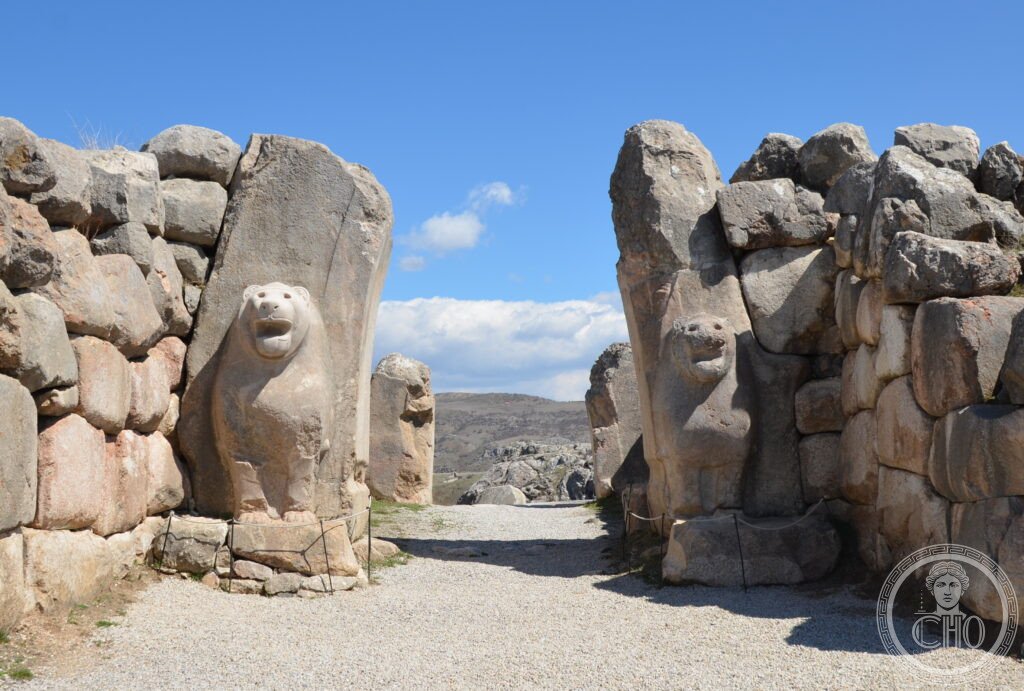
- The Lion Gate: the most famous monument at Hattusa; two large stone sphinxes (commonly called lions but actually more sphinx-like in their treatment) carved in relief on the inner faces of the southern city gate; built c. 1400–1200 BC; the lions face outward, as guardians of the city; the gateway was one of four major gates in the 7-km circuit of the city walls; the walls themselves (still visible in sections) were built on a rubble-filled stone foundation (the construction technique, called casement walls, was a Hittite innovation)
- The Great Temple (Büyük Mabet): the largest Hittite temple, dedicated to the storm god Teshub and the sun goddess Arinna (the two principal deities of the Hittite pantheon); the temple complex (approximately 65 × 42 metres) was also a storage facility for the city (enormous pithoi — storage jars — still stand in the magazine rooms of the temple; one pithos is large enough for a person to stand inside); the temple is at the base of the lower city, adjacent to the main gate
- The Hittite archive (Cuneiform Library): the royal citadel (Büyükkale) yielded approximately 30,000 clay tablets inscribed in cuneiform in the Hittite language (the oldest known Indo-European language recorded in writing; the tablets were deciphered by Bedřich Hrozný in 1915–17, establishing for the first time that the Hittites spoke a language related to Latin, Greek, and Sanskrit); the tablets cover administrative records, royal correspondence, religious rituals, mythology (the Kumarbi myths that may have influenced Hesiod’s Theogony), and diplomatic treaties; most are in the Museum of Anatolian Civilizations in Ankara
- Heritage: UNESCO World Heritage Site, Hattusa: Hittite Capital, inscribed 1986
- GPS: 40.0167° N, 34.6152° E
History
The site of Hattusa was settled from the Early Bronze Age (c. 3000 BC); the Hattians (a pre-Hittite indigenous Anatolian people, not related linguistically to the Hittites) built a city here before 2000 BC. The Hittites (an Indo-European people who appear in the historical record from approximately 1750 BC) took control of the city under King Pithana of Kussara and subsequently made it the capital of their expanding kingdom; the city was destroyed and cursed by the Hittite king Anitta (c. 1800 BC) who was based at the rival city of Kussara, but was rebuilt by the early Hittite Old Kingdom kings and became the permanent capital under Hattusili I (c. 1650–1620 BC).
The Empire period (c. 1400–1180 BC) saw Hattusa at its maximum extent: the upper city (added in the 14th century BC, doubling the city’s size) included dozens of temples, the Sphinx Gate and the Lion Gate, the Yerkapı (earth ramp and tunnel gate), and the Büyükkale royal citadel. The collapse of the Hittite Empire around 1180 BC (part of the wider Bronze Age Collapse that destroyed most of the major Late Bronze Age civilisations of the eastern Mediterranean simultaneously) was catastrophic: Hattusa was burned and abandoned around 1180–1160 BC; the cause is unknown but may have included internal political fragmentation, drought, invasions by the Sea Peoples, and the disruption of the eastern Mediterranean trade networks. The Hittite language and script were forgotten for approximately 3,000 years until Hrozný’s decipherment in 1915–17.
What you see
The site covers approximately 180 hectares across a rocky plateau and requires transport (hire car, organised tour, or the site’s internal circuit road — a circuit of approximately 6 km is typical by car). The Great Temple (lower city, near the site entrance) has the best-preserved architectural fabric and the giant pithoi storage jars still in situ; the Büyükkale citadel (upper city, south) requires a steep climb and has the best views across the archaeological landscape. The Lion Gate, the King’s Gate (a basalt relief of the god Teshub in warrior pose, the original now in Ankara; a cast in place), and the Sphinx Gate (on the Yerkapı earth ramp) are the three most impressive sculpted monuments. The Yerkapı (a 71-metre stone-lined tunnel under the city wall, through which you can walk) is the most dramatic spatial experience on site.
The Museum of Anatolian Civilizations in Ankara (3 hours drive) is essential for understanding Hattusa: it holds the great collection of Hittite sculpture (original Lion Gate guardians, the original King’s Gate warrior, Hittite sphinxes), cuneiform tablets, and Bronze Age artefacts that are the primary documentary evidence for the Hittite world; visit Ankara before or after Hattusa.
Practical information
- Admission: TRY 200 (approximately €5) for the site; the site is open daily from 8 am to 7 pm (May–October) or 8 am to 5 pm (November–April); the site museum at the entrance provides context; the small Boğazköy local museum (in the village, near the car park) has Hittite artefacts from the site including cuneiform tablets; a full visit to the site requires 3–4 hours; bring water and sun protection (the plateau is exposed)
- Getting there: Hattusa is 200 km east of Ankara; by hire car from Ankara (2.5 hours via the D785 to Sungurlu, then north to Boğazköy); by bus from Ankara Otogar (Sungurlu, 2 hours; then local minibus to Boğazköy, 30 minutes); by organised tour from Ankara (typically half-day or full-day excursions including Yazılıkaya); the nearest overnight accommodation is in Sungurlu or in the village of Boğazköy (2–3 small pensions)
- Yazılıkaya: 2 km north-east of the main Hattusa site, the open-air rock sanctuary of the Hittite Empire (a chamber of natural rock outcrops carved with a processional frieze of all the major Hittite gods — 66 figures); the best-preserved large-scale Hittite sculpture; covered by the same entrance ticket as Hattusa; can be combined in the same visit (Circuit A: Great Temple → Büyükkale → King’s Gate → Lion Gate → Sphinx Gate; Circuit B: Yazılıkaya 2 km north-east)
Getting there
200 km east of Ankara (2.5h by hire car). Bus to Sungurlu (2h from Ankara) then local minibus to Boğazköy (30 min). GPS: 40.0167, 34.6152.
Nearby
- Yazılıkaya — 2 km north-east of Hattusa; the open-air rock sanctuary of the Hittite Empire — two natural rock chambers (Chamber A and Chamber B) carved with processional friezes of Hittite deities; Chamber A has a 50-metre frieze of 66 deities marching in two processions toward the central altar; Chamber B is smaller and more intimate, with a carving of the 12 underworld gods; included in the Hattusa site ticket; a 10-minute drive or 25-minute walk from the main site
- Alacahöyük — 30 km south-east of Hattusa; the site of the royal tombs of the Bronze Age Hatti people (pre-Hittite, c. 2400–2200 BC) — a small but important site with a sphinx gate and the ruins of an Early Bronze Age palace; the original tomb objects (golden sun discs, stag standards, musical instruments) are in the Museum of Anatolian Civilizations in Ankara; a small site museum is at the entrance
- Museum of Anatolian Civilizations, Ankara — 200 km west of Hattusa (2.5 hours); the pre-eminent museum of Anatolian prehistory and Bronze Age civilisations, with the most important collection of Hittite sculpture and artefacts in the world (originals of the Lion Gate guardians, the King’s Gate warrior, cuneiform tablets from Hattusa, and Çatalhöyük finds); an essential companion visit to the archaeological sites of central Anatolia
Sources
- Wikipedia, Hattusa; Hittites; Battle of Kadesh, accessed June 2026
- UNESCO, Hattusa: Hittite Capital, WHS reference 377, inscribed 1986
- Trevor Bryce, The Kingdom of the Hittites, Oxford University Press, 2005
- Bedřich Hrozný, Die Sprache der Hethiter, 1917 (the decipherment of Hittite cuneiform)
Find it on the map
See this place and what’s around it →📷 Become a Cultural Heritage Online photographer
Share your photos of places: they stay published under your name as the author. The more they're seen, the more you get noticed — and soon a contest will reward the most appreciated photos.
Log in or sign up free to add a photo