

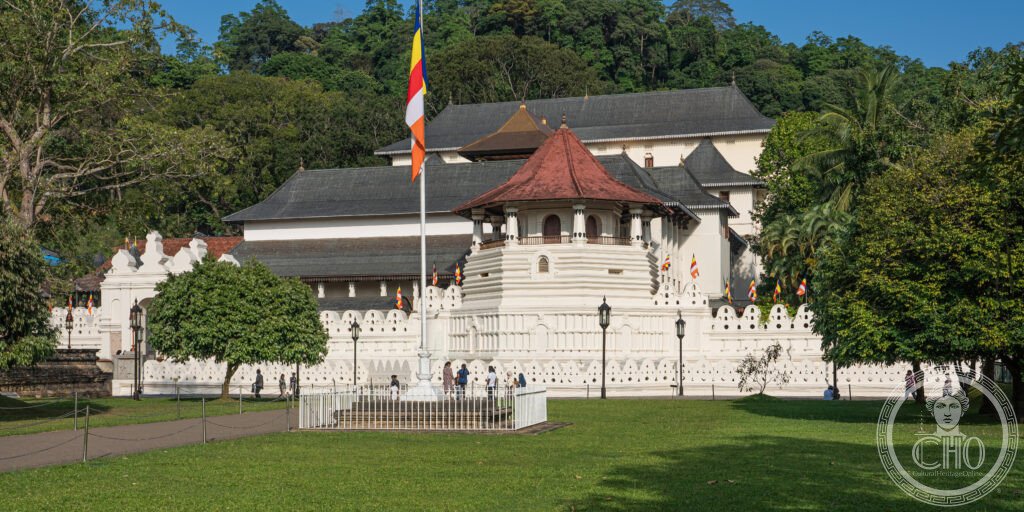
The last royal capital of the Sinhalese kings — a lakeside city in the hill country of Sri Lanka built around the Temple of the Tooth Relic, which houses the left canine tooth of the Buddha, the most revered object in Theravada Buddhism; the possession of this relic conferred the divine right to rule the island, and its protection through three centuries of Portuguese, Dutch, and British colonial pressure was the defining preoccupation of the Kingdom of Kandy.
At a glance
Kandy (Sinhalese: මහනුවර, Mahanuwara, “Great City”) is the capital of the Central Province of Sri Lanka, with a population of approximately 110,000, set in a bowl of forested hills at an elevation of 485 metres above sea level. The Sacred City of Kandy refers to the temple complex, the royal palace, the Kandy Lake (an artificial lake excavated by the last king, Sri Vikrama Rajasinha, in 1807), and the surrounding botanical gardens and royal forest; this ensemble is the cultural and religious capital of Sri Lanka and the primary pilgrimage centre for the 70 million Sinhalese Buddhists of Sri Lanka and the global Theravada Buddhist community. The Temple of the Tooth Relic (Sri Dalada Maligawa) is the most visited monument in Sri Lanka. UNESCO inscribed the Sacred City of Kandy in 1988.
Key facts
- The Buddha’s Tooth Relic: the left canine tooth of the Buddha, according to tradition, was recovered from his funeral pyre at Kushinagar (India) in 543 BC and sent to Sri Lanka in the 4th century AD. The tradition holds that it was smuggled out of India in the hair of a princess — Princess Hemamali and her husband, Prince Dantha — and brought to King Devanampiya Tissa of Anuradhapura. The relic has been preserved in a series of successively more elaborate golden reliquaries; the outermost, of solid gold set with gems, is kept in a sealed inner chamber accessible only to the high priests, and the tooth itself has not been publicly displayed since 1560. The relic is processed in public once a year at the Esala Perahera festival
- The Esala Perahera: the festival of the Tooth Relic — held annually in July or August (the month of Esala in the Sinhalese calendar) — is the largest Buddhist procession in the world; over ten nights, the golden casket containing the tooth (or a replica) is processed through the streets of Kandy on the back of a caparisoned tusker elephant, accompanied by 100+ decorated elephants, drummers, dancers, fire-spinners, and torch-bearers; the procession has been held continuously since at least the 4th century AD; it draws approximately 100,000 spectators per night
- The Temple (Sri Dalada Maligawa): the current temple building was primarily constructed in the 18th century under the Kandyan kings; the octagonal tower (Patthirippuwa) added by Sri Vikrama Rajasinha in 1821 is the most distinctive element of the silhouette; the gilded roof was added in 1987 by President J.R. Jayewardene; the main shrine room (Vadahitina Maligawa) on the upper floor contains the altar on which the relic casket is kept; the daily puja (offering ceremony) with drumming, incense, and flowers is held three times daily and is open to visitors of all faiths
- The Kingdom of Kandy: the last independent kingdom of Sri Lanka (capital established at Kandy 1592; fell to the British in 1815 after 313 years of independence); the Kandyan kingdom successfully resisted the Portuguese (1592–1658) and Dutch (1658–1796) colonial powers, which controlled the coasts but never captured Kandy; the British under General John Wilson captured the city in 1815 after a series of campaigns; the Kandyan Convention (1815) transferred sovereignty to the British Crown; Kandy was the seat of the last king, Sri Vikrama Rajasinha, who was deposed and exiled to India
- Kandy Lake: the artificial lake (27.5 acres, 0.43 km²) excavated by King Sri Vikrama Rajasinha in 1807; the island in the lake (Kiri Muhuda, “Milk Sea”) was the original site of the king’s bathing platform, later converted into a British powder house; the lake’s embankment (the “cloud wall,” Walakulu Bamma) is the evening promenade of Kandy and gives the clearest view of the temple silhouette reflected in the water
- Heritage: UNESCO World Heritage Site, Sacred City of Kandy, inscribed 1988
- GPS: 7.2936° N, 80.6413° E
History
The Tooth Relic arrived in Sri Lanka during the reign of King Meghavanna of Anuradhapura (301–328 AD) and was housed in successive capitals (Anuradhapura, Polonnaruwa, Dambadeniya, Yapahyva, Kurunegala, Gampola) as the island’s political centre shifted. The Portuguese destroyed the relic on several occasions — or believed they had, burning it publicly in Goa in 1560 — but the Sinhalese court maintained that the destroyed objects were replicas, and the genuine relic survived. The capital moved to Kandy in the late 16th century, and the temple complex grew around its protection.
The Kandyan kingdom’s reputation for impenetrability was not merely military: the dense jungle, the mountain roads, and the unhealthy highlands proved fatal to successive Portuguese and Dutch expeditions. Robert Knox, an English sailor captured by the Kandyan king in 1660, spent 19 years in captivity before escaping (his An Historical Relation of the Island Ceylon, 1681, is the primary European source on the Kandyan kingdom). The British finally captured Kandy in 1815 through a combination of internal political fragmentation (the Kandyan nobles, tired of Sri Vikrama Rajasinha’s tyranny, invited the British to intervene) and superior logistics; the Kandyan Convention ceded sovereignty in exchange for British protection of Buddhism and the Kandyan aristocracy’s privileges.
What you see
The approach to the temple is through the Natha Devale (a 14th-century shrine, the oldest structure in Kandy) and along the lake embankment, which gives the full silhouette of the gilded roof and the octagonal Patthirippuwa tower. The entrance through the Maha Vahalkada (the Great Arch Gate, flanked by the Digge or drummers’ hall) opens onto the moat; the moat itself is spanned by a bridge and reflects the temple walls. The interior (remove shoes at the threshold; cover shoulders and knees) moves through the lower shrine rooms (with relic caskets, gifts from foreign governments, royal regalia) to the first-floor main shrine room, where the actual puja ceremonies take place before the altar holding the relic casket — the casket itself is a nested set of seven golden reliquaries, the outermost visible at the altar through flowers and incense smoke.
The Peradeniya Botanical Gardens (6 km west of the city centre) are the finest botanical garden in South Asia (147 acres, established 1821); the avenue of royal palms (1950), the bat colony roosting in the ancient fig trees, and the collection of orchids (over 300 species) are the highlights; the gardens are open daily 7:30 am to 5 pm. The view of the city from the Adam’s Peak road (Hanthana Range, 5 km south) gives a panorama of the lake and the temple spire against the forested hills.
Practical information
- Admission: the Temple of the Tooth charges LKR 1,500 (approximately €4.50) for non-Sri Lankan visitors; the puja ceremonies (7:30 am, 11:30 am, 6:30 pm) last approximately 45 minutes; visiting during the puja is the essential experience; the museum in the lower levels (royal regalia, relic casket replicas, gifts from Buddhist countries) takes 30–45 minutes; shoes off, shoulders and knees covered; the temple is busiest on poya (full-moon) days when Sri Lankan pilgrims arrive in large numbers
- Getting there: Colombo Bandaranaike International Airport (CMB) is 150 km south-west of Kandy; by train from Colombo Fort Station to Kandy (3–4 hours, scenic hill-country line; book first class for the views; trains depart approximately hourly); by bus from Colombo (3–4 hours); by hire-car with driver (3 hours); the Kandy–Ella road (A5) continues south through the tea country to Ella (3 hours), Nuwara Eliya, and the south coast
- Esala Perahera dates: the Esala Perahera dates change annually (aligned to the Esala full moon, usually July–August); check the year’s dates in advance; processions run for 10 nights (each night slightly longer); grandstand tickets for the main procession night (Randoli Perahera, on the full moon) must be booked months in advance through the temple; standng-view access (from the street, with limited sightlines) is free
Getting there
Colombo Bandaranaike International Airport (CMB), 150 km south-west. Train from Colombo Fort (3–4h, the hill-country line). On the Kandy–Ella–Colombo tourist circuit. GPS: 7.2936, 80.6413.
Nearby
- Sigiriya Rock Fortress — 90 km north of Kandy (2 hours); the sheer 200-metre volcanic rock crowned with the ruins of a 5th-century palace built by King Kasyapa (477–495 AD), who murdered his father to take the throne and built his capital on a naturally defended outcrop; the rock has frescoes (the “Cloud Maidens”, 500 AD, among the finest ancient paintings in South Asia) halfway up a sheltered gallery, and mirror-smooth plastered outer walls (the “Mirror Wall,” still partially intact with graffiti poems scratched by 8th-century visitors); UNESCO WHS 1982
- Dambulla Cave Temple — 70 km north of Kandy (1.5 hours); a complex of 5 Buddhist cave temples whose interiors are covered in murals and sculptures; the murals (covering 2,100 square metres of ceiling and walls) are the largest and best-preserved example of Sri Lankan cave painting; UNESCO WHS 1991; can be combined with Sigiriya in a single full-day loop
- Peradeniya Botanical Gardens — 6 km west of Kandy city centre; 147 acres of botanical garden on a loop of the Mahaweli River; established 1821 by the British; avenue of royal palms, orchid conservatory, giant fig trees with fruit bat colonies, and the finest collection of tropical flowering trees in Asia; entrance fee LKR 2,000 for non-Sri Lankans
Sources
- Wikipedia, Temple of the Tooth; Sacred City of Kandy; Esala Perahera, accessed June 2026
- UNESCO, Sacred City of Kandy, WHS reference 450, inscribed 1988
- Robert Knox, An Historical Relation of the Island Ceylon, 1681 (repr. Tisara Prakasakayo, 2004)
- Wilhelm Geiger, The Mahavansa (the great chronicle of Sri Lanka), Pali Text Society, 1912
Find it on the map
See this place and what’s around it →📷 Become a Cultural Heritage Online photographer
Share your photos of places: they stay published under your name as the author. The more they're seen, the more you get noticed — and soon a contest will reward the most appreciated photos.
Log in or sign up free to add a photo