
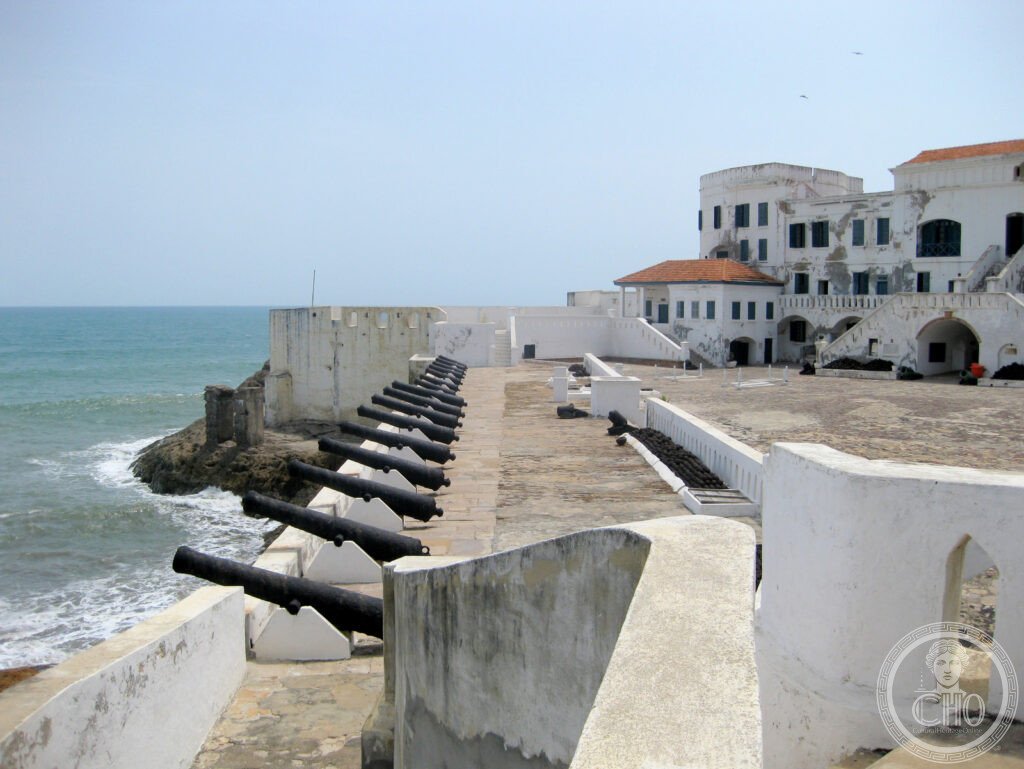
The most visited monument of the transatlantic slave trade — a whitewashed fortress on the Atlantic coast of Ghana whose underground dungeons held as many as 1,500 enslaved Africans at a time in darkness, waiting to be loaded onto slave ships through the “Door of No Return,” a sea-gate opening directly onto the surf; the castle was the administrative headquarters of the British Gold Coast colony and the slave trade simultaneously, the governor’s chapel and the slave dungeons sharing the same walls, directly above and below each other.
At a glance
Cape Coast Castle (Fante: Oguaa) is a fortified building on the coast of the Central Region of Ghana, approximately 3 km from the centre of Cape Coast city. It was established as a trading post by Swedish traders in 1653, taken by the Danish (1657), the British (1664), and returned to the Dutch (briefly) before the British East India Company took permanent control in 1665. Under British control, the castle became the principal headquarters of the British transatlantic slave trade on the Gold Coast: the underground slave dungeons (capable of holding 1,000–1,500 enslaved people) were used continuously until the British abolition of the slave trade in 1807. The castle is now a museum documenting the slave trade and is a UNESCO World Heritage Site (as part of the “Forts and Castles, Volta, Greater Accra, Central and Western Regions” inscription, 1979); it is one of the most emotionally affecting heritage sites in Africa and a major destination for diaspora visitors, particularly from the United States.
Key facts
- The slave dungeons: the male slave dungeon (below the main courtyard) was a windowless room approximately 40 × 10 metres capable of holding 1,000 men; the female dungeon (below the governor’s quarters) held 500–600 women; enslaved people were held for weeks or months waiting for a full ship cargo to assemble; the dungeons had no sanitation; the marks of human fingers scraping the whitewashed walls are still visible; a small opening in the ceiling of the male dungeon allowed guards to monitor from above
- The Door of No Return: a narrow sea-gate at the base of the castle, opening directly onto the Atlantic surf, through which enslaved people were loaded onto longboats and then onto slave ships anchored offshore; the door is approximately 1.5 metres wide; it is called the “Door of No Return” in the museum and in African diaspora tradition — the point of no return, the last sight of Africa; in 1998, as part of the UNESCO Slave Route Project, a counter-door was designated the “Door of Return” for the African diaspora returning as visitors; both doors remain physically accessible
- The chapel above the dungeons: the British governor’s Anglican chapel (still intact, with original wooden pews and a pulpit) was built directly above the male slave dungeon — the Christian service above and the enslaved people below, the same wooden floor separating them; this physical arrangement is the most frequently cited detail by guides at the castle, and the most viscerally effective confrontation with the moral contradiction of Christian slavery
- Scale of the slave trade from the Gold Coast: the UNESCO inscription covers 30 forts and castles along the Ghanaian coast (collectively called the “castles”); Cape Coast Castle alone processed approximately 75,000 enslaved people between 1665 and 1807; the total transatlantic slave trade from the Gold Coast is estimated at 1–1.5 million people over 400 years (though most of the trade was concentrated in the 18th century); the Slave Database project (Trans-Atlantic Slave Trade Database) documents individual ship voyages
- Notable visitors: Barack Obama visited the castle in 2009, shortly after his inauguration as the first African-American US President; the visit was broadcast live and drew 200 million viewers in Africa; Obama stood at the Door of No Return and returned through the Door of Return; the visit significantly increased international awareness of the site
- Heritage: UNESCO World Heritage Site, Forts and Castles, Volta, Greater Accra, Central and Western Regions, inscribed 1979
- GPS: 5.1031° N, 1.2428° W
History
The Cape Coast area (called Cabo Corso by the Portuguese, who were the first Europeans to trade on the Gold Coast from 1471) was a centre of the gold trade before the slave trade; the Gold Coast was named for the gold mined by the Akan states of the interior, which was traded to European merchants on the coast. The Swedish trading company established the first fort on the site in 1653; the British East India Company captured it permanently in 1665. Under the British Royal African Company (chartered 1672, which held a monopoly on the slave trade until 1698) and subsequently under the open slave trade, Cape Coast Castle became the most important British slave-trading post in West Africa.
The British slave trade was concentrated on the Gold Coast (present-day Ghana) and the Slave Coast (Dahomey/Benin, Togo, Nigeria) because these regions had organised states capable of supplying enslaved people in large numbers; the Asante Confederacy (founded c. 1700, with its capital at Kumasi, 200 km north of Cape Coast) became the dominant supplier of enslaved people to the British from the early 18th century, selling people captured in wars against neighbouring states. The British abolition of the slave trade in 1807 (the Slave Trade Act) ended the slave-loading function of Cape Coast Castle; the castle became the headquarters of the British Gold Coast Colony, which expanded to encompass most of modern Ghana; Ghana became independent on 6 March 1957 as the first sub-Saharan African country to achieve independence.
The museum at Cape Coast Castle was established in 1962; the UNESCO inscription in 1979 recognised the 30 forts and castles of the Ghanaian coast as a collective world heritage site. The Slave Route Project (UNESCO, 1994) placed Cape Coast and the other castles on the itinerary of a global effort to acknowledge and memorialise the history of the slave trade; the Cape Coast Castle Museum was substantially renovated in 1997 with support from the Smithsonian Institution and the American diaspora community.
What you see
The castle is a whitewashed collection of structures on a headland above the Atlantic surf; the exterior walls and bastions (with cannon emplacements) date from the 17th–18th century British rebuilding. The museum visit begins in the outer courtyard (with context on the slave trade) and then descends to the dungeons — the male dungeon (the most affecting space in the castle, dark, low-ceilinged, with the lingering smell of centuries of human occupation) and the female dungeon. The Door of No Return (accessed through a narrow passage at the base of the seaward walls) opens onto a platform above the surf; standing in the doorway looking at the Atlantic is the central emotional experience of the visit.
The governor’s quarters (upper floors, converted to the museum display on colonial administration and the castle’s European history) and the chapel (still with original furnishings) complete the circuit. Guided tours are mandatory (included in the admission) and are conducted by Ghanaian guides who provide the essential historical and cultural context; the tour takes 60–90 minutes. The adjacent Elmina Castle (12 km west, the oldest European trading fort in sub-Saharan Africa, 1482, Portuguese/Dutch/British) is equally important and is usually combined with Cape Coast Castle in a single day trip.
Practical information
- Admission: GHS 80 (approximately €5) for non-Ghanaians; guided tours are included and mandatory; the museum is open daily 9 am–4:30 pm; photography is permitted in most areas except some parts of the dungeons (the guides explain which areas); the emotional intensity of the dungeon visit should not be underestimated — some visitors (particularly African-Americans with family history connected to the slave trade) may find the experience overwhelming
- Getting there: Kotoka International Airport (ACC), Accra, is the main international hub; direct flights from London Heathrow, Amsterdam, Frankfurt, New York (JFK), Washington Dulles, and Addis Ababa; from Accra, Cape Coast is 150 km (2.5–3 hours by road); bus (STC or VIP) from Accra bus station to Cape Coast (GHS 30–40, 2.5 hours); shared taxis (tro-tros) are available but less comfortable; from Cape Coast town centre, the castle is a 10-minute walk along the seafront
- Context: visiting Cape Coast Castle in the context of Ghana’s contemporary culture — the Asante traditional courts, the Ashanti Kulturzentrum in Kumasi, the Kakum National Park — rather than as an isolated slave-trade site provides a fuller picture of the country’s history; the “Year of Return” (Ghana, 2019) — a government initiative encouraging African diaspora visitors — significantly expanded international awareness of the castles and their heritage tourism role
Getting there
Kotoka International Airport (ACC), Accra, 150 km east. Bus or shared taxi from Accra (2.5–3h). From Cape Coast town centre, 10 minutes walk to the castle. GPS: 5.1031, -1.2428.
Nearby
- Elmina Castle — 12 km west of Cape Coast; built by the Portuguese in 1482 as São Jorge da Mina, the oldest surviving European building in sub-Saharan Africa; the largest slave fort on the Gold Coast (the Portuguese name Elmina derives from “a mina,” “the mine” — the gold trade that predated the slave trade); taken by the Dutch West India Company in 1637 (the first Dutch colonial acquisition in the Americas and Africa) and used as a slave fort until 1814; UNESCO WHS (same inscription as Cape Coast Castle); accessible from Cape Coast by shared taxi (20 minutes)
- Kakum National Park — 40 km north of Cape Coast; a patch of Ghanaian tropical rainforest with a canopy walkway (330 metres of suspension bridges at 30 metres above the forest floor, connecting platforms in the canopy trees); habitats include forest elephants, bongos, diana monkeys, and approximately 300 bird species; the canopy walk is one of the few accessible examples of West African rainforest canopy in a national park context
- Kumasi (Asante Cultural Capital) — 200 km north of Cape Coast (4 hours by road); the historical capital of the Asante Confederacy and the seat of the Asantehene (the Asante king), whose Manhyia Palace houses a museum of Asante royal regalia (including the Golden Stool, the spiritual throne of the Asante — not publicly displayed but described); the Kejetia Market (one of the largest markets in West Africa) and the National Cultural Centre are the primary visitor destinations; accessible by bus from Cape Coast (4 hours) or Accra (5 hours)
Sources
- Wikipedia, Cape Coast Castle, accessed June 2026
- UNESCO, Forts and Castles, Volta, Greater Accra, Central and Western Regions, WHS reference 34, inscribed 1979
- John Thornton, Africa and Africans in the Making of the Atlantic World, 1400–1800, Cambridge University Press, 1998
- David Eltis and David Richardson (eds), Extending the Frontiers: Essays on the New Transatlantic Slave Trade Database, Yale University Press, 2008
Find it on the map
See this place and what’s around it →📷 Become a Cultural Heritage Online photographer
Share your photos of places: they stay published under your name as the author. The more they're seen, the more you get noticed — and soon a contest will reward the most appreciated photos.
Log in or sign up free to add a photoDo you manage this place?
This page is read by travellers and heritage enthusiasts who find it on Google. Keep it accurate — and make it work for you. Free for non-profit heritage institutions.