
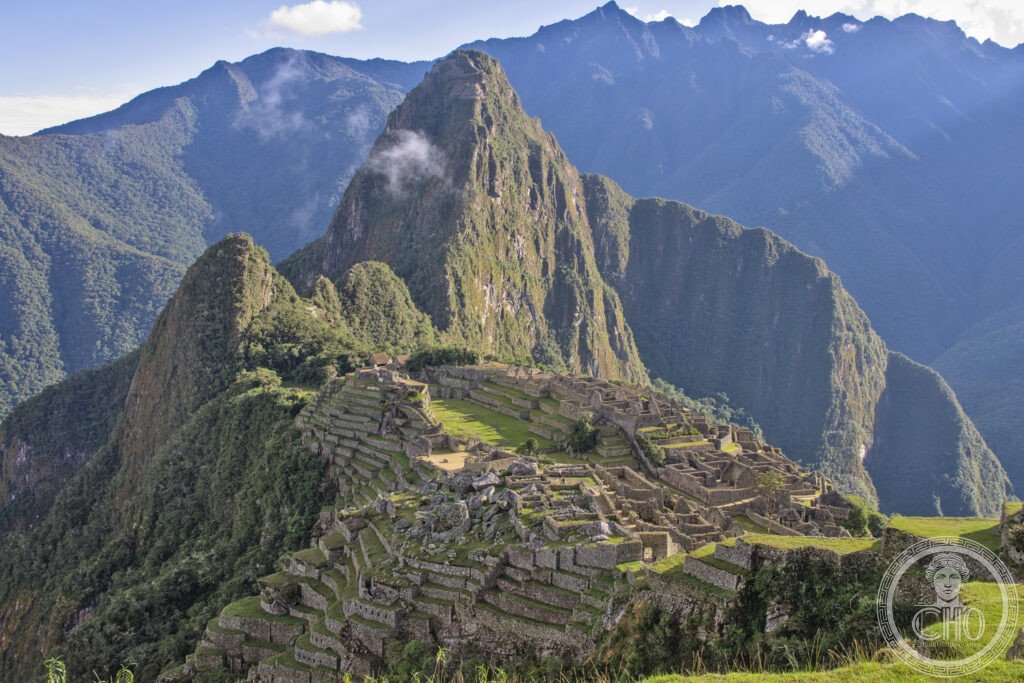
Machu Picchu
The most photographed archaeological site in the Americas — an Inca royal estate of 150 dry-stone buildings at 2,430 metres on a cloud-wreathed saddle between two mountain peaks in the Andes of Peru, invisible from the valley below, connected to Cusco by a 4-day mountain trail, and so precisely fitted with astronomical alignments that sunrise on the winter solstice enters through a window in the Temple of the Sun to illuminate a carved rock at a single point — a piece of stone carpentry so tight that a knife blade cannot be inserted between the blocks.
At a glance
Machu Picchu (Quechua: “Old Mountain”) is a 15th-century Inca citadel on a mountain saddle between the peaks of Machu Picchu (3,061 m) and Huayna Picchu (2,693 m) in the Cusco Region of Peru, 80 km north-west of Cusco city. Built c. 1450 AD, possibly as a royal retreat of the Inca emperor Pachacuti (r. 1438–1471), it contains approximately 150 stone structures including temples, palaces, storehouses, and residential buildings, set within agricultural terraces on the mountain slopes. The site covers 13 sq km; the urban sector is concentrated on 5 sq km at the mountain saddle. Machu Picchu was abandoned c. 1572, probably in the context of the Spanish conquest of the Inca Empire; its existence was not widely known outside the indigenous Quechua community until Hiram Bingham (a Yale history lecturer) was guided to the site in 1911. It is a UNESCO World Heritage Site inscribed in 1983 and one of the New Seven Wonders of the World (voted 2007).
Key facts
- Inca stonework: the ashlar masonry (dry-stone construction without mortar) of Machu Picchu is the finest example of Inca building technique; the largest stones weigh over 50 tonnes; the blocks are cut with bronze tools and river sand to fit with tolerances of less than 1 mm; the walls survive earthquakes because the slight inward tilt (battered wall) and the trapezoidal niches and doorways allow flex without cracking; no mortar, no reinforcement, no failure in 600 years
- The Intihuatana stone: a carved granite outcrop in the upper urban sector; the name (Quechua: “hitching post of the sun”) refers to its role as an astronomical calendar; at the spring and autumn equinoxes, the sun stands almost directly above the stone (casting no shadow); at other times, the shadow angle indicates the season; the stone was deliberately cracked in 2000 when a crane being used for an Inca Kola advertisement fell on it; this is the only Intihuatana in the Inca world not destroyed by the Spanish (who systematically destroyed these “sun hitching posts” as pagan objects)
- The Temple of the Sun: a semicircular tower over a natural rock outcrop; at the winter solstice sunrise (June 21 in the Southern Hemisphere), sunlight enters through the east-facing trapezoidal window and illuminates a carved altar stone; the alignment was confirmed by astronomical measurement; the cave below (the “Royal Tomb,” though no mummies were found there) has the finest wall niches at the site
- Hiram Bingham and the “rediscovery”: Bingham, then a Yale history lecturer, was guided to Machu Picchu on July 24, 1911, by a local farmer named Melchor Arteaga; he did not discover Machu Picchu (it was known to local farmers and possibly to the missionaries in the valley below), but his Yale Peruvian Expeditions (1911–1915) made it known internationally; the artifacts he took to Yale were returned to Peru in 2010–2011 after a century-long dispute
- The Inca Trail: a 43-km mountain trail from the Sacred Valley (Km 82 marker, near Ollantaytambo) through three mountain passes (the highest at 4,215 m, the “Dead Woman’s Pass”) to the Sun Gate (Intipunku) above Machu Picchu; the trail is a classic 4-day trek; limited to 500 hikers/day (including porters); permits sell out months in advance; it is the finest multi-day trek in South America
- Heritage: UNESCO World Heritage Site, Historic Sanctuary of Machu Picchu, inscribed 1983; New Seven Wonders of the World, 2007
- GPS: 13.1631° S, 72.5450° W
History
The Inca civilisation (Tawantinsuyu — the “empire of the four quarters”) expanded rapidly under Pachacuti (r. 1438–1471) from a small regional chieftainship around Cusco to an empire stretching from Ecuador to Chile. Pachacuti is the most likely builder of Machu Picchu; a royal estate or llacta at this location appears in documents of 1568 as the property of the “panaca” (royal kin group) of Pachacuti. The Inca built the site without wheeled vehicles or iron tools; the largest stones were moved using log rollers, rope, and hundreds of labourers under the mita (corvée labour) system; the ashlar blocks were cut and fitted with bronze tools and river sand.
The site appears to have been occupied for approximately 100 years (c. 1450–1572). The Spanish conquest of the Inca Empire began in 1532 with the capture of the emperor Atahualpa by Francisco Pizarro; the last Inca stronghold (Vilcabamba, about 100 km north-west of Machu Picchu) fell in 1572. Whether Machu Picchu was abandoned because of the Spanish conquest, smallpox epidemics (which preceded the Spanish themselves into the Inca Empire), or both, is debated. The site was not “lost” — local Quechua farmers cultivated the terraces and knew the ruins — but it was not mentioned in Spanish colonial documents, possibly because the Spanish never reached it or because it had already been stripped of gold before they did.
Post-Bingham excavation and research has dramatically changed the interpretation of the site. The original claim that it was a “lost city of the Incas” has been revised to a royal estate and religious complex; analysis of skeletal remains has shown that the resident population was not primarily military (as Bingham supposed) but included both men and women from various regions of the empire — probably a mixed retinue of priests, administrators, servants, and craftspeople serving the royal llacta.
What you see
Machu Picchu is entered through the main gate on the south side (reached from Aguas Calientes, the town 400 metres below, by bus on a switchback road or by the 1.5-hour foot path). The classic view — the agricultural terraces on the left, the urban sector on the right, Huayna Picchu peak rising behind — is reached within 5 minutes of the entrance, from the “Guardian’s Hut” on the terrace above the Dry Moat. This is the view on every poster; seeing it in three dimensions for the first time is disorienting in its familiarity.
The site is divided into an agricultural sector (terraces) and an urban sector (temples, palaces, residences). The Temple of the Sun, the Intihuatana, the Temple of the Three Windows, and the Principal Temple are the architectural highlights of the religious zone (upper urban sector); the Royal Residence and the warehouses are in the lower sectors. The Inca Trail enters through the Sun Gate on the ridge above the site; arriving this way (after 4 days on the trail) gives a different spatial experience than the bus approach.
Practical information
- Admission: PEN 152 adult standard ticket (approximately USD 40); tickets must be pre-booked online (machupicchu.gob.pe) with a timed entry slot; daily visitor capacity is currently 4,044 (reduced from 5,940 after 2023 protests); Huayna Picchu mountain requires a separate ticket (PEN 200) with a small capacity (limited to 400/day)
- Getting there: from Cusco by Peru Rail or Inca Rail train to Aguas Calientes (Machu Picchu Pueblo, 1.5–3.5 hours depending on service); then bus (25 minutes) or walk (1.5 hours) to the site entrance; no road access to Aguas Calientes (train or foot only); Inca Trail requires separate permits, booked months in advance
- Altitude: Machu Picchu (2,430 m) is lower than Cusco (3,400 m) and acclimatisation issues are less severe; the Inca Trail passes 4,215 m (Dead Woman’s Pass) and requires full Cusco acclimatisation; allow at least 2 nights in Cusco before attempting the trail
Getting there
From Cusco: Peru Rail or Inca Rail to Aguas Calientes (1.5–3.5 hours), then bus 25 minutes to the site. No road to Aguas Calientes. From Lima: flight to Cusco (1.5 hours, multiple daily), then train. Cusco Airport (CUZ) has direct flights from Lima (LIM) and international connections. GPS: -13.1631, -72.5450.
Nearby
- Cusco — the Inca capital and the most complete surviving Inca city; the Sacsayhuaman fortress (above the city), the Coricancha (the Temple of the Sun, now the convent of Santo Domingo, built on Inca foundations), and the main square (Plaza de Armas) with its two colonial cathedrals; 80 km south-east of Machu Picchu, 3.5 hours by train; UNESCO WHS as part of the City of Cusco (inscribed 1983)
- Sacred Valley — the valley of the Urubamba river between Cusco and Aguas Calientes; the Inca sites of Pisac (terraces and cemetery), Ollantaytambo (the only Inca town with its original street plan intact, inhabited since the 13th century), and Moray (circular agricultural terraces used as a microclimate laboratory); the valley has the best accommodation and food between Cusco and Machu Picchu
- Rainbow Mountain (Vinicunca) — a 5,200-metre mountain 100 km south of Cusco with naturally coloured mineral bands in red, orange, yellow, and green; accessible on a day trip from Cusco (3-hour drive + 2-hour walk); the walk at altitude is strenuous; crowded but spectacular
Sources
- Wikipedia, Machu Picchu, accessed June 2026
- UNESCO, Historic Sanctuary of Machu Picchu, WHS reference 274, inscribed 1983
- Johan Reinhard, Machu Picchu: Exploring an Ancient Sacred Center, Cotsen Institute of Archaeology Press, 2007
- Hiram Bingham, Lost City of the Incas, Weidenfeld and Nicolson, 1951 — the original popular account; historically important but now largely superseded in its interpretations
Find it on the map
See this place and what’s around it →📷 Diventa un fotografo di Cultural Heritage Online
Condividi le tue foto dei luoghi: restano pubblicate con la tua firma come autore. Più vengono viste, più ti fai conoscere — e presto un concorso premierà le foto più apprezzate.
Accedi o registrati gratis per aggiungere una foto