
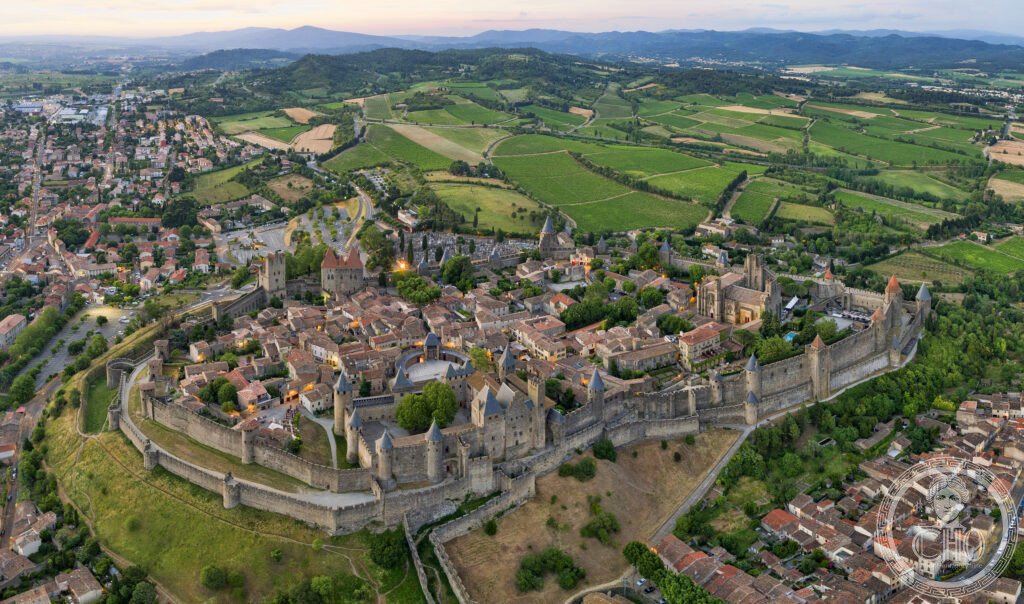
Carcassonne
The largest medieval walled city in Europe — a hilltop citadel in Languedoc with double concentric walls, 52 towers, a Romanesque cathedral, and a history that encompasses Roman occupation, Visigoth rule, Cathar heresy, the Albigensian Crusade, and the 19th-century restoration architect Viollet-le-Duc, who rebuilt the conical-capped towers so carefully from the original foundations that later medieval historians spent decades arguing about which parts were his and which were 13th century.
At a glance
Carcassonne (Occitan: Carcassona) is a city in the Aude département of Occitanie, southern France. The historic fortified city (la Cité) is a hilltop citadel on the right bank of the river Aude, approximately 1 km from the lower modern town (la Bastide Saint-Louis, founded in 1262 by Louis IX). The Cité has a double perimeter of walls (the inner Gallo-Roman wall and the outer 13th-century French royal wall), 52 towers, the Château Comtal (the count’s castle), the Romanesque basilica of Saint-Nazaire-et-Saint-Celse, and a medieval village within the walls. The fortifications were restored from 1853 by the architect Eugène Viollet-le-Duc. Carcassonne is a UNESCO World Heritage Site inscribed in 1997 and one of the most visited tourist sites in France.
Key facts
- The walls: the inner wall (enceinte intérieure) is built on Roman and Visigoth foundations of the 1st century BC–6th century AD; the outer wall (enceinte extérieure) was added in the 13th century after the Albigensian Crusade by the French crown; the corridor between the two walls (the lices, or lists) was the killing ground for any attacker who breached the outer wall; the total length of walls is approximately 3 km; the 52 towers project from the walls to allow flanking fire along the curtain walls
- The Cathars and the Albigensian Crusade: in the 12th–13th centuries, Carcassonne was the principal stronghold of the Cathar heresy (a dualist Christian sect that denied the Incarnation and rejected the Roman Church); the Albigensian Crusade (1209–1229), launched by Pope Innocent III, was the first crusade directed against Christians rather than Muslims; Carcassonne was taken in 1209 by the crusader army led by Simon de Montfort; the Cathars were expelled from the city; subsequent inquisitions eliminated the movement from Languedoc; the fall of the last Cathar stronghold (Montségur, 1244) is the defining trauma in Occitan historical memory
- Viollet-le-Duc’s restoration: Eugène Viollet-le-Duc began the restoration of Carcassonne in 1853, working from medieval documents, archaeological evidence, and his own interpretation of medieval fortification; his conical tower caps (replacing flat Languedoc roofs with pointed northern-French slate roofs) have been criticised as historically inaccurate for the south of France; he replied that any covering that kept water out was historically preferable to no covering; the restoration debate continues; most modern scholarship acknowledges Viollet-le-Duc’s work as creative restoration that made the site legible at the cost of some authenticity
- Basilica of Saint-Nazaire-et-Saint-Celse: the Romanesque-Gothic church within the Cité; the Romanesque nave (11th–12th century) and Gothic transepts and choir (13th–14th century); the stained glass windows (13th–14th century, partly original) are among the finest in southern France; the window of the Siege of Carcassonne (1355, when the English Black Prince sacked and burned the lower town but could not breach the Cité) is particularly notable
- Heritage: UNESCO World Heritage Site, Historic Fortified City of Carcassonne, inscribed 1997
- GPS: 43.2053° N, 2.3642° E
History
The hill on which Carcassonne stands was occupied from the Neolithic period; the oppidum (hill-fort) was established by the Volcae Tectosages (a Gaulish tribe) and conquered by Rome in the 1st century BC. The Romans built the town of Carcaso on the hill, encircling it with the wall whose foundations are still visible in the inner enceinte; the distinctive towers with their horseshoe-shaped bases are Roman in origin. The Visigoths held the city from 462 to 725 AD and added to the Roman walls; the Visigoth tower foundations (with their characteristic opus spicatum brickwork) are still visible in the inner wall.
The city passed to the Saracens in 725, to the Franks in 759, and to the counts of Carcassonne (the Trencavel dynasty) in the 10th century. The Trencavels were patrons of the troubadour culture of Languedoc and tolerated the Cathar faith; this brought them into conflict with the papacy and the French crown. When Pope Innocent III launched the Albigensian Crusade in 1209, Carcassonne was taken within two weeks (the Trencavel count, Raimond-Roger, died in prison three months later); the crusader leader Simon de Montfort became the new viscount. By the 1230s, Carcassonne had passed to the French crown; Louis IX (Saint Louis) built the outer enceinte and the bastide (planned lower town) in the 1260s.
The city’s importance declined after the Treaty of the Pyrenees (1659) moved the French frontier south to include Roussillon; Carcassonne was no longer a frontier fortress. By the 18th century, the walls were being quarried for building materials; the State Archaeological Commission proposed demolishing the ruins in 1849. The poet Prosper Mérimée (inspector of historic monuments) ordered a halt and commissioned Viollet-le-Duc — who was simultaneously restoring Notre-Dame de Paris — to begin the systematic restoration that transformed the ruins into the best-preserved medieval fortification in Europe.
What you see
The Cité is best approached on foot from the Pont Vieux (the old bridge over the Aude) and the 15-minute walk up through the vineyard and meadow to the Porte Narbonnaise (the main gate); the approach reveals the walls in a sequence that the direct road does not. The lices (the corridor between the two walls) can be walked for the full length of the western face; the difference between the Roman inner wall (rough, heterogeneous stonework with brick courses) and the French royal outer wall (uniform, precise, geometrically consistent) is immediately visible from this angle.
The Château Comtal (the count’s castle within the Cité) has a guided tour that explains the construction phases and Viollet-le-Duc’s restoration decisions; it is the only part of the Cité with comprehensive interpretation. The basilica of Saint-Nazaire is usually quiet compared to the main street; the Gothic stained glass and the Romanesque nave stone carving are well worth 30 minutes. The lower town (la Bastide Saint-Louis) has the Canal du Midi (UNESCO WHS, inscribed 1996) running through its southern edge — the 240-km canal linking the Atlantic to the Mediterranean (1681) is an engineering and landscape masterpiece and a complementary visit.
Practical information
- Admission: the Cité walls and streets are free to enter; the Château Comtal and tour of the lices cost €9.50 adult (free for EU citizens under 26); open daily 9:30 am–6:30 pm (summer), 9:30 am–5 pm (winter)
- Getting there: TGV from Paris (Gare de Lyon) to Carcassonne (5 hours, up to 8 daily services); from Toulouse (55 minutes, frequent regional trains); from Montpellier (2 hours); Carcassonne airport (CCF) has Ryanair services from London, Manchester, and Dublin
- Practical tips: mid-July to August is extremely crowded (3 million annual visitors concentrated in 2 months); the city at night (free) is the best experience — the illuminated walls and deserted streets after 10 pm are as good as the famous 14 July fireworks; the Canal du Midi towpath cycling route (la ViaRhona) passes through
Getting there
TGV from Paris Gare de Lyon (5 hours). Regional train from Toulouse (55 minutes). Carcassonne Airport (CCF) has Ryanair connections from UK and Ireland. The Cité is 3 km from the train station (taxi, bus, or 30-minute walk via the Pont Vieux). GPS: 43.2053, 2.3642.
Nearby
- Canal du Midi — the 240-km royal canal linking Toulouse to Sète on the Mediterranean, designed by Pierre-Paul Riquet (1681); the towpath is shaded by plane trees (planted by Napoleon’s army) and lined by locks of great elegance; cycling the 80-km Carcassonne–Béziers section takes 1–2 days; UNESCO WHS (inscribed 1996)
- Cathar Castles — the ruined fortresses (Peyrepertuse, Quéribus, Puilaurens, Aguilar) on the crests of the Corbières hills south of Carcassonne; most date from the Cathar period and were further strengthened by the French crown; Peyrepertuse (one of the most dramatically sited castles in France) and Quéribus are the most visited; 40–70 km south
- Montségur — the last Cathar stronghold, on a 1,216-metre pog (an isolated conical hill) in the Pyrenean foothills; the ruins of the castle where 225 Cathars were burned alive in March 1244 rather than renounce their faith; 100 km south of Carcassonne; a pilgrimage site for Cathar enthusiasts
Sources
- Wikipedia, Carcassonne, accessed June 2026
- UNESCO, Historic Fortified City of Carcassonne, WHS reference 345bis, inscribed 1997
- Jean Guilaine and Daniel Fabre (eds.), La Cité de Carcassonne, Éditions du Patrimoine, 2004
- Emmanuel Le Roy Ladurie, Montaillou: Cathars and Catholics in a French Village 1294–1324, Scolar Press, 1978 (tr. Barbara Bray) — the classic account of Catharism’s last generation, from the Inquisition records
Find it on the map
See this place and what’s around it →📷 Diventa un fotografo di Cultural Heritage Online
Condividi le tue foto dei luoghi: restano pubblicate con la tua firma come autore. Più vengono viste, più ti fai conoscere — e presto un concorso premierà le foto più apprezzate.
Accedi o registrati gratis per aggiungere una foto