
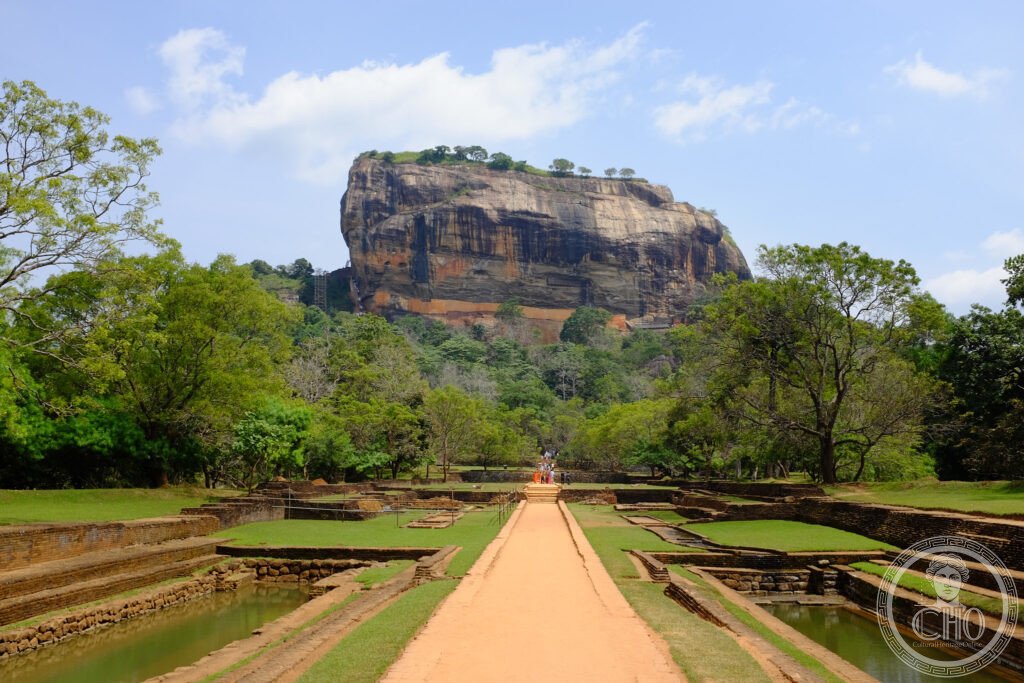
Sigiriya
A 200-metre granite inselberg in the Sri Lankan jungle, its vertical rock face pierced by a pair of giant brick lion’s paws at the entrance to the summit stairway, its sheer west face painted with 22 golden-skinned apsara maidens in a 5th-century fresco register of such freshness and refinement that even after 1,500 years of monsoonal weathering, the pigments hold their warmth against the grey rock — the surviving fragment of a composition that may once have extended for 140 metres.
At a glance
Sigiriya (Sinhalese: සීගිරිය, “Lion Rock”) is a rock fortress and ancient palace site in the Matale District of the Central Province, Sri Lanka, near the town of Dambulla. The site consists of a 200-metre granite inselberg (a free-standing rock mass) rising from the central plain of Sri Lanka, its summit (1.6 ha) occupied by the palace of King Kasyapa I (r. 477–495 AD), who moved his capital here after seizing the throne by imprisoning and later killing his father. The rock face was decorated with frescoes (the “Sigiriya Damsels”); a polished plaster wall (the “Mirror Wall”) along the western path has the oldest surviving secular poetry in Sri Lanka, written by visitors from the 6th to 14th centuries; and the surrounding area has one of the earliest examples of a formal water garden in Asia. Sigiriya is a UNESCO World Heritage Site inscribed in 1982. It is one of the best-preserved examples of ancient urban planning in South Asia.
Key facts
- The rock: a plug of magma that crystallised inside the vent of a now-eroded volcano; the surrounding rock has been weathered away over millions of years, leaving a near-vertical column of hardened gabbro 200 metres above the plain; the closest geological parallel in the region is the Pidurangala Rock (adjacent, 667 metres, views over Sigiriya for photographers)
- The Lion Gate: at the mid-point of the ascent (roughly halfway up the 1,200 steps), the stairway passes through the body of a giant brick-and-plaster lion whose paws (the only surviving elements) flank the final stairway to the summit; the lion’s head — which would have towered 14 metres above the rock face — had collapsed by the 14th century; the iconography of the lion (the Sinhala lion, symbol of Sri Lanka) made Kasyapa’s palace an explicit embodiment of kingship
- The Sigiriya Damsels (frescoes): 22 figures of golden-skinned women (apsaras, or possibly the king’s consorts, or the princess of the sky goddess) painted in the 5th century AD in a shaded recess on the west face; the pigments include red ochre, yellow ochre, green (a copper compound), and white; the paintings are among the earliest surviving secular frescoes in Asia and comparable in naturalism to 5th-century Ajanta; originally estimated to cover up to 500 figures; only 22 survive (many were destroyed in 1967 by vandals)
- The Mirror Wall: a 3-metre-tall polished white plaster wall along the western gallery that was polished so smoothly that the king could see his reflection; visitors from the 6th to 14th centuries wrote poems on it in gold, silver, and black ink; the inscriptions (over 1,800 verses) constitute the oldest known collection of secular poetry in Sinhalese
- The Water Gardens: the moats, ramparts, and formal water gardens surrounding the rock base are among the oldest examples of symmetrical formal garden design in Asia (5th century AD); the hydraulic system maintained water level in the moats and gardens through the dry season using an interconnected system of cisterns, channels, and underground pipes some of which still function
- Heritage: UNESCO World Heritage Site, Ancient City of Sigiriya, inscribed 1982
- GPS: 7.9572° N, 80.7603° E
History
The rock was inhabited from prehistoric times; cave shelters on the western and northern faces were occupied by Buddhist monks from at least the 3rd century BC, and the rock was used as a monastic refuge between the reigns of various kings. The transformation of the summit into a royal palace is attributed to King Kasyapa I (r. 477–495 AD), who had usurped the Sinhalese throne from his father Dhatusena (whom he allegedly had immured alive in a wall) and feared the revenge of his half-brother Moggallana, who had fled to India. Kasyapa’s choice of an almost unscalable rock as his capital was therefore both defensive and symbolic: the Lion Gate made him the Lord of Lions (Sinhala kingship embodied in the heraldic lion of the Vijayan dynasty).
After Kasyapa’s death in 495 AD (he was defeated in battle by Moggallana’s Indian army and, according to the chronicle Mahavamsa, took his own life when his elephant turned away from the fight), the rock and palace were converted into a Buddhist monastery. The monastery at Sigiriya continued to function for centuries; the Mirror Wall inscriptions date primarily from the 6th–14th centuries AD and record the thoughts of pilgrims, poets, administrators, and ordinary visitors who made the climb.
The site was “rediscovered” by British military officer Major Jonathan Forbes in 1831; systematic archaeological investigation was begun by the Cultural Triangle Project (Sri Lanka) in the 1980s following UNESCO inscription. H.C.P. Bell of the Ceylon Civil Service made the first systematic survey in 1907; the water gardens and irrigation systems were excavated in the 1980s–1990s and revealed a sophistication not previously understood.
What you see
The ascent from the ticket office takes 1–2 hours depending on fitness and crowds; the path leads through the formal water gardens (ground level), the boulder garden (mid-level), and the terrace gardens before reaching the Lion Gate. The gallery of frescoes is reached by a spiral metal staircase clinging to the west face — the staircase itself is an experience of exposure, with the plain 80 metres below and the fresco alcove directly above. The 22 surviving apsara figures are fenced and photographed through wire; even through the mesh, the quality of the painting (the modelling of the breasts, the gesture of the hands holding flowers, the variety of ornaments) is immediately evident.
The Mirror Wall gallery runs horizontally across the west face at mid-height; the inscriptions are now protected behind perspex panels; the polished plaster surface is still visible where the protective covering has not been applied. The summit (top platform, c. 1.6 ha) has the remains of brick walls, cisterns, the throne room (a rock-cut throne facing east, from which the king watched the sunrise), and panoramic views across the flat green plain to the hills. Allow 3–4 hours for the full ascent, frescoes, summit, and descent.
Practical information
- Admission: USD 30 for foreign visitors (the highest entry fee in Sri Lanka); tickets purchased online (culturaltriangle.lk) reduce queuing; open daily 7 am–5:30 pm; sunrise visits (arrive at 6:30 am, ticket office opens 7 am) are recommended for cooler temperatures and fewer crowds
- Getting there: from Colombo by train or bus to Dambulla (4–5 hours), then tuk-tuk or bus to Sigiriya (20 km, 30 minutes); from Kandy by bus to Dambulla (2.5 hours) then Sigiriya; by car from Kandy (95 km, 2.5 hours); most visitors stay in Dambulla or in Sigiriya village
- Practical tips: climb begins at 7 am to avoid the heat; fitness required (1,200 steps, some exposed); bring water; a hat is essential; the frescoed gallery involves a narrow spiral staircase exposed to the cliff face; the ascent is not recommended for those with vertigo; the Pidurangala Rock (adjacent, 45 minutes’ walk from Sigiriya, USD 5) offers the best full view of Sigiriya and is a worthwhile complement
Getting there
From Colombo: train or bus to Dambulla (4–5 hours), then tuk-tuk or bus to Sigiriya (30 minutes). From Kandy: bus to Dambulla (2.5 hours), then Sigiriya (30 minutes). By car from Kandy 95 km (2.5 hours). Colombo Bandaranaike Airport (CMB) is 200 km south-west. GPS: 7.9572, 80.7603.
Nearby
- Dambulla Cave Temple — the largest and best-preserved cave temple complex in Sri Lanka (1st century BC–18th century AD); five caves with 153 Buddha statues and 2,100 sq metres of ceiling frescoes; UNESCO WHS (inscribed separately 1991); 20 km from Sigiriya
- Polonnaruwa — the medieval royal capital of Sri Lanka (11th–13th century AD); the Gal Vihara (four Buddha images cut directly from a granite face, the finest medieval sculpture in Sri Lanka), the Lankatilaka temple, and the Audience Hall; UNESCO WHS (inscribed 1982); 55 km east of Sigiriya
- Anuradhapura — the ancient capital of Sri Lanka (4th century BC–10th century AD); the sacred Bodhi tree (the oldest documented tree in the world, a cutting from the tree under which the Buddha attained enlightenment, planted c. 288 BC); the great stupas (Ruvanvelisaya, Abhayagiri, Jetavanaramaya — one of the largest buildings of the ancient world); UNESCO WHS (inscribed 1982); 75 km north of Sigiriya
Sources
- Wikipedia, Sigiriya, accessed June 2026
- UNESCO, Ancient City of Sigiriya, WHS reference 216, inscribed 1982
- Senake Bandaranayake, Sigiriya, Central Cultural Fund, 1994 — the standard archaeological monograph on the site
- Shelton Gunawardena, Mirror Wall Inscriptions of Sigiriya, Central Cultural Fund, 1993
Find it on the map
See this place and what’s around it →📷 Diventa un fotografo di Cultural Heritage Online
Condividi le tue foto dei luoghi: restano pubblicate con la tua firma come autore. Più vengono viste, più ti fai conoscere — e presto un concorso premierà le foto più apprezzate.
Accedi o registrati gratis per aggiungere una foto