
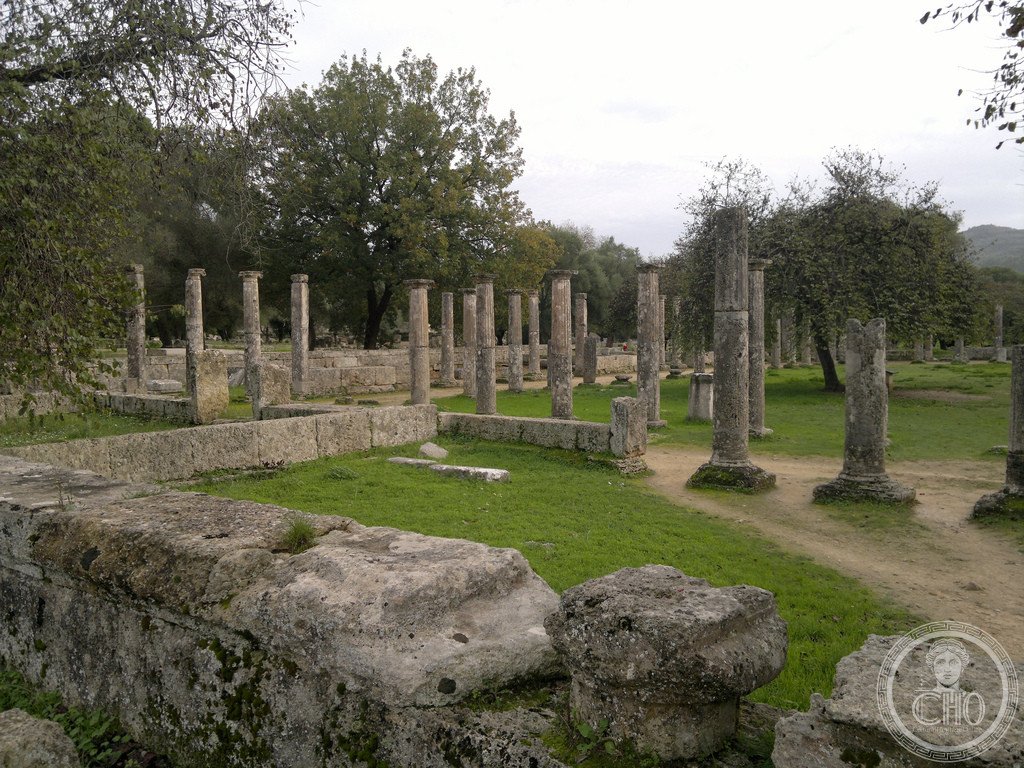
Olympia
The birthplace of the Olympic Games — a wooded valley in the western Peloponnese where the Panhellenic sanctuary of Zeus hosted the most important athletic and religious festival in the ancient world for over 1,000 years, where a 12-metre gold-and-ivory cult statue of Zeus (one of the Seven Wonders of the Ancient World) sat in a temple whose entablature frieze contained the finest narrative sculpture the Greeks ever produced, and where the flame is still lit today for the modern Olympic Games.
At a glance
Olympia (Greek: Ολυμπία) is an ancient Greek sanctuary in the municipality of Ancient Olympia, in the regional unit of Elis, in the western Peloponnese. The sanctuary was dedicated to Zeus, king of the gods, and hosted the ancient Olympic Games every four years from 776 BC (the traditional founding date, though the sanctuary and games may be older) to 393 AD, when the emperor Theodosius I abolished all pagan festivals. During the games, a sacred truce (ekecheiria) was declared across the Greek world; competing athletes came from Greek colonies as far as Spain and the Black Sea. The sanctuary complex (the Altis, or sacred grove) contained the Temple of Zeus (housing one of the Seven Wonders), the Temple of Hera, the Prytaneion, the Bouleuterion, the Palaestra, and the original stadium (which survives in its earthen form). Olympia is a UNESCO World Heritage Site inscribed in 1989.
Key facts
- The Olympic Games: the games were held every four years (an Olympiad); events included foot races, the pentathlon (discus, javelin, long jump, sprint, wrestling), chariot racing, and the pankration (a form of unrestricted wrestling); winners received only an olive wreath (kotinos) cut from the sacred olive tree of Zeus, but returned home to civic honours, statues, and lifelong benefits; the games were open only to freeborn Greek men; women had their own separate festival (Heraia) at Olympia
- Temple of Zeus (c. 470–456 BC): the largest temple on mainland Greece, Doric, 64 × 28 metres, designed by the Elian architect Libon; the sculptural programme is the masterpiece of early Classical Greek sculpture: the east pediment depicts the chariot race between Pelops and Oenomaos (the myth that founded the games); the west pediment depicts the battle of Lapiths and Centaurs; the 12 metopes depict the Labours of Heracles; all are now in the Olympia Archaeological Museum
- Pheidias’s Chryselephantine Zeus: the 12-metre gold-and-ivory cult statue of Zeus installed in the temple c. 430 BC (after the Parthenon Athena), created by the same sculptor Pheidias; described by all ancient sources as the finest cult statue in the Greek world; Dio Chrysostom wrote that anyone in sorrow who stood before it instantly lost their grief; the statue was taken to Constantinople in the 5th century AD and destroyed in a fire; it is considered one of the Seven Wonders of the Ancient World
- The Hermes of Praxiteles: a marble statue (c. 330–300 BC) found in the Temple of Hera in 1877; attributed to the sculptor Praxiteles (though the attribution is debated); one of the best-preserved original Greek marble sculptures, in the Olympia Archaeological Museum; the figure of the god Hermes holding the infant Dionysus shows the new naturalism of the 4th century BC
- The modern Olympics connection: the Olympic flame for the modern games is lit at Olympia in a ceremony where an actress playing a high priestess focuses sunlight onto the torch; it is then carried to the host city; the ceremony was introduced at the 1936 Berlin Olympics (by Hitler’s Germany) and has continued since; the lighting takes place in the Altis near the ruins of the Temple of Hera
- Heritage: UNESCO World Heritage Site, Archaeological Site of Olympia, inscribed 1989
- GPS: 37.6380° N, 21.6300° E
History
The sanctuary at Olympia was settled from the Neolithic period; Mycenaean remains on the site date from c. 1500 BC. In the early Greek period, the valley of the Alpheios river was sacred to a pre-Olympian earth cult; the heroic founder of the games, Pelops (after whom the Peloponnese — Pelops’s island — is named), was worshipped here before Zeus. The traditional date of the first Olympic Games is 776 BC; whether this represents a genuine founding or the adoption of the modern calendar for calculating Olympiads is debated, but games certainly took place from at least the 7th century BC.
The sanctuary’s importance grew through the Classical period. The Temple of Hera (c. 600 BC, the oldest temple in the sanctuary) replaced a series of earlier structures; initially its columns were of wood and were replaced individually over centuries as they decayed, which is why the surviving columns vary in style from the earliest to the latest Doric. The Temple of Zeus (finished 456 BC) was the largest temple in the Peloponnese; the sculptor Pheidias built his workshop at Olympia (now excavated and preserved as a museum exhibit) to produce the chryselephantine cult statues of Athena (for Athens) and Zeus (for Olympia). The two statues were made using the same technique — a wooden armature covered in gold plates for the drapery and ivory for the flesh.
The games continued through the Hellenistic and Roman periods; Roman emperors competed at Olympia (Nero, notoriously, won a chariot race from which all other competitors withdrew in deference). The sanctuary was damaged by earthquake in the 4th century AD and the games abolished by Theodosius I in 393 AD; the temple was destroyed by another earthquake in the 5th century and the entire site was buried by repeated floods of the Alpheios river and Kladeos stream, which preserved the collapsed fabric in silt. French excavations began in 1829; the German Archaeological Institute has continued since 1875 and the excavation of the sanctuary (the world’s largest ongoing classical excavation project) continues today.
What you see
The archaeological site is entered from the north side; the Sacred Altis (the walled sacred precinct) is directly ahead, with the Temple of Zeus to the left (south) and the Temple of Hera to the right (north). The Temple of Zeus stands in a state of total collapse: all 34 columns have fallen, most as single monolithic drums tumbled by earthquake; the collapsed columns lie in-situ, demonstrating the destructive power of the earthquake that ended the temple’s existence. The Temple of Hera (c. 600 BC) is more complete, with a colonnade of standing columns; the variety of capitals — from heavy proto-Doric to evolved later Doric — tells the story of the temple’s centuries of reconstruction.
The original ancient stadium — with the starting line (balbis) and finish line still in place, and the earthen embankments where 45,000 spectators sat without seats — is entered through the stone vaulted tunnel (krypte eisodos) that the athletes used to process into the arena; walking out of the dark tunnel onto the track is an affecting spatial experience. The Olympia Archaeological Museum (adjacent, included in combined ticket) contains the sculptural programme of the Temple of Zeus in its entirety — the two pediment groups and all twelve metopes, displayed as they were originally positioned. The quality of the Centaur-and-Lapith west pediment figures is exceptional for Early Classical sculpture.
Practical information
- Admission: combined ticket (site + museum) €12; site only €6; museum only €6; open daily 8 am–8 pm (summer), 8 am–3 pm (winter); the Museum of the History of the Olympic Games in Antiquity (in the village, separate ticket) is also worth visiting
- Getting there: by train from Athens (Kiato line change to Patras, then bus from Pyrgos to Olympia — 5–6 hours total); by road from Athens via Corinth and Patras (4.5 hours); from Patras (90 km south-west, 90 minutes); by KTEL bus from Pyrgos (40 minutes, frequent)
- Practical tips: the site is shaded by large pine trees (the ancient sacred grove) and is more comfortable in summer than most exposed Greek sites; the village of Olympia has excellent tourist infrastructure; a 2-night stay allows a more relaxed visit of the site, two museums, and the surrounding Peloponnese countryside
Getting there
From Athens by road via Corinth and Patras (310 km, 4.5 hours). From Patras (90 km, 90 minutes). KTEL buses from Pyrgos (40 minutes) connect to the regional hub. Nearest airports: Kalamata (KLX) 130 km south, Patras/Araxos (GPA) 100 km north, Athens (ATH) 300 km east. GPS: 37.6380, 21.6300.
Nearby
- Ancient Messene — the best-preserved ancient Greek city in the Peloponnese (founded 369 BC by Epaminondas of Thebes after the defeat of Sparta); the theatre, stadium, Asklepieion, and town walls are extraordinarily complete; 80 km south-east of Olympia; ongoing excavation; almost no tourists
- Bassae Temple of Apollo — the temple designed by the Parthenon architect Iktinos (c. 420 BC), built in a remote mountain setting at 1,131 metres altitude; UNESCO WHS; the interior contained the first known Corinthian capital, now in the British Museum; currently covered by a protective tent awaiting restoration; 60 km south of Olympia
- Nafplio — the most beautiful town in the Peloponnese, the first capital of modern Greece (1828–1834); the Palamidi fortress (above the town), the Venetian Bourtzi (island fortress in the harbour), and the well-preserved neoclassical streets; 150 km south-east of Olympia
Sources
- Wikipedia, Olympia, Greece, accessed June 2026
- UNESCO, Archaeological Site of Olympia, WHS reference 517, inscribed 1989
- Judith Swaddling, The Ancient Olympic Games, British Museum Press, 2011
- Nikolaos Yalouris (ed.), The Olympic Games in Ancient Greece, Ekdotike Athenon, 1982
Find it on the map
See this place and what’s around it →📷 Diventa un fotografo di Cultural Heritage Online
Condividi le tue foto dei luoghi: restano pubblicate con la tua firma come autore. Più vengono viste, più ti fai conoscere — e presto un concorso premierà le foto più apprezzate.
Accedi o registrati gratis per aggiungere una foto