
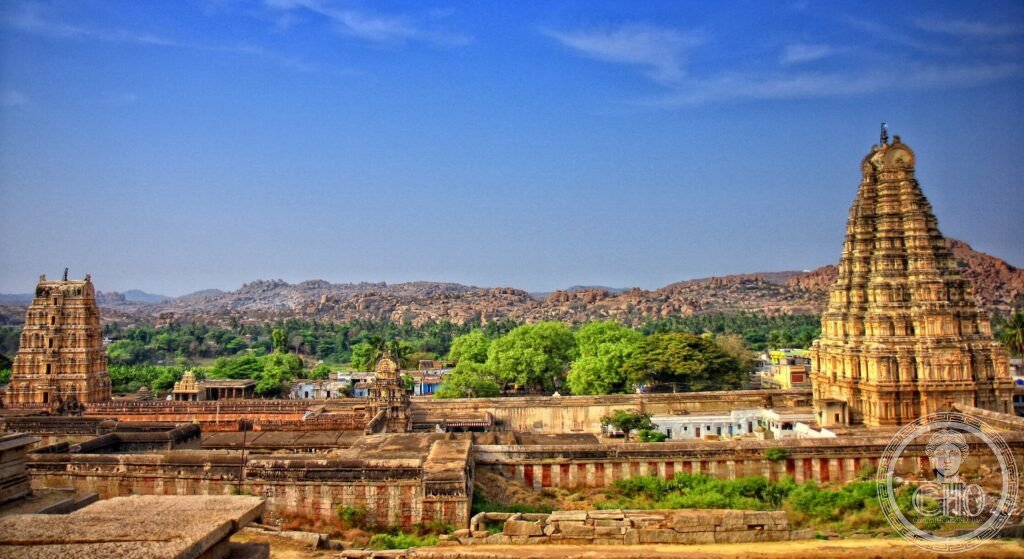
Hampi
The ruins of Vijayanagara — the richest and most powerful Hindu empire of medieval India, the last great Deccan kingdom that for two centuries stood between the Sultanates of the north and South India — strewn across a surreal landscape of orange granite boulders on the banks of the Tungabhadra river; at its peak, the city sheltered half a million people in a 40-square-kilometre urban complex that Portuguese traders in 1520 reported was larger than Rome.
At a glance
Hampi is a UNESCO World Heritage Site in the Ballari district of Karnataka, India, on the south bank of the Tungabhadra river, 350 km north of Bengaluru. The site encompasses the ruins of the medieval Hindu city of Vijayanagara (“City of Victory”), which served as the capital of the Vijayanagara Empire from its founding in 1336 to its sack and abandonment in 1565. At its peak in the 15th–16th centuries, Vijayanagara was one of the largest cities in the world — the Portuguese explorer Domingo Paes, who visited in 1520, estimated the population at 500,000 and described streets with shops “very large and with many merchants.” The site contains over 1,600 surviving monuments: temples, gopurams (tower gateways), mandapas (pavilions), bazaars, royal enclosures, elephant stables, bath houses, aqueducts, and the original Virupaksha Temple (still an active place of worship). Hampi was inscribed as a UNESCO World Heritage Site in 1986.
Key facts
- The Virupaksha Temple: the oldest functioning temple at Hampi, with continuous worship from before the founding of Vijayanagara; dedicated to Shiva (as Virupaksha, a local form); the main tower (gopuram) is 50 metres tall and was the landmark by which travellers navigating the Tungabhadra identified the city; the temple is still active and managed by the Archaeological Survey of India; the inner sanctuary is accessible to all
- The Vittala Temple: the most architecturally refined temple at Hampi (16th century); dedicated to Vishnu; the famous Stone Chariot in its courtyard (a ratha representing the chariot of Garuda) is the icon of Hampi; the 56 musical pillars of the main mandapa, when struck, produce different musical notes; the pillars are now protected from tapping (a sign warns visitors) after years of percussion caused micro-cracking
- The Royal Enclosure: the ceremonial and administrative centre of the Vijayanagara kings; the audience hall (Mahanavami Dibba, a 12-metre platform richly carved with friezes of elephant processionals, horse ceremonies, and wrestling matches) was used for the Mahanavami festival and for receiving tribute; the Queen’s Bath (a vaulted pool with Islamic-influenced arched corridors) and the Lotus Mahal (a pavilion combining Hindu and Islamic architectural forms) are in the Zenana Enclosure nearby
- The boulder landscape: Hampi sits in a 40-square-kilometre landscape of extraordinary grey-orange granite boulders (Deccan granites of Archaean age, c. 2.5 billion years old), rounded by weathering into shapes that seem pre-Raphaelite; the ancient builders incorporated the boulders into the city plan (using them as walls, water features, and natural platforms) rather than clearing them; the landscape is now a popular destination for rock climbing (the boulders offer excellent friction on vertical faces)
- Sack of 1565: after the Battle of Talikota (January 1565), the allied Deccan Sultanates defeated the Vijayanagara army; the victors sacked the city for six months; the population fled; Hampi was never resettled on the same scale; the ruins were colonised by villages, which were relocated in the 1970s–1990s to enable archaeological work
- Heritage: UNESCO World Heritage Site, Group of Monuments at Hampi, inscribed 1986
- GPS: 15.3350° N, 76.4600° E
History
The site at Hampi was sacred before the founding of Vijayanagara: the Virupaksha Temple and the Matanga Hill (the highest point in the area, the setting for an episode in the Ramayana) were pilgrimage destinations of the Kampili kingdom before 1336. The empire of Vijayanagara was founded in 1336 by Harihara I and Bukka Raya I, two brothers who had served as generals in the Hoysala kingdom and broke away to create a new Hindu kingdom in resistance to the expanding Sultanate of Delhi. The empire’s founding mythology associates it with the sage Vidyaranya, who encouraged the brothers and provided religious legitimacy to their rule.
The empire grew through the 14th and 15th centuries to control most of peninsular India south of the Krishna river; it fought a constant series of wars with the Bahmanid Sultanate (and its successor Deccan Sultanates) to the north. Under the Saluva dynasty (1485–1505) and the Tuluva dynasty — particularly Krishnadevaraya (r. 1509–1529), the greatest Vijayanagara ruler — the empire reached its political and cultural peak. Krishnadevaraya was a poet (in Telugu and Sanskrit), a military strategist, and a generous patron of temple construction; the Vittala Temple was either begun or greatly expanded during his reign. The Ashtadiggajas (the “eight elephants of the directions”) — eight of the finest Telugu poets — were his court poets.
The empire’s decline began after Krishnadevaraya’s death (1529). Factional conflict within the court weakened the military; the Battle of Talikota (1565) was the result of a combined alliance of five Deccan Sultanates — the only time they cooperated — that overwhelmed the larger Vijayanagara army. The city was systematically looted and burned; the population (estimated at 500,000 at the city’s peak) fled to other parts of the empire, which continued to function from other capitals for another century, but Vijayanagara itself was never rebuilt.
What you see
Hampi is best explored over two to three days; the site is large (40 sq km) and the monuments are distributed across both sides of the Tungabhadra. The Virupaksha Temple (Sacred Centre, south bank) is the logical starting point: the active temple with its 50-metre gopuram is immediately north of the main bazaar (Hampi Bazaar); the Hemakuta Hill behind the temple has a cluster of early (pre-Vijayanagara) temples with the earliest architectural forms on the site. The Vittala Temple Complex (2.5 km east of the Virupaksha, via the old King’s Road) is the architectural highlight: the Stone Chariot, the Kalyana Mandapa (wedding pavilion), and the musical pillars make it the best-preserved ceremonial complex at the site.
The Royal Enclosure (south of the Vittala, on the opposite side of the road) contains the Mahanavami Dibba audience platform (the friezes of elephants, horses, and wrestling matches are exceptional) and the Lotus Mahal (a pavilion whose pointed arches and ribbed vaulting blend Vijayanagara temple tower forms with Deccan Sultanate architectural influences). The Elephant Stables nearby (eleven vaulted bays for the royal elephants) are a vivid reminder of the military power of the empire. The north bank of the Tungabhadra (accessible by coracle, a traditional round boat) has fewer tourists and more ruined temples in a wilder landscape.
Practical information
- Admission: most monuments are free to visit; the Vittala Temple Complex charges INR 600 for foreign visitors (INR 40 for Indian citizens); the ticket is valid for the Vittala and Queen’s Bath complex
- Getting there: the nearest railway junction is Hospet (13 km from Hampi Bazaar), with trains from Bengaluru (overnight Hampi Express, 9 hours), Hubballi, and Goa (Vasco da Gama); from Bengaluru by bus (KSRTC Airavata, 9 hours overnight); from Goa by overnight bus (9 hours); no direct trains from Mumbai — change at Guntakal
- Getting around: within Hampi, bicycles (INR 100–150/day from the bazaar) and mopeds are the recommended transport; the main sites are all within 5 km of the bazaar; autos (tuk-tuks) cover the Royal Enclosure and Vittala route (agree price in advance)
- Best time: November–February for mild temperatures; Hampi is extremely hot March–June (45°C); the Vijayanagara Utsav Festival (usually in November) has classical music, dance, and light shows against the ruins
Getting there
Nearest railway station: Hospet Junction (13 km). Train from Bengaluru: Hampi Express (overnight, 9 hours). Bus from Bengaluru: KSRTC overnight (9 hours). Nearest airports: Jindal Vijayanagar (VDY) 35 km (small airport, few connections), Bengaluru (BLR) 350 km. GPS: 15.3350, 76.4600.
Nearby
- Badami, Aihole, and Pattadakal — the three early Chalukya (6th–8th century AD) sites within 100 km of Hampi; Badami has rock-cut cave temples with extraordinary sculpted panels; Pattadakal (UNESCO WHS) is the earliest site in India where architects experimented with both northern (Nagara) and southern (Dravida) temple styles side by side; an essential pairing with Hampi for understanding the origins of South Indian temple architecture
- Tungabhadra Dam — the major dam on the Tungabhadra river, 6 km from Hospet, with a garden and boating; the dam was built in 1953 and provides irrigation to the entire region; a reminder that the same river that supported the Vijayanagara empire now underpins the region’s modern agricultural economy
- Bijapur (Vijayapura) — the former capital of the Adil Shahi Sultanate, one of the Deccan Sultanates that sacked Vijayanagara; the Gol Gumbaz (the second-largest dome in the world after St Peter’s in Rome, 38 metres diameter) and the Ibrahim Rauza mausoleum demonstrate the extraordinary quality of Deccan Sultanate architecture; 160 km north of Hampi
Sources
- Wikipedia, Hampi, accessed June 2026
- UNESCO, Group of Monuments at Hampi, WHS reference 241, inscribed 1986
- John M. Fritz and George Michell, New Light on Hampi: Recent Research at Vijayanagara, Marg Publications, 2001
- Domingo Paes, Narrative of Domingo Paes (1520, Portuguese), tr. Robert Sewell in A Forgotten Empire, Swan Sonnenschein, 1900 — the primary Portuguese eyewitness account of Vijayanagara at its peak
Find it on the map
See this place and what’s around it →📷 Diventa un fotografo di Cultural Heritage Online
Condividi le tue foto dei luoghi: restano pubblicate con la tua firma come autore. Più vengono viste, più ti fai conoscere — e presto un concorso premierà le foto più apprezzate.
Accedi o registrati gratis per aggiungere una foto