
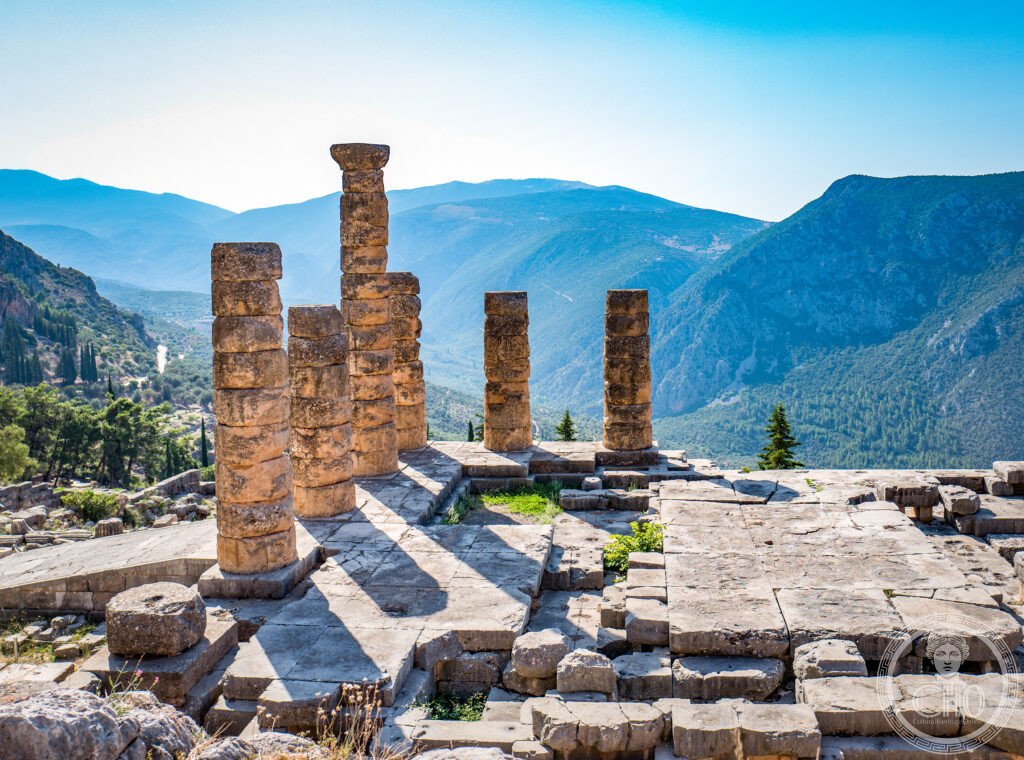
Delphi
The most important sanctuary in the ancient Greek world — the site at the foot of Mount Parnassus where pilgrims from every Greek city-state, from Lydia to Rome, came for nine centuries to consult the Oracle of Apollo, whose answers (filtered through a priestess in a trance who inhaled volcanic gases) shaped the founding of Carthage, the campaigns of Xerxes, the liberation of Athens, and the decisions of virtually every significant ruler in the Mediterranean world.
At a glance
Delphi (Greek: Δελφοί) is an ancient Greek sanctuary and archaeological site in the municipality of Delphi, in the Phocis regional unit of Central Greece, on the south-western spur of Mount Parnassus. In antiquity, it was known as the “navel of the world” (omphalos) — the Greeks believed it to be the centre of the earth, where Zeus had released two eagles from opposite ends of the world and they had met above Delphi. The Panhellenic Sanctuary of Apollo at Delphi was the most important shrine in the ancient Greek world from approximately the 8th century BC to the 4th century AD; the Oracle of Delphi (the Pythia) was consulted by city-states, kings, and private individuals on questions ranging from military strategy to personal decisions. The sanctuary also hosted the Pythian Games (the second most important Panhellenic games after Olympia). Delphi was inscribed as a UNESCO World Heritage Site in 1987.
Key facts
- The Oracle (Pythia): the priestess of Apollo at Delphi, who delivered oracles from the inner sanctuary (adyton) of the Temple of Apollo; modern geological investigation (2001) has established that the adyton sits above a fault line emitting ethylene gas (or methane/CO₂ mixtures), which could have produced the trance-like state described by ancient sources; the Pythia spoke in verse (or in prose that was versified by priests) and her ambiguous answers required interpretation — making them technically unfalsifiable
- Temple of Apollo: the most sacred structure at Delphi; the visible ruins are from the 4th-century BC temple (finished c. 330 BC on a design attributed to the architects Spintharus, Xenodoros, and Agathon); it stands on the foundations of at least two earlier temples (7th century BC and 548 BC, destroyed by fire and earthquake); the temple contained Apollo’s cult statue, the eternal flame, and the adyton where the Pythia sat on a tripod over the chasm
- The Omphalos: a carved stone (omphalos = “navel”, or possibly “umbilical cord of the earth”) believed to mark the centre of the world; the sacred omphalos was kept in the adyton of the Temple of Apollo; a copy (of uncertain Hellenistic date) is in the Delphi Archaeological Museum; a modern replica stands at the spot in the sanctuary
- The Treasury of the Athenians: the best-preserved building at Delphi, rebuilt (using original blocks) between 1903–1906; built by Athens after the Battle of Marathon (490 BC) to display the captured Persian spoils; the Doric building has a rich sculptural programme including metopes depicting the Labours of Heracles and the exploits of Theseus
- The Tholos of Athena Pronaia: a circular Doric building of the 4th century BC in the sanctuary of Athena Pronaia, 800 metres east of the main Apollo sanctuary; three of its 20 columns were re-erected and are now the iconic image of Delphi used in most photographs; its purpose is unknown (it was neither a temple nor a treasury by the standard definitions)
- The Charioteer: the most famous bronze sculpture in the Delphi Archaeological Museum; a life-size standing figure of a chariot-driver (c. 478 BC, attributed to the school of Pythagoras of Rhegium), one of the best-preserved original bronzes from the archaic period; dedicated at Delphi by the Sicilian tyrant Polyzalos after a chariot victory at the Pythian Games
- Heritage: UNESCO World Heritage Site, Archaeological Site of Delphi, inscribed 1987
- GPS: 38.4824° N, 22.5010° E
History
Delphi’s history as a sacred site long precedes the Olympian Apollo. Mycenaean occupation of the site dates from the 15th century BC; the site was associated with Gaia (the earth goddess) and a serpent oracle in the early Greek religious tradition. The Homeric Hymn to Apollo (7th century BC) describes Apollo slaying the serpent Python (from which the priestess Pythia takes her name) and establishing his oracle at Delphi — a myth that encodes the historical transition from the older chthonic religion to the Olympian cult. The Amphictyonic League (an association of 12 tribes) administered the sanctuary and organised the Pythian Games from at least the 6th century BC.
Delphi’s political influence was at its maximum in the 7th–5th centuries BC. Every major Greek foundation colony (Syracuse, Byzantium, Massilia/Marseille, Tarentum) consulted Delphi before founding; the Oracle is credited with enabling (or at least sanctioning) the colonisation movement that spread Greek culture across the Mediterranean. The Persian Wars produced two famous Oracle responses: the “wooden wall” that Themistocles interpreted as the Athenian fleet (which proved correct at Salamis, 480 BC); and the advice to Croesus of Lydia that if he crossed the river Halys, he would destroy a great empire (he did — his own). The sanctuary was looted by the Roman dictator Sulla in 86 BC and by the emperor Nero (who took 500 bronze statues); the Oracle ceased to function in 395 AD under the Christian emperor Theodosius I, who prohibited pagan worship throughout the empire.
The modern village of Kastri was built over the ancient sanctuary in the Byzantine period; the French Archaeological School at Athens purchased the land and relocated the village (with Greek government approval) in 1891–1893, enabling systematic excavation from 1893 to the present. The site is one of the most excavated in Greece; the finds — including the Charioteer, the Naxian Sphinx, and thousands of votive offerings from across the Greek world — are in the Delphi Archaeological Museum adjacent to the site.
What you see
The main sanctuary of Apollo is entered from the Sacred Way (Hiera Hodos), a paved road that zig-zags up the hillside past the remains of treasuries dedicated by Greek city-states: Athens, Siphnos, Thebes, Corinth, and others. The scale of the site — spread across a steep hillside above the Pleistos valley, with the grey limestone cliffs of the Phaedriades towering above — is best appreciated slowly. The Temple of Apollo dominates the upper plateau: six Doric columns of the 4th-century BC temple remain standing against the mountain backdrop; the sacred inscriptions (“Know thyself” — gnōthi seauton — and “Nothing in excess”) were carved on the temple’s pronaos (entrance porch).
The Delphi Archaeological Museum (adjacent to the site, included in the combined ticket) is one of the finest in Greece. The Charioteer (Room 5) should be seen first — the level of psychological detail in the bronze (slightly parted lips, irises of onyx and white enamel, eyelashes still attached) makes it one of the most arresting works of ancient sculpture. The Naxian Sphinx (c. 570 BC, Room 4), perched on an original Ionic column, is a rare example of an archaic votive monument at full scale. The Tholos of Athena Pronaia (800 metres east of the main site, free access) is best visited at sunrise before the buses arrive.
Practical information
- Admission: combined ticket (site + museum) €12; site only €6; museum only €6; free for EU citizens under 25; open daily, closing times vary seasonally (8 am–8 pm in summer, 8 am–3 pm in winter)
- Getting there: from Athens, KTEL Fokidas buses depart from Terminal B (Liossion 260, Athens) for Delphi via Levadia (2.5 hours, €14 each way, departures at 7:30, 10:30, 13:30, 17:30); from Thessaloniki, change at Lamia; no train service directly to Delphi; by car from Athens via E75/A1 north then National Road 3 west (180 km, 2.5 hours)
- Practical tips: the site involves significant uphill walking on stone paths; wear non-slip footwear; the combined site + museum visit takes a full morning (4–5 hours); the museum is air-conditioned and provides essential context; the village of Delphi (500 metres above the site) has accommodation, restaurants, and panoramic views
- Best time: April–May and September–October for mild temperatures; midsummer (July–August) is extremely hot on the exposed hillside; the site at sunrise (before 9 am) is unforgettable
Getting there
Buses from Athens Bus Terminal B (Liossion, line Fokidas) take 2.5 hours to Delphi village. By car from Athens: A1/E75 north to Livadeia, then National Road 3 west (180 km, 2.5 hours). No train. Nearest airports: Athens (ATH) 180 km south-east, Thessaloniki (SKG) 300 km north. GPS: 38.4824, 22.5010.
Nearby
- Osios Loukas Monastery — a Byzantine monastery (11th century AD) with the finest mosaic cycle in Greece outside Constantinople; 40 km south-east of Delphi; the mosaics in the Catholikon include a Pantocrator and a Descent into Hell of the highest quality; UNESCO WHS (as part of Monasteries of Daphni, Hosios Loukas and Nea Moni of Chios, 1990)
- Arachova — the ski resort village 10 km east of Delphi on the slopes of Parnassus; renowned for its honey, local wine (Mavrodaphne), and woven blankets; the view back toward Delphi from the road is one of the best in central Greece
- Galaxidi — a 19th-century Aegean merchant-shipping village on the Gulf of Corinth, 40 km south of Delphi; the preserved neoclassical captains’ houses and two naval museums make it a distinct stop; the carnival celebrations (Clean Monday) are famous for flour-throwing among visitors
Sources
- Wikipedia, Delphi, accessed June 2026
- UNESCO, Archaeological Site of Delphi, WHS reference 393, inscribed 1987
- John Fontenrose, The Delphic Oracle: Its Responses and Operations, University of California Press, 1978 — the standard critical analysis of the Oracle’s recorded responses
- Jelle Zeilinga de Boer et al., “New Evidence for the Geological Origins of the Ancient Delphic Oracle,” Geology 29(8), 2001 — the ethylene/fault line hypothesis
Find it on the map
See this place and what’s around it →📷 Diventa un fotografo di Cultural Heritage Online
Condividi le tue foto dei luoghi: restano pubblicate con la tua firma come autore. Più vengono viste, più ti fai conoscere — e presto un concorso premierà le foto più apprezzate.
Accedi o registrati gratis per aggiungere una foto