
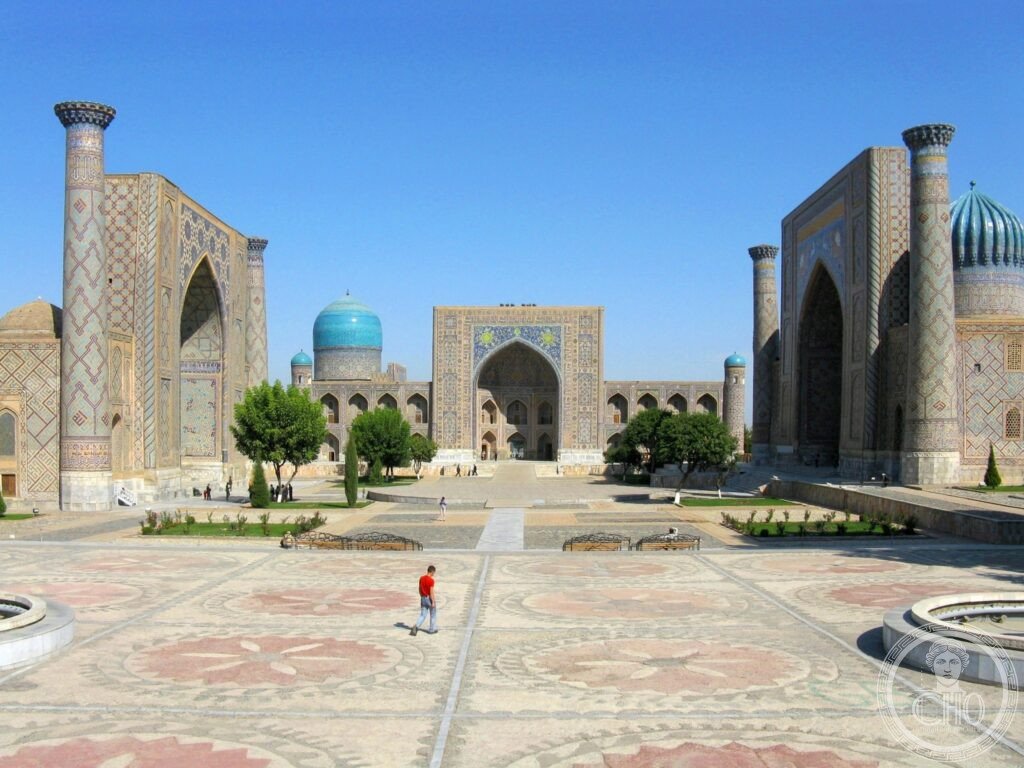
Registan, Samarkand
The finest ensemble of Islamic architecture in Central Asia — three madrasas surrounding a square in the heart of Samarkand, each covered in tilework of ultramarine, turquoise, and gold that catches the morning light so powerfully that the great traveller Ibn Battuta called Samarkand the most beautiful city he had ever seen, and that Napoleon is said to have wanted to rebuild in Paris after the Rosetta Stone campaign confirmed that he could not simply remove it.
At a glance
The Registan (Persian: رگستان, “Sandy Place” — the traditional Silk Road term for a town square) is a public square in the heart of Samarkand, Uzbekistan, surrounded on three sides by three madrasas (Islamic schools): the Ulugh Beg Madrasa (1420), the Sher-Dor Madrasa (1636), and the Tilya-Kori Madrasa (1660). The ensemble is considered the finest example of Timurid architecture and the most impressive ensemble of Islamic buildings in Central Asia. The Timurid dynasty (the descendants of Timur, also known as Tamerlane) made Samarkand their imperial capital in the 14th–15th century and built it into one of the most magnificent cities of the medieval world; the Registan was the ceremonial and commercial heart of this city. Samarkand was inscribed as a UNESCO World Heritage Site in 2001.
Key facts
- Ulugh Beg Madrasa (1420): the oldest of the three; built by Ulugh Beg, astronomer and grandson of Timur; one of the most important Islamic educational institutions of the 15th century, teaching mathematics, astronomy, and philosophy; its portal is 35 metres tall; the tympana of the corner minarets have star patterns derived from astronomical calculations; Ulugh Beg himself lectured here; he was later murdered by his own son
- Sher-Dor Madrasa (1636): built to face and mirror the Ulugh Beg Madrasa; its name (“having lions”) refers to the unusual decorative programme on the spandrels of the main portal: two tigers (labelled “lions” in Persian) chasing deer beneath a sun with a human face — an iconographic departure from strict Islamic anti-figurative conventions that reflects the more relaxed Central Asian interpretation of Islamic art
- Tilya-Kori Madrasa (1660): the third and most recently completed madrasa, built to close the north side of the square; its name (“gilded”) refers to the interior of the mosque within the complex, which has a ceiling covered in gold leaf and one of the most elaborate painted surfaces in Central Asia; the mosque was also used as the Friday mosque of Samarkand until the main mosque was restored
- Timurid tilework: the mosaic faience covering the three madrasas is the highest expression of Central Asian ceramic art; the deep Timurid blue (a cobalt-based glaze that remains stable over centuries without fading) is the defining colour of Samarkand architecture; the geometric and arabesque patterns are cut from differently coloured tiles and fitted together with precision that creates compositions visible from hundreds of metres
- Timur (Tamerlane, 1336–1405): the founder of the Timurid empire, the most powerful Central Asian ruler since Genghis Khan; his conquests extended from Anatolia to India; he made Samarkand his capital and brought craftsmen and scholars from every conquered territory; he is buried in the Gur-e-Amir mausoleum 600 metres from the Registan; his descendants built the Ulugh Beg Madrasa and patronised the most advanced Islamic astronomy of the 15th century
- Heritage: UNESCO World Heritage Site, Samarkand — Crossroad of Cultures, inscribed 2001
- GPS: 39.6547° N, 66.9758° E
History
Samarkand was one of the oldest continuously inhabited cities in Central Asia — settlements on the site date from at least 2700 BC. As the main stop on the Silk Road between China and the Mediterranean (the trade route that Alexander the Great reached in 329 BC, calling the city Marakanda), it was the commercial and cultural crossroads of the ancient world. Under the Sogdians (6th–8th century AD), it was the capital of a mercantile culture that connected China, Persia, India, and Byzantium; the Sogdian alphabet eventually became the ancestor of both the Mongolian and the Arabic scripts.
The city was destroyed twice by invasions before Timur (Tamerlane) rebuilt it as his imperial capital: by Alexander the Great in 329 BC (who admired it, then burned part of it in a drunken episode similar to Persepolis) and by Genghis Khan in 1220 (who killed most of the population and left the city largely uninhabited for a generation). Timur’s rebuilding from the 1370s onward was the most intensive urban construction project in Central Asian history: he brought 150,000 artisans and craftsmen from his conquered territories (Persia, India, Syria) and built mosques, madrasas, bazaars, and palaces of unprecedented scale and sophistication. The Bibi-Khanym mosque (the largest mosque in Central Asia at the time) and the Gur-e-Amir mausoleum were the first of his projects; the Registan was the commercial and ceremonial square at the centre of the new city.
The Timurid dynasty’s most significant cultural contribution was in scholarship: Ulugh Beg, Timur’s grandson (r. 1411–1449 as governor, later ruler), built the Ulugh Beg Observatory and produced star catalogues of such accuracy that 16th-century European astronomers used them as primary sources. He was one of the greatest pre-telescopic astronomers in history. His murder by his own son in 1449 ended Samarkand’s brief period as the scientific capital of the Islamic world. The Shaybanid and later Bukharan khanates completed the Registan ensemble in the 17th century; Soviet restoration in the 1960s–1980s stabilised and partially reconstructed the damaged structures.
What you see
The Registan is entered from the east, approaching the square along the pedestrian zone. The effect of arrival in the square is immediate and overwhelming: the three madrasas close the square on three sides, their 35-metre portal towers covered in ultramarine and turquoise geometric tilework catching the morning and afternoon light from different angles. The Ulugh Beg Madrasa (left, oldest) and the Sher-Dor Madrasa (right) face each other across the square in a near-mirror arrangement; the Tilya-Kori Madrasa closes the north end.
Entry to all three madrasas is included in the ticket. The interior of the Tilya-Kori mosque (north-west corner of the Tilya-Kori Madrasa) is the most spectacular interior in Samarkand: the entire surface — walls, arched niches, stalactite dome — is covered in gold leaf and polychrome painting; the effect is of a cave of gold. The Gur-e-Amir mausoleum (600 metres north-west; the tomb of Timur and several Timurid princes) is an essential second visit; its ribbed melon dome is the model for the Mughal mausoleums of India, including the Taj Mahal.
Practical information
- Admission: UZS 50,000 per madrasa (approximately EUR 4); a combined ticket for all three madrasas is available; the interior of the Tilya-Kori mosque is included; the Gur-e-Amir mausoleum is a separate ticket (UZS 30,000)
- Light show: the Registan hosts a sound and light show on summer evenings (May–September), when the madrasas are illuminated; the show is a striking but contrived experience compared with the architectural reality in daylight
- Getting there: Samarkand International Airport (SKD) has direct flights from Tashkent (1 hour), Moscow, Istanbul, Dubai, and other regional hubs; the high-speed Afrosiyob train from Tashkent to Samarkand takes 2 hours; the Registan is 10 minutes walk from the main bazaar and accessible by taxi from anywhere in the city
- Best time: morning light (east-facing portals of Ulugh Beg and Sher-Dor lit) is the best time for photography; the square is quietest before 9 am
Getting there
Samarkand Airport (SKD) has direct flights from Tashkent, Moscow, Dubai, Istanbul, and seasonal European charters. The Afrosiyob high-speed train from Tashkent (2 hours) is comfortable and efficient. The Registan is in central Samarkand, 10 minutes walk from the main bazaar. GPS: 39.6547, 66.9758.
Nearby
- Gur-e-Amir Mausoleum — the tomb of Timur (Tamerlane) and several Timurid princes; the jade cenotaph (the largest jade piece in the world, placed over Timur’s actual burial vault) and the gilded inscriptions are the highlights; the ribbed melon dome is the model for the Mughal mausoleums including the Taj Mahal; 600 metres north-west of the Registan
- Shah-i-Zinda — the “Avenue of the Dead,” a necropolis with over 20 Timurid mausolea from the 14th–15th century arranged along a stepped approach; the tilework of the individual mausolea (each different in colour and pattern) is arguably finer than the Registan’s; 2 km north of the Registan
- Bukhara — the second great Silk Road city of Uzbekistan, 270 km west; the Lyab-i-Hauz square, the Kalon minaret (1127 AD), and the Ark fortress; UNESCO WHS; 3 hours by train or road from Samarkand
Sources
- Wikipedia, Registan, accessed June 2026
- UNESCO, Samarkand — Crossroad of Cultures, WHS reference 603, inscribed 2001
- Richard Haywood, The Silk Roads: A Brief History with Documents, Bedford/St. Martin’s, 2013
- Lisa Golombek and Donald Wilber, The Timurid Architecture of Iran and Turan, Princeton University Press, 1988 — the standard academic reference on Timurid architecture
Find it on the map
See this place and what’s around it →📷 Diventa un fotografo di Cultural Heritage Online
Condividi le tue foto dei luoghi: restano pubblicate con la tua firma come autore. Più vengono viste, più ti fai conoscere — e presto un concorso premierà le foto più apprezzate.
Accedi o registrati gratis per aggiungere una foto