
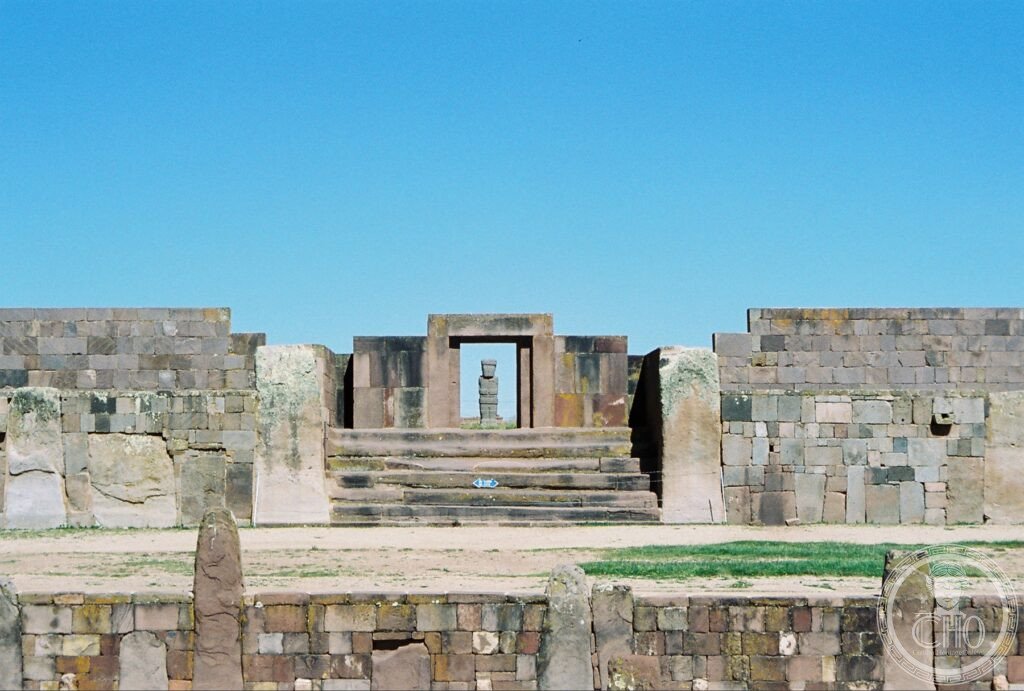
Tiwanaku
A ceremonial centre at 3,850 metres on the Bolivian Altiplano that served as the spiritual and political capital of one of the most influential pre-Columbian civilisations of the Andes — the Gateway of the Sun, carved from a single block of andesite 3 metres tall and weighing 10 tonnes, is the most important surviving monument of a culture that exerted influence over an area extending from northern Chile to southern Peru for over five centuries.
At a glance
Tiwanaku (also Tiahuanaco; Aymara: Tiwanaku) is a pre-Columbian archaeological site near the south-eastern shore of Lake Titicaca in the La Paz Department of Bolivia, at an altitude of approximately 3,850 metres above sea level, 72 km west of La Paz. The site was the political and ceremonial centre of the Tiwanaku culture (also called the Tiahuanaco culture or Tiahuanaco state), which flourished from approximately 300 BC to 1000 AD, with its peak period of influence between c. 500–900 AD. At its height, the Tiwanaku state extended over an area approximately 600,000 km² (an area comparable to France and Germany combined), encompassing the southern Andes from northern Chile to southern Peru. The city had a population estimated at 10,000–20,000 inhabitants, with the ceremonial core densely packed with monumental stone structures. Tiwanaku was inscribed as a UNESCO World Heritage Site in 2000.
Key facts
- Gateway of the Sun (Puerta del Sol): a monolithic arch carved from a single block of grey andesite, 3 metres tall and 4 metres wide, weighing approximately 10 tonnes; the upper frieze shows a central figure (identified as Viracocha or a staff deity) flanked by 48 winged attendants running toward the centre; below are 24 sacrificial heads; the symbolism relates to the calendar, astronomy, and the religious cosmology of the Tiwanaku state; the gateway was moved from its original position and has a crack (possibly from an earthquake)
- Akapana pyramid: a stepped earthen and stone pyramid approximately 200 metres on a side and 18 metres tall, the largest structure at the site; its original shape (cruciform when seen from above, in the form of an Andean cross or chakana) was a cosmological symbol; it was heavily looted for building materials in the colonial period and only partially excavated
- Kalasasaya platform: a large ceremonial platform (130 × 120 metres) built of upright stone pillars and sandstone blocks; the Gateway of the Sun originally stood at its north-west corner; the interior has been partially reconstructed; a second monolith, the Ponce Stela (7 metres, one of the largest at the site), stands in the interior
- Bennett Monolith (Monolito Bennet): the largest stone sculpture at Tiwanaku, 7.3 metres tall; discovered in 1932; moved to La Paz for display (it was in the central plaza of La Paz from 1958 to 2002, then moved to the underground Museo Lítico at the Tiwanaku site); covered with carved figures of deities and offerings
- Altitude: at 3,850 metres above sea level, Tiwanaku is the highest major archaeological site in the world; this altitude presented physiological challenges to the site’s builders and requires acclimatisation from visitors; the ancient Tiwanaku people were adapted to altitude over generations and their agriculture (raised field agriculture, or sukakollos) was specifically designed for the high-altitude climate
- Heritage: UNESCO World Heritage Site, Tiwanaku: Spiritual and Political Centre of the Tiwanaku Culture, inscribed 2000
- GPS: 16.5549° S, 68.6732° W
History
The Tiwanaku culture emerged on the southern shores of Lake Titicaca from at least 300 BC; the early period (c. 300 BC–400 AD) was characterised by local agricultural intensification and the beginnings of monumental construction. The expansion period (c. 400–800 AD) saw the state extend its control through a combination of military conquest, trade networks, and religious/ideological influence; the Tiwanaku deity complex (the Staff God, the Sacrificer, the winged attendants of the Gateway of the Sun) spread across the Andes and appears on the textiles, ceramics, and architecture of peoples as distant as the coast of Chile and the Moche territories of northern Peru. This “Tiwanaku horizon” (a term used by archaeologists for the period of widespread Tiwanaku cultural influence) was the first truly pan-Andean cultural phenomenon before the Inca Empire.
The site of Tiwanaku itself was a planned ceremonial city; the major monuments (Akapana, Kalasasaya, Pumapunku, Akapana East, Putuni) are arranged in a formal layout that archaeologists believe corresponded to a cosmological programme. The most enigmatic structure is Pumapunku — a platform and hall complex with H-shaped stone blocks fitted so precisely that they could not be moved without cranes, whose purpose and construction technique remain incompletely understood. The Pumapunku blocks include large andesite pieces weighing up to 130 tonnes, transported from quarries 90 km away; the logistical achievement rivals the pyramid-building of Egypt.
The Tiwanaku state declined precipitously around 1000 AD, probably as a result of a severe drought that lasted approximately 300 years and collapsed the raised-field agriculture that sustained the population. The city was abandoned; the site was incorporated into the Inca Empire in the 15th century, which maintained its symbolic importance as the “place of origin” (the Inca creation myth located the creation of humanity at Lake Titicaca); after the Spanish conquest, the site was extensively looted for building materials. The colonial church of Tiwanaku town was built partly with stones from the ancient monuments.
What you see
The archaeological site is reached from the village of Tiwanaku, 72 km west of La Paz on the main road to the Chilean border. The main excavated area is entered through a ticket gate; the site museum (Museo Lítico) near the entrance is essential first viewing, as it houses the Bennett Monolith (7.3 metres) and provides context for what is otherwise a difficult-to-read landscape of partially excavated platforms. The Kalasasaya platform, with the Gateway of the Sun at its corner, is the most immediately comprehensible monument; the scale of the individual stone blocks and the precision of the fitting (no mortar; the blocks interlock using I-shaped bronze clamps) is legible from close inspection.
The Pumapunku complex (400 metres south-west of the main site, accessed by a separate path) has the most extraordinary stonework: the H-shaped sandstone blocks with their machine-like precision of fit and the large andesite pieces that once formed the walls are scattered across the ground after the collapse of the structure, allowing close inspection of the cutting and fitting techniques. The scale of the fallen blocks — each weighing several tonnes and fitted without mortar to tolerances of millimetres — is the most cognitively demanding experience at the site.
Practical information
- Admission: BOB 100 (approximately USD 14.50); includes entry to both the main site and the Museo Lítico; the site guidebook is available at the entrance
- Getting there: from La Paz, buses depart from the cemetery district (Cementerio) terminal every 30–60 minutes to Tiwanaku village (2 hours, BOB 10–15); shared minibuses are faster (1.5 hours, BOB 15–20); tour operators in La Paz offer half-day and full-day excursions that include transport and a guide (USD 30–50)
- Altitude sickness: at 3,850 metres, altitude sickness (soroche) is possible; acclimatise in La Paz or Copacabana for 1–2 days before visiting; the site requires walking on uneven ground; drink coca tea (universally available) and move slowly
- Combined day trip: Tiwanaku can be combined with a visit to Lake Titicaca (Copacabana, Isla del Sol) in a 2–3 day circuit from La Paz; Tiwanaku is 72 km west of La Paz, Lake Titicaca is 150 km north-west
Getting there
La Paz El Alto International Airport (LPB) is the nearest airport; at 4,061 metres, it is the highest commercial airport in the world. From La Paz, bus or minibus to Tiwanaku village (1.5–2 hours); the site is 1 km from the village centre. GPS: -16.5549, -68.6732.
Nearby
- Lake Titicaca — the highest navigable lake in the world (3,810 metres); the Uros Floating Islands (inhabited reed islands built by the Uros people, a pre-Incan culture); Isla del Sol and Isla de la Luna (islands with Inca ruins at the lake’s centre); Copacabana (pilgrimage town with a famous Black Madonna); Bolivia-Peru border crossing; 150 km north-west of Tiwanaku
- La Paz — the political capital of Bolivia at 3,640 metres (the world’s highest capital city); the witches’ market (Mercado de las Brujas); the cable car (Mi Teleférico) system connecting La Paz to El Alto; the Valley of the Moon erosion landscape 10 km south; 72 km east of Tiwanaku
- Samaipata — the carved rock of El Fuerte (a Tiwanaku-period sacred site subsequently used by the Incas, with carved channels, niches, and figures in a large sandstone outcrop); UNESCO WHS; 120 km south-east of Santa Cruz (8 hours from La Paz)
Sources
- Wikipedia, Tiwanaku, accessed June 2026
- UNESCO, Tiwanaku: Spiritual and Political Centre of the Tiwanaku Culture, WHS reference 567, inscribed 2000
- John W. Janusek, Ancient Tiwanaku, Cambridge University Press, 2008
- Alan Kolata, Valley of the Spirits: A Journey into the Lost Realm of the Aymara, John Wiley and Sons, 1996
Find it on the map
See this place and what’s around it →📷 Diventa un fotografo di Cultural Heritage Online
Condividi le tue foto dei luoghi: restano pubblicate con la tua firma come autore. Più vengono viste, più ti fai conoscere — e presto un concorso premierà le foto più apprezzate.
Accedi o registrati gratis per aggiungere una foto