
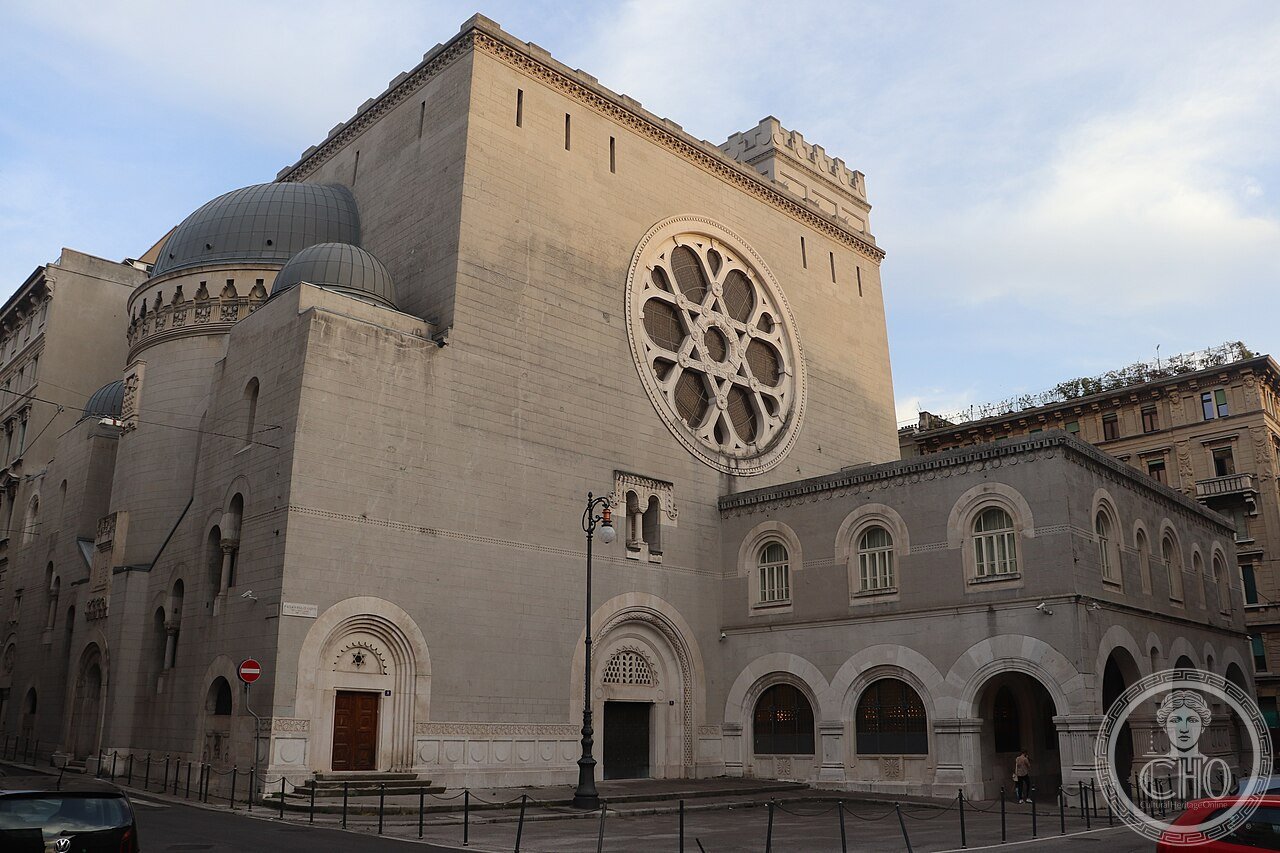

Ruggero and Arduino Berlam’s 1912 synagogue is a hybrid that resists easy classification: Sephardic-revival massing with Jugendstil ornamental detail, the second-largest synagogue in Europe after Budapest, and a building that survived the Holocaust intact.
At a glance
The Sinagoga di Trieste was designed by Ruggero Berlam and his son Arduino Berlam between 1908 and 1912, following an 1903 international competition. It was inaugurated on 21 June 1912. According to the Comunità Ebraica di Trieste, it is one of the largest synagogues in Italy and the second-largest in Europe after Budapest. The building is an active Orthodox synagogue and survived the 1938 Fascist racial laws, the German occupation of Trieste in 1943–45, and the Holocaust deportations from the nearby Risiera di San Sabba.
Key facts
- Architects: Ruggero Berlam (1854–?) and Arduino Berlam (1880–1946)
- Competition: 1903 international competition
- Built: 1908–12
- Inaugurated: 21 June 1912
- Address: Piazza Virgilio Giotti 4 (main entrance) / Via San Francesco d’Assisi 19, 34133 Trieste
- Style: Sephardic revival + Jugendstil
- Scale: Second-largest synagogue in Europe after Budapest (per Comunità Ebraica di Trieste)
- GPS: 45.6532, 13.7801
History
The Berlam dynasty matters in Trieste architecture. Ruggero Berlam (born 1854) was the patriarch; his son Arduino would later design the Aedes red skyscraper on the Canal Grande. Arduino received the synagogue commission from his father in his early thirties. The brief was for a synagogue serving one of the largest Jewish communities in the Mediterranean, on a scale that would visually compete with the city’s Catholic churches and Austrian civic buildings. The building survived the Fascist racial laws of 1938, the German occupation of Trieste in 1943–45, and the Holocaust deportations from the Risiera di San Sabba. It still hosts an Orthodox congregation.
What you see
The building is a hybrid that resists easy classification. The massing and exotic ornamental programme draw on the Sephardic and Romanesque-revival vocabularies that synagogue architecture across Europe employed in the 1900s. The detail draws on the Jugendstil current that Vienna had codified by 1900 and that Trieste’s Berlam family worked in fluently. The rose window, the stylised stone carving, and the linear ornament around the portal are the Jugendstil notes; the basilica plan and classicising volumes are the Sephardic-revival ones.
Practical information
- Access: Active Orthodox synagogue — guided visits by appointment with the Comunità Ebraica di Trieste
- Closed: During religious services and Shabbat (Friday sunset to Saturday night)
- Main entrance: Piazza Virgilio Giotti 4 (secondary access Via San Francesco 19)
- Time needed: 30–45 minutes including guided tour
Getting there
The synagogue is in the Borgo Teresiano, between Via San Francesco and the parallel streets south of the Canal Grande. From the Canal Grande, walk south on Via Galatti or Via Battisti; the synagogue is 5 minutes on foot.
Nearby
- Palazzo della Banca di Praga (1914) — 400 m north-west, Via Roma 7
- Narodni Dom (1904) — 400 m north, Via Filzi 14
- Palazzo Viviani-Giberti (1907) — 200 m south, Viale XX Settembre 35
Sources
- Comunità Ebraica di Trieste: La Sinagoga — inaugural date, competition 1903, second-largest in Europe
- Wikimedia Commons: Sinagoga photo, Andrzej Otrębski, CC BY-SA 4.0
Find it on the map
See this place and what’s around it →📷 Become a Cultural Heritage Online photographer
Share your photos of places: they stay published under your name as the author. The more they're seen, the more you get noticed — and soon a contest will reward the most appreciated photos.
Log in or sign up free to add a photoDo you manage this place?
This page is read by travellers and heritage enthusiasts who find it on Google. Keep it accurate — and make it work for you. Free for non-profit heritage institutions.