
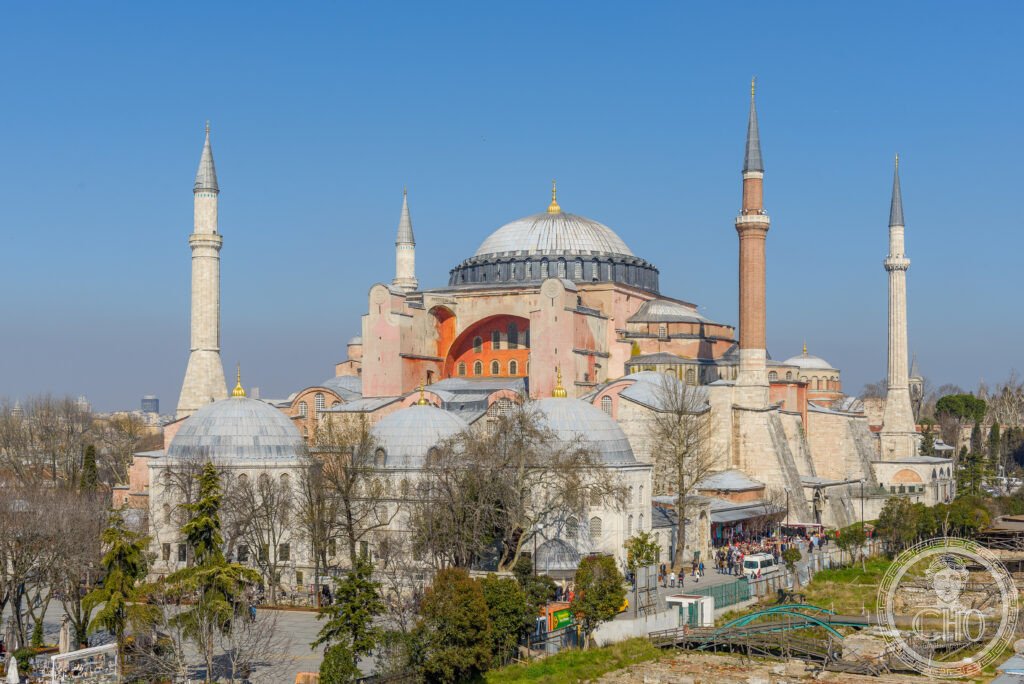
Hagia Sophia — Istanbul
Built in 537 under Justinian I, Hagia Sophia stood for nearly a thousand years as the largest cathedral on earth — then became a mosque, then a museum, then a mosque again; its 31-metre dome, floating on 40 arched windows, remains one of the supreme structural achievements in the history of architecture.
At a glance
Hagia Sophia (Turkish: Ayasofya, Greek: Ἁγία Σοφία) stands in the Sultanahmet district of Istanbul, its half-domed silhouette and four Ottoman minarets forming the most recognised skyline in Turkey. Dedicated on 27 December 537 as the patriarchal cathedral of Constantinople, it was designed by the mathematicians Isidore of Miletus and Anthemius of Tralles under the patronage of the Emperor Justinian I, and was the largest cathedral in the world from its completion until the construction of the Cathedral of Seville in 1520 — nearly a thousand years. Converted to a mosque by Mehmed II in 1453 following the Ottoman conquest of Constantinople, then converted to a museum by Kemal Atatürk in 1934, and reconverted to a mosque in 2020, the building has functioned under four distinct religious and political regimes without losing the cumulative architectural identity that makes it unmistakable. It is part of the UNESCO World Heritage inscription of the Historic Areas of Istanbul (1985).
Key facts
- Architects: Isidore of Miletus and Anthemius of Tralles, both mathematicians; under Emperor Justinian I (527–565 AD)
- Dedicated: 27 December 537 AD; construction took approximately five years
- Main dome: 31.87 metres in diameter, 55.6 metres above floor level; 40 ribbed windows at the base create the “floating” appearance
- Record: largest cathedral in the world from 537 to c. 1520 (Cathedral of Seville); largest dome in the world from 537 to 1436 (Florence Cathedral)
- Status changes: Orthodox Christian cathedral (537–1453); mosque (1453–1934); museum (1934–2020); mosque (2020–present; open to non-Muslim visitors outside prayer times)
- Heritage: UNESCO World Heritage Site, Historic Areas of Istanbul, inscribed 1985
- GPS: 41.0086° N, 28.9802° E
History
The building that stands today is the third church on the site; the first, built under Constantine I in 360, burned during a riot in 404. Justinian ordered a new church of unprecedented scale after the Nika revolt of 532, which had burned the existing basilica. The architects he chose — Isidore and Anthemius — were not primarily designers but theoreticians of geometry and mechanics. Their solution to the problem of placing a circular dome on a square base — the pendentive, which allows the dome’s circular rim to resolve into four arched openings — was not new, but they executed it at a scale and with a refinement of spatial sequence that had not been attempted before. The dome, when first completed, was shallower than the current one; it collapsed in 558 following an earthquake and was rebuilt at greater height by Isidore the Younger, the nephew of the original Isidore.
For the next nine centuries Hagia Sophia was the most important building in Christendom: the seat of the Ecumenical Patriarch, the place of imperial coronations, the model for domed church architecture across the Byzantine world and subsequently across the Islamic world. When Mehmed II entered Constantinople on 29 May 1453, he went directly to Hagia Sophia and had the Christian mosaics partially covered with whitewash, the relics removed, and a prayer rug placed toward Mecca. The minarets — four in total, added between 1453 and the 1590s by successive Ottoman sultans — transformed the exterior into a mosque silhouette. The Islamic calligraphic medallions and the mihrab and minbar were added to the interior; the Christian mosaics were plastered over.
In 1934, Atatürk’s government converted the building to a secular museum, removing the prayer rugs and instructing the restoration of the Byzantine mosaics. For eighty-six years, Hagia Sophia functioned as a museum open to all. In July 2020, a Turkish administrative court reversed the 1934 conversion; the building was reconverted to a mosque. It remains open to non-Muslim visitors outside the five daily prayer times, with head coverings required.
What you see
The exterior, approached from the Sultanahmet square, presents the massive drum of the central dome flanked by two semi-domes and stabilised by the great buttresses that were added after the 10th-century earthquakes. The four minarets — of differing ages and slightly differing heights — read as an Ottoman addition but have become so thoroughly integrated into the silhouette that the building is inconceivable without them. The main entrance, through the Inner Narthex, leads to the nave via the Imperial Door, a 9th-century mosaic above which shows the emperor prostrating before Christ.
Inside, the primary spatial experience is the dome: 31.87 metres in diameter, its base pierced by forty windows that flood the space with diffused light, it appears to float rather than rest on the structure below. This effect was deliberate — Procopius, writing shortly after the dedication, described the dome as “suspended from heaven by a golden chain.” The gold mosaic that originally covered the dome and semi-domes is now gone, but the figural mosaics in the galleries — particularly the Deësis mosaic of the 13th century, considered among the finest examples of Byzantine art — have been restored and are visible to visitors. The mihrab, the minbar, and the Ottoman calligraphic medallions coexist with the Byzantine fabric in a layering of religious and imperial history that is unique in world architecture.
Practical information
- Address: Sultan Ahmet, Ayasofya Meydanı 1, 34122 Fatih, Istanbul
- Status: active mosque; open to non-Muslim visitors except during the five daily prayer times (roughly 90 minutes each)
- Admission: free (as a mosque)
- Dress code: head covering required for women; shoulders and knees covered for all visitors; remove shoes at entrance
- Visit timing: early morning (before 9 am) or mid-afternoon (between the Dhuhr and Asr prayers) are the least crowded times
- Time needed: 1–1.5 hours; the upper gallery (best view of the Deësis mosaic) requires a separate queue
Getting there
Hagia Sophia is in the Sultanahmet district, five minutes on foot from the Blue Mosque, Topkapi Palace, and the Grand Bazaar area. Tram line T1 (Sultanahmet stop) is directly adjacent. Istanbul Airport is 41 km north-west via the Airport Metro. GPS: 41.0086, 28.9802.
Nearby
- Blue Mosque (Sultan Ahmed Mosque) — the 1616 Ottoman imperial mosque with six minarets, facing Hagia Sophia across the Hippodrome; five minutes on foot
- Topkapi Palace — the primary residence of the Ottoman sultans from 1465 to 1856; UNESCO WHS; ten minutes on foot
- Basilica Cistern — the 6th-century underground water reservoir beneath Sultanahmet; the largest surviving Byzantine cistern in Istanbul; five minutes on foot
- Istanbul Archaeological Museums — three museums including the classical Greek and Roman collections; ten minutes on foot
Sources
- Wikipedia, Hagia Sophia, accessed June 2026
- Procopius of Caesarea, De Aedificiis (On Buildings), c. 560 AD
- UNESCO, Historic Areas of Istanbul, WHS reference 356, inscribed 1985
- Robert Ousterhout, Eastern Medieval Architecture: The Building Traditions of Byzantium and Neighboring Lands, Oxford, 2019
Find it on the map
See this place and what’s around it →📷 Diventa un fotografo di Cultural Heritage Online
Condividi le tue foto dei luoghi: restano pubblicate con la tua firma come autore. Più vengono viste, più ti fai conoscere — e presto un concorso premierà le foto più apprezzate.
Accedi o registrati gratis per aggiungere una foto