
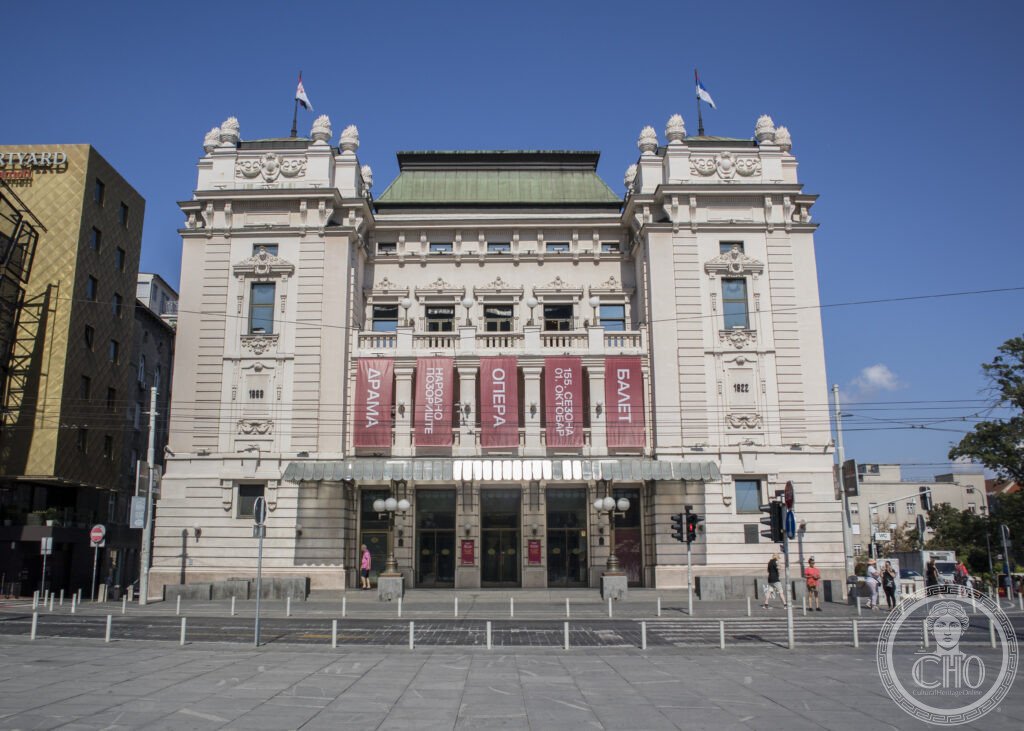
Alexander Bugarski’s 1869 Neoclassical theatre on Republic Square is the oldest professional theatre in Serbia and the institutional heart of its dramatic, operatic, and balletic life since the Serbian Renaissance.
At a glance
The National Theatre in Belgrade (Narodno Pozorište) stands on the north side of Republic Square, its cream-stuccoed facade and Ionic columns forming the architectural backdrop to the city’s central civic space. Designed by architect Alexander Bugarski — a Romanian-born architect of Bulgarian origin trained in Vienna — and inaugurated on 13 October 1869, the theatre was a deliberate statement of cultural ambition by the Principality of Serbia as it sought to define its national identity following partial independence from the Ottoman Empire. Today it hosts opera, ballet, and drama companies, making it Serbia’s most programmatically diverse performing arts institution.
Key facts
- Architect: Alexander Bugarski (1835–1891), Romanian-born architect of Bulgarian origin, trained at Vienna’s Academy of Fine Arts
- Built: 1868–1869; inaugurated 13 October 1869 with a patriotic drama
- Style: Neoclassical with Baroque elements; Ionic columns; cream stucco; three-stage elevation
- Companies resident: opera, ballet, and drama ensembles — Serbia’s only multi-genre national stage
- Renovation: major restoration 2014–2018 restored the 19th-century interior
- Location: Republic Square (Trg Republike), the civic centre of Belgrade, facing the National Museum
- GPS: 44.8167° N, 20.4606° E
History
The establishment of a national theatre was a central project of the Serbian cultural revival (the so-called “Serbian Renaissance”) that accompanied the country’s gradual emancipation from Ottoman rule during the 19th century. Literary societies, schools, and cultural institutions founded in the decades before 1869 laid the groundwork; the National Theatre was the capstone, its opening coinciding with a period of intense nation-building. The initial repertoire centred on Serbian historical drama, with works by Jovan Sterija Popović and visiting Belgrade-premiere productions of European classics.
Bugarski’s design took as its reference the Viennese Neoclassical theatres that represented the aspiration of a small nation toward European modernity. The three-storey elevation, with Ionic columns at the piano nobile and a pedimented central bay, communicated institutional dignity through architectural language familiar to the diplomatic audience of a capital city receiving recognition from the major European powers. The choice of location on Republic Square — already the site of the National Museum — reinforced the theatre’s role as a cultural monument rather than a purely commercial venue.
The building survived the Balkan Wars (1912–1913), the First World War occupation of Belgrade, and the Second World War, undergoing repairs and partial rebuilding after each conflict. A major renovation begun in 2014 and completed in 2018 restored the 19th-century interior to its original appearance — including the ceiling paintings, box velvets, and the gilded proscenium — while bringing the stage machinery into the 21st century. The theatre maintains three resident companies: opera, ballet, and drama.
What you see
The facade on Republic Square presents a horizontal composition of rusticated base, Ionic-columned piano nobile, and attic storey with carved reliefs. The central projecting bay carries a triangular pediment bearing allegorical reliefs of the Arts. The side bays, slightly recessed, are marked by pilasters and pedimented windows. The overall colour is the warm cream of Viennese Historicism, a choice that aligned the building visually with the Habsburg cultural orbit rather than the Ottoman one.
Inside, the post-2018 restoration has recovered the original 1869 decoration: a horseshoe auditorium of three tiers, the box fronts gilded and upholstered in red velvet, the ceiling carrying a circular fresco of Apollo and the Muses. The proscenium arch — also gilded — is flanked by carved groups representing Drama and Music. The proportions are those of a mid-19th-century European court theatre: intimate by modern standards, but acoustically suited to the unamplified voice.
Practical information
- Address: Trg Republike 1, Belgrade 11000, Serbia
- Season: September to June; limited summer schedule
- Tickets: online and box office; reasonably priced by Western European standards
- Dress code: smart casual for most performances; formal for galas
- Time needed: 2–3.5 hours depending on genre
- Languages: productions in Serbian; opera in original language with Serbian surtitles
Getting there
Republic Square is the central hub of Belgrade’s pedestrian street network, on Knez Mihailova Street, 20 minutes on foot from Belgrade Fortress. Nikola Tesla Airport is 18 km west; taxis take 25–35 minutes to the centre. GPS: 44.8167, 20.4606.
Nearby
- National Museum of Serbia — across the square; fine arts and archaeological collection from pre-Roman to modern
- Knez Mihailova Street — the main pedestrian promenade of old Belgrade, lined with 19th-century buildings
- Kalemegdan Fortress — medieval citadel at the confluence of the Sava and Danube, 15 minutes on foot
- Nikola Tesla Museum — the only museum dedicated to Tesla’s legacy, 20 minutes on foot
Sources
- Wikipedia, National Theatre in Belgrade, accessed June 2026
- Official theatre website: narodnopozoriste.rs
- Ministry of Culture of Serbia, heritage listing for the National Theatre
- Dubravka Ugresic, The Museum of Unconditional Surrender — literary context for Yugoslav cultural institutions
Find it on the map
See this place and what’s around it →📷 Become a Cultural Heritage Online photographer
Share your photos of places: they stay published under your name as the author. The more they're seen, the more you get noticed — and soon a contest will reward the most appreciated photos.
Log in or sign up free to add a photoIs this page about you?
This page is read by travellers and heritage enthusiasts who find it on Google. Tell us how you are connected to this place and we will take it from there.