
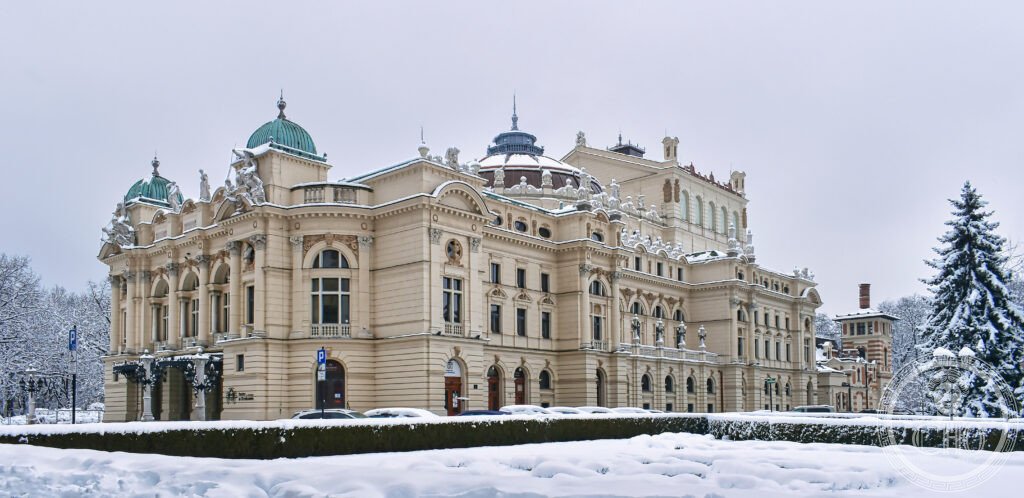
Jan Zawiejski’s 1893 Neo-Baroque theatre brought the gilded grammar of the Paris Opéra to Kraków’s limestone city, one chandelier and one ceiling fresco at a time.
At a glance
The Juliusz Słowacki Theatre stands at the northern edge of Kraków’s Old Town, its cream-stucco façade and patinated copper domes rising just inside the former city wall. Jan Zawiejski completed the building in 1893 on the cleared site of the old Carmelite convent, producing one of the most coherent examples of Neo-Baroque theatre architecture in Central Europe. The interior — gilded loggias, crystal chandeliers, and a ceiling fresco by Henryk Siemiradzki depicting Apollo and the Muses — has hosted continuous performances since opening night. Kraków’s Historic Centre, including the theatre’s surroundings, was inscribed as a UNESCO World Heritage Site in 1978.
Key facts
- Architect: Jan Zawiejski (1854–1922), Kraków architect and urban planner
- Built: 1891–1893; inaugurated 21 October 1893 with Słowacki’s Mazepa
- Style: Neo-Baroque / Historicist Eclectic, modelled on the Paris Opéra (Garnier, 1875)
- Capacity: approximately 900 seats across stalls, boxes, and three tiers
- Heritage: UNESCO Historic Centre of Kraków (1978); Polish national monument since 1962
- Named for: Juliusz Słowacki (1809–1849), Romantic poet and playwright, one of Poland’s Three Bards
- GPS: 50.0639° N, 19.9431° E
History
The project grew from civic ambition rather than royal patronage. Kraków in the 1880s belonged to Austrian Galicia, and its Polish-speaking bourgeoisie channelled national identity into cultural institutions. A design competition held in 1888 drew entries from across the Austro-Hungarian empire; Zawiejski won with a proposal that borrowed the tripartite massing of the Paris Opéra and adapted it to the tighter footprint of the convent site.
Construction ran from 1891 to 1893, and the theatre opened on 21 October with a double bill: Słowacki’s patriotic drama Mazepa followed by a ballet. The choice of dedication was deliberate — Słowacki had died in exile in Paris in 1849, and naming the theatre after him asserted cultural continuity across the partition era. The building survived both world wars largely intact. Major restoration in the 1990s preserved Siemiradzki’s ceiling frescoes and the original gilded plasterwork without altering the 1893 layout.
Today the Słowacki Theatre remains Kraków’s principal lyric stage, staging opera, ballet, and major touring productions. Its foyer hosts chamber concerts throughout the city’s festival seasons.
What you see
The exterior presents a rusticated stone base, a cream stucco piano nobile, and an attic storey with round-arched windows framing terracotta reliefs of theatrical masks and laurel swags. Two shallow domed towers flank the central block; the patinated copper turns the building a muted grey-green in winter light. From Świętego Ducha Square the theatre reads as wider than tall — a proportion that sits comfortably against the medieval street fabric around it.
Inside, the auditorium runs stalls, a wide parterre, and three tiers of boxes and open galleries. The ceiling fresco by Henryk Siemiradzki — the painter known for his monumental Nero’s Torches — fills the domed central coving with an allegory of Apollo, the Muses, and figures from Polish Romantic drama. Gilded cartouches bearing the names of Mickiewicz, Słowacki, and Krasiński — the Three Bards — mark the upper tier. The chandelier, brass and crystal, is the original 1893 fitting.
Practical information
- Address: pl. Świętego Ducha 1, 31-023 Kraków, Poland
- Season: September to June; reduced schedule July–August
- Tickets: book online at the theatre’s official website; same-day availability limited for opera and ballet
- Dress code: smart casual for most performances; formal dress optional for premieres
- Time needed: 2–3 hours including interval for most programmes
- Languages: surtitles in Polish and English for major operatic productions
Getting there
The theatre stands one block north of the main Rynek Główny market square, a four-minute walk from central tram stops on Planty park. Kraków Główny railway station is twelve minutes on foot; express trains connect to Warsaw (2 h 15 min) and Wrocław (3 h). From John Paul II International Airport, tram line 4 or 208 reaches the centre in 40 minutes. GPS: 50.0639, 19.9431.
Nearby
- Rynek Główny — Kraków’s medieval market square with the Cloth Hall and St Mary’s Basilica, five minutes south
- Wawel Royal Castle — hilltop royal residence above the Vistula, 20 minutes on foot through the Old Town
- Czartoryski Museum — holds Leonardo da Vinci’s Lady with an Ermine, ten minutes west
- Collegium Maius — oldest university building in Poland, medieval courtyard open to visitors
Sources
- Wikipedia, Juliusz Słowacki Theatre, accessed June 2026
- UNESCO, Historic Centre of Kraków, WHS reference 29, inscribed 1978
- Official theatre website: slowacki.krakow.pl
- Encyklopedia Krakowa, entry “Teatr im. Juliusza Słowackiego”
Find it on the map
See this place and what’s around it →📷 Become a Cultural Heritage Online photographer
Share your photos of places: they stay published under your name as the author. The more they're seen, the more you get noticed — and soon a contest will reward the most appreciated photos.
Log in or sign up free to add a photoIs this page about you?
This page is read by travellers and heritage enthusiasts who find it on Google. Tell us how you are connected to this place and we will take it from there.