
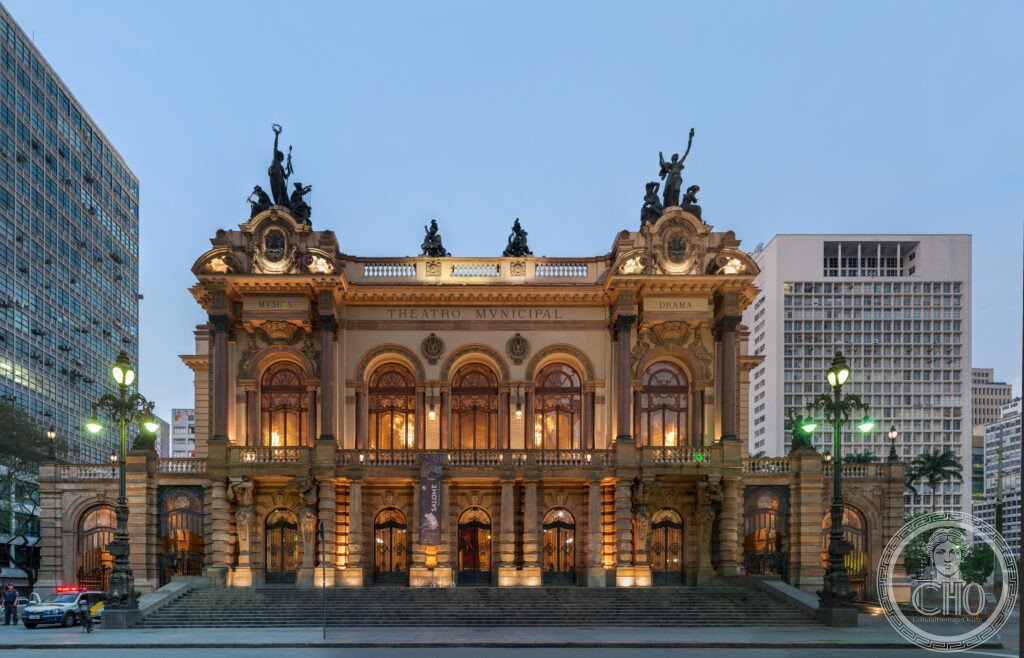
Francisco Ramos de Azevedo’s 1911 theatre on Praça Ramos de Azevedo stands not only as São Paulo’s finest architectural monument but as the building where, in 1922, a group of young Brazilian artists launched the Week of Modern Art and rewrote the course of the country’s cultural history.
At a glance
The Theatro Municipal de São Paulo — the city hall keeps the archaic spelling “theatro” — occupies Praça Ramos de Azevedo in the historic centre of São Paulo. Designed by Francisco Ramos de Azevedo in collaboration with Claudio Rossi and Domiziano Rossi, it was built between 1903 and 1911 in a style that the building’s own Wikipedia article describes as “Renaissance, Baroque and Art Nouveau.” Its 1,523 seats have hosted opera, ballet, and orchestral concerts since its inauguration on 12 September 1911. In 1922 the building became the site of the Semana de Arte Moderna (Week of Modern Art), a festival of painting, sculpture, literature, and music that triggered a Brazilian cultural revolution. Today it is the home of the São Paulo Municipal Symphony Orchestra, the Coral Lírico (Lyric Choir), and the City Ballet of São Paulo. It was listed as national heritage (Tombamento) in 1995.
Key facts
- Architects: Francisco Ramos de Azevedo, Claudio Rossi, Domiziano Rossi
- Construction: 1903–1911
- Inaugurated: 12 September 1911
- Style: Renaissance, Baroque and Art Nouveau
- Capacity: 1,523 seats
- Address: Praça Ramos de Azevedo s/n, Centro, São Paulo
- GPS: −23.5453, −46.6386 — Google Maps
- Heritage: National Heritage of Brazil (Tombamento IPHAN, 1995)
History
Francisco Ramos de Azevedo (1851–1928) was the dominant architect of São Paulo’s coffee-boom expansion at the turn of the twentieth century — the period when the city grew from a minor provincial town to a metropolitan centre of global importance, on the wealth generated by the São Paulo plateau’s coffee plantations. His architectural language was the French-inflected eclecticism of the period: Renaissance and Baroque elements drawn from his study in Europe, applied to the institutional commissions that a rapidly prospering city was willing to fund.
The municipal theatre commission came in the early 1900s, when São Paulo felt the need for a cultural institution commensurate with its economic ambitions. Working with the Italian architects Claudio and Domiziano Rossi, Ramos de Azevedo developed a design that drew on the Paris Opera (Opéra Garnier) as its model: a monumental street front in carved stone, a horseshoe auditorium, and a decorative programme that worked Renaissance and Baroque elements into a composition with Art Nouveau ornamental detail in the ironwork, mosaic floors, and plasterwork ceilings. Construction began in 1903 and the building opened on 12 September 1911.
The building’s most historically significant moment came a decade after its opening: from 13 to 17 February 1922, a group of young Brazilian painters, sculptors, writers, and musicians occupied the Theatro Municipal for the Semana de Arte Moderna. Over five evenings, they presented work that broke with European academic tradition and proposed a genuinely Brazilian modernism — a cultural declaration of independence whose ripple effects are still felt in Brazilian literature, art, and music. The building is listed as national heritage since 1995 and underwent a major restoration completed in 2011.
What you see
The main façade faces Praça Ramos de Azevedo with a symmetrical composition of columns, arched windows, carved stone cartouches, and a recessed central loggia framed by pilasters. The Art Nouveau detail appears most clearly in the ironwork of the entrance gates and stair railings, the botanical relief panels in the entrance vestibule, and the mosaic floors of the foyers — a decorative layer that coexists with the dominant Renaissance register without disrupting it. The corner domes above the flanking pavilions and the attic balustrade with its sculptural groups complete the composition.
The main auditorium follows the nineteenth-century horseshoe plan, with four tiers of boxes framing the stage on three sides. The painted ceiling, the gilded plasterwork of the box fronts, and the chandeliers were all restored in the 2011 campaign to their 1911 condition. The foyer and staircase spaces — with their mosaic floors, ornamental ironwork, and painted vaults — form the most Art Nouveau-inflected interiors in the building.
Practical information
- Home of the São Paulo Municipal Symphony Orchestra, Coral Lírico, and City Ballet.
- Tickets for concerts and performances at the official ticket office or online.
- Guided tours of the interior are offered on selected days; check the theatre’s website for schedule.
- The exterior and surrounding square are freely accessible at all hours.
- The theatre is a 10-minute walk from the Praça da Sé (Cathedral Square), the historic centre of São Paulo.
Getting there
The Theatro Municipal is on Praça Ramos de Azevedo in central São Paulo. Anhangabaú metro station (Line 3 – Red) is 5 minutes’ walk. São Paulo–Guarulhos International Airport (GRU, 30 km northeast) is connected by bus or taxi (45–90 minutes depending on traffic). Congonhas Airport (CGH, 14 km south) is accessible by taxi in 30–40 minutes.
Nearby
- Vale do Anhangabaú — the public park valley directly in front of the theatre, a landmark of early São Paulo urbanism
- Praça da Sé — the city’s central square with the Neo-Gothic cathedral, 10-minute walk east
- Pinacoteca do Estado — São Paulo’s main art museum, in a Ramos de Azevedo building (1900), 15-minute walk north
- Mercado Municipal — “Mercadão,” São Paulo’s famous covered market (1933), 10-minute walk east
Sources
- Wikipedia (EN): Theatro Municipal de São Paulo — architects Ramos de Azevedo + Claudio Rossi + Domiziano Rossi; style “Renaissance, Baroque and Art Nouveau”; 1903–1911; inaugurated 12 Sept 1911; 1,523 seats; IPHAN 1995; GPS −23.54528/−46.63861
- Wikipedia (EN): Week of Modern Art (1922) — venue was the Theatro Municipal, 13–17 February 1922; significance for Brazilian culture
- Wikipedia (EN): Francisco Ramos de Azevedo — architect biography, role in São Paulo coffee-boom expansion
Find it on the map
See this place and what’s around it →📷 Become a Cultural Heritage Online photographer
Share your photos of places: they stay published under your name as the author. The more they're seen, the more you get noticed — and soon a contest will reward the most appreciated photos.
Log in or sign up free to add a photoDo you manage this place?
This page is read by travellers and heritage enthusiasts who find it on Google. Keep it accurate — and make it work for you. Free for non-profit heritage institutions.