
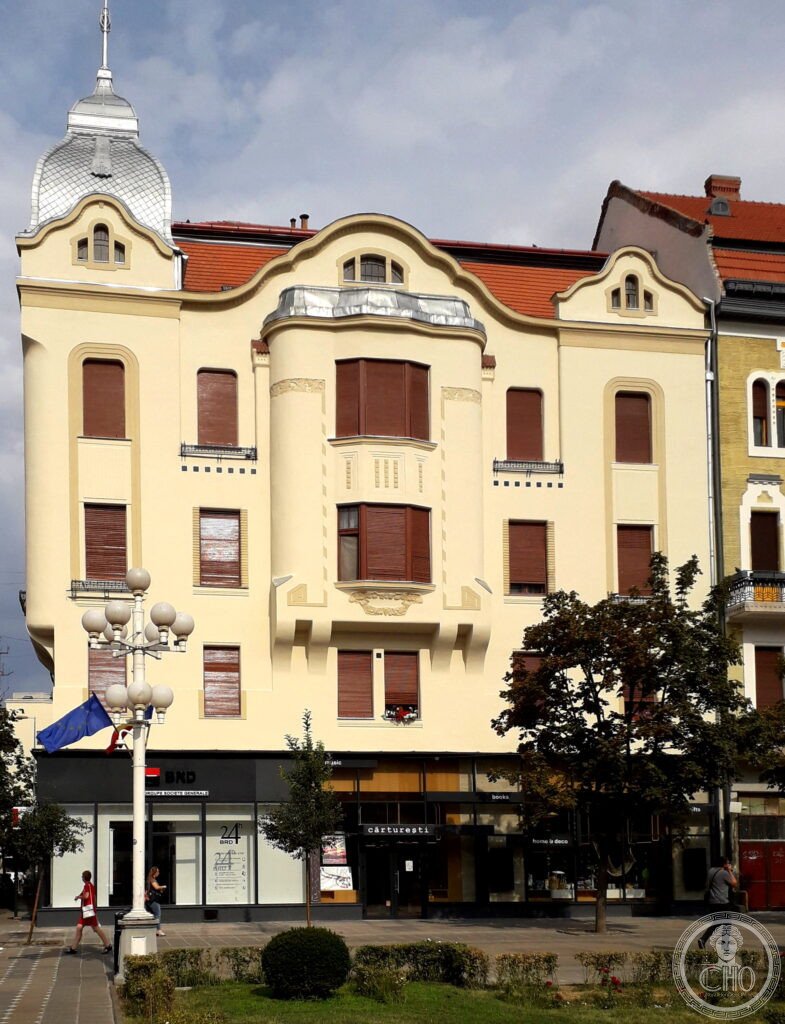
Arnold Merbl designed this 1911 Secession apartment block and gave it his own name — the signature gesture of a builder-architect who also raised the Lloyd Palace next door and shaped a significant stretch of Timișoara’s celebrated Corso promenade.
At a glance
Merbl Palace occupies the mid-section of Piața Victoriei’s western “Corso” strip, wedged between the Lloyd Palace to the north and the Neuhausz Palace to the south. Built in 1911, one year before the grander Lloyd commission on the same square, it stands as the most personal statement of Arnold Merbl’s career: a residential palace the builder-architect designed and named after himself. Today it forms part of the interwar Corso urban ensemble listed under Romanian heritage code LMI TM-II-a-A-06115 — one of several protected Art Nouveau and Secession palaces that give Timișoara its distinctive pedestrian heart.
Key facts
- Architect: Arnold Merbl
- Completed: 1911
- Style: Secession
- Location: Piața Victoriei (Corso), Timișoara, Romania
- GPS: 45.753, 21.2249 — Google Maps
- Heritage: LMI TM-II-a-A-06115, interwar Corso urban ensemble
- Neighbours: Lloyd Palace (N) and Neuhausz Palace (S)
History
Arnold Merbl was among the most active builder-architects working in Temesvár in the years before the First World War. His practice combined the roles of designer and contractor — a common arrangement in the Austro-Hungarian provincial city where the same firm often drew the plans and laid the foundations. The Lloyd Palace, which he built as construction contractor to Lipót Baumhorn’s designs around 1910–12, is the grander building on the square; the Merbl Palace, completed in 1911, is the one he designed and named for himself.
The building served as a residential apartment block from its construction through the transition from Austro-Hungarian Temesvár to Romanian Timișoara in 1918–19. Like its neighbours on the Corso, it retained its original Secession character through the turbulent decades of the twentieth century, surviving both wartime damage and communist-era neglect to reach the present in recognisable condition.
The listing of the entire Corso ensemble under Romanian heritage protection — which includes Merbl, Lloyd, Löffler, Dauerbach, and Neuhausz palaces — ensures the survival of what amounts to the most concentrated display of Secession residential architecture in Romania outside Cluj-Napoca.
What you see
The façade is four storeys of pale render enlivened by Secession ornament deployed with the practical economy of a builder who knew exactly what each decorative element cost to execute. Stylised floral reliefs frame the windows of the upper floors; the entrance portal carries the most concentrated ornament, with carved botanical motifs that echo the vocabulary used on the Lloyd Palace next door without copying it exactly.
Between the Merbl Palace and the Neuhausz Palace is a narrow passage — the “alternation” noted in historic accounts of the Corso — that breaks the continuous wall of palace fronts and creates an unexpected glimpse of the courtyard behind. It is a spatial accident that adds rhythm to the otherwise unbroken pedestrian elevation.
Practical information
- Exterior freely visible from Piața Victoriei at all hours.
- The narrow passage between Merbl and Neuhausz palaces is worth noting — a gap in the Corso wall with courtyard view.
- Combine with the Lloyd, Löffler, and Dauerbach palaces for a 45-minute Corso walking tour.
Getting there
On the western Corso side of Piața Victoriei in central Timișoara, between Lloyd Palace to the north and Neuhausz Palace to the south. Reach the square by tram 1 or 8 from Gara de Nord (under 15 minutes). The Opera is a 3-minute walk to the west.
Nearby
- Lloyd Palace — directly north on the Corso, Baumhorn’s 1910–12 Secession civic landmark
- Dauerbach Palace — south on the Corso, László Székely 1913, site of the historic “Palace” restaurant
- Löffler Palace — further north on the Corso, 1912–13, Jacob Löffler’s three-son apartment complex
Sources
- Wikidata entry Q1283686 — Merbl Palace (GPS, building data)
- Wikipedia: Palatul Merbl (Romanian) — architect Arnold Merbl, 1911, Secession style, Neuhausz neighbour, LMI code
- Wikipedia: Palatul Merbl (Romanian) — confirms Arnold Merbl also built Lloyd Palace on the same square
- Romanian national heritage register LMI TM-II-a-A-06115
Find it on the map
See this place and what’s around it →📷 Become a Cultural Heritage Online photographer
Share your photos of places: they stay published under your name as the author. The more they're seen, the more you get noticed — and soon a contest will reward the most appreciated photos.
Log in or sign up free to add a photoIs this page about you?
This page is read by travellers and heritage enthusiasts who find it on Google. Tell us how you are connected to this place and we will take it from there.