
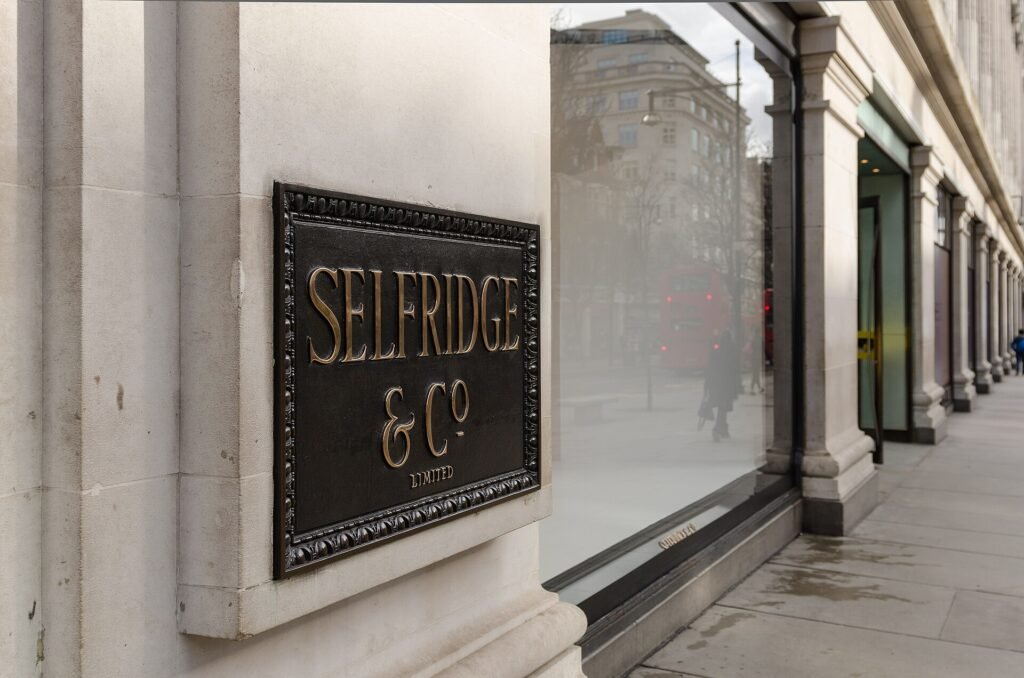
An American showman gave Oxford Street a temple of shopping, fronted by a colonnade you could see from down the street.
At a glance
Selfridges opened on Oxford Street in 1909, the creation of the American retailer Harry Gordon Selfridge. Its long façade is a Beaux-Arts colonnade of giant Ionic columns, designed with the help of the Chicago architect Daniel Burnham and the London architects R. Frank Atkinson and Francis Swales. Selfridge made shopping an entertainment, and the building was built to match.
Key facts
- Location: 400 Oxford Street, London
- Architects: Daniel Burnham, R. Frank Atkinson, Francis Swales
- Opened: 1909
- Style: Edwardian Beaux-Arts
- Function: department store, still trading
History
Selfridge had learned the department-store trade in Chicago, at Marshall Field. He brought its ideas to London: open displays, a perfume hall at the door, the customer free to browse without pressure to buy. The store opened in 1909 and was extended over the following decades to fill the block.
Its colonnade, with the great Queen of Time clock over the main entrance, became a London landmark. More than a century on, it is still one of the city’s busiest stores.
What you see
The front is a row of giant columns rising through several storeys, the windows set deep behind them. Over the main door, the Queen of Time rides above the clock. It is retail dressed as civic architecture, the same instinct that built Selfridge’s training ground in Chicago.
Practical information
- Open: standard retail hours
- Cost: free to enter
- Best for: the colonnade and the Queen of Time clock
- Time needed: 30–60 minutes
Getting there
The store fills the block on Oxford Street near Duke Street. Bond Street Underground (Central, Elizabeth and Jubilee lines) is a minute away; Marble Arch is a short walk west.
Nearby
- Wallace Collection — the art collection in Manchester Square, north
- Marble Arch — at the top of Park Lane, to the west
Sources
- Encyclopædia Britannica / Wikipedia — Selfridges
- Historic England — listed building record
- Wikimedia Commons — image source and licence
Find it on the map
See this place and what’s around it →📷 Become a Cultural Heritage Online photographer
Share your photos of places: they stay published under your name as the author. The more they're seen, the more you get noticed — and soon a contest will reward the most appreciated photos.
Log in or sign up free to add a photoIs this page about you?
This page is read by travellers and heritage enthusiasts who find it on Google. Tell us how you are connected to this place and we will take it from there.