
Overview
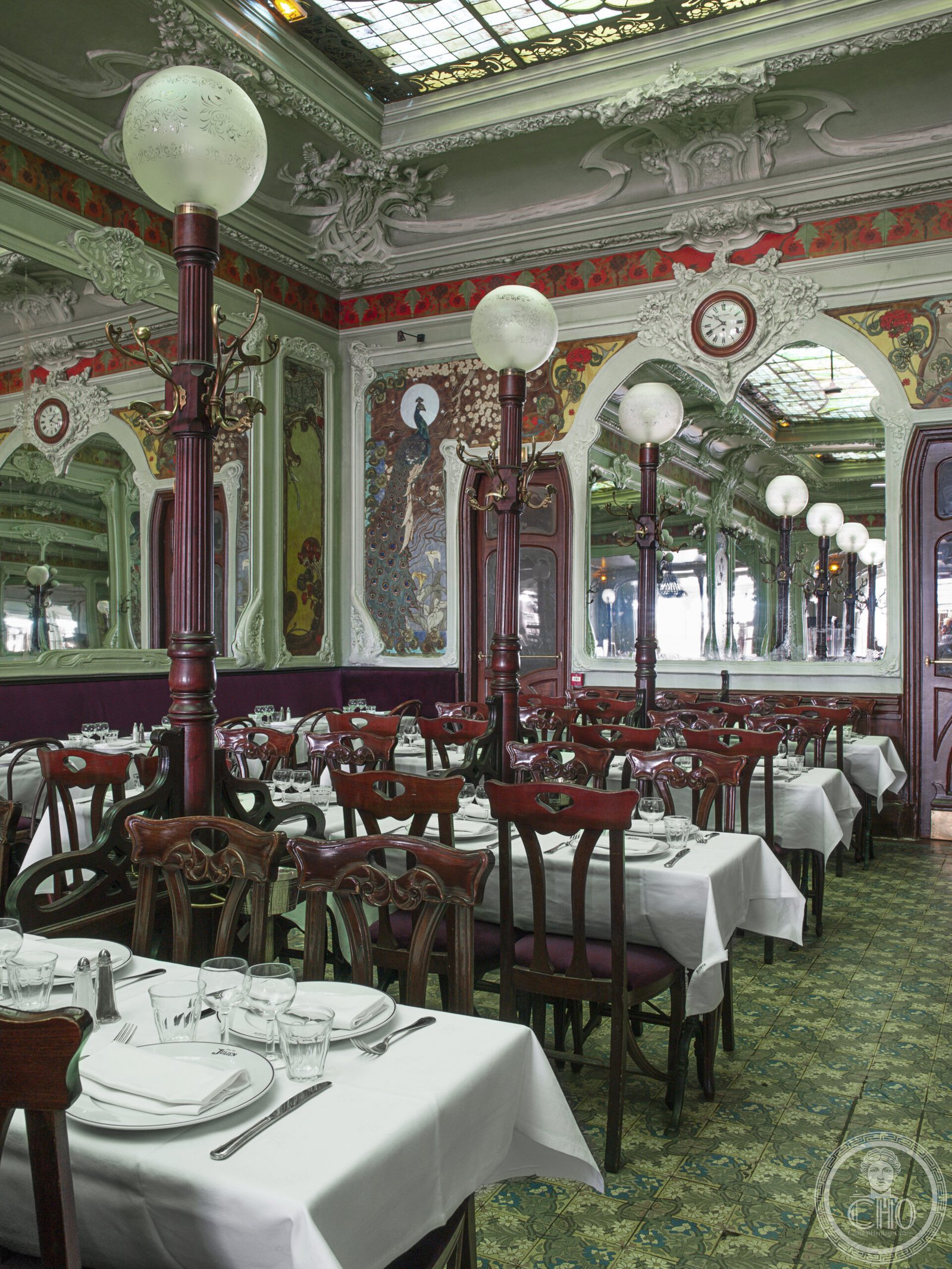
Bouillon Julien on the Rue du Faubourg Saint-Denis is one of the most intact Art Nouveau restaurant interiors in Paris. Built between 1901 and 1903 by architect Édouard Fournier, its dining room combines mahogany bar furniture by Louis Majorelle, ceramic floors by Boulenger, and Mucha-inspired glass panels by Louis Trézel, Armand Ségaud, and Charles Buffet. Classified as a Monument Historique in 1997, the restaurant was meticulously restored in 2018 and today operates as a classic Parisian bouillon serving affordable French cuisine beneath an extraordinary decorative canopy.
Architecture
Édouard Fournier designed the interior as a complete Art Nouveau environment. The façade on the Rue du Faubourg Saint-Denis features elaborate ironwork and stained-glass transoms. Inside, sinuous wooden panelling frames tall stained-glass panels inspired by the Mucha poster aesthetic. A mahogany bar by the Majorelle workshops occupies one wall; geometric ceramic floor tiles by Boulenger cover the ground plane; and the ceiling is divided into plasterwork compartments with organic floral decoration — all surviving virtually unaltered since 1903.
History
The bouillon format — affordable, fast, communal dining — was the fast food of Belle Époque Paris. Julien opened in the workers quarter of the 10th arrondissement during the city architectural boom that preceded the 1900 World Exhibition. Its investors hired the best Art Nouveau craftsmen available, treating the Faubourg Saint-Denis neighbourhood to the same decorative standard as the grand boulevards. Classified in 1997 and closed for years, it was restored and reopened in 2018 by the group Les Grandes Brasseries de l'Est, to wide acclaim.
Interior
The dining room is a complete Belle Époque environment. Tall stained-glass panels by Louis Trézel — their imagery rooted in the Mucha decorative tradition — divide the room into luminous bays. Majorelle mahogany furniture, including banquettes and the central bar, survives intact. Boulenger ceramic tiles carpet the floor in geometric patterns. Mirrored panels multiply the decorative surfaces, while plasterwork vines and flowers trail across the ceiling. The 2018 restoration stripped decades of grime and repainted the plasterwork to the original colour scheme, recovering the full chromatic richness of the room.
Visiting
Bouillon Julien is open daily for lunch and dinner. No reservation is required; the format is first come, first served, in the true bouillon tradition. Prices are remarkably low for central Paris. The restaurant is at its most atmospheric in the evening when the stained glass glows from within.
Getting There
Address: 16 rue du Faubourg Saint-Denis, 75010 Paris, France. Métro Strasbourg-Saint-Denis (lines 4, 8, 9) is a two-minute walk. Gare du Nord and Gare de l'Est are both within ten minutes on foot.
In the Area
The Faubourg Saint-Denis is rich in Belle Époque commercial architecture. The covered Passage Brady is one block north. Brasserie Flo, another surviving Art Nouveau interior, is on the nearby Cour des Petites Écuries. The Canal Saint-Martin neighbourhood begins a short walk east.
Find it on the map
See this place and what’s around it →📷 Become a Cultural Heritage Online photographer
Share your photos of places: they stay published under your name as the author. The more they're seen, the more you get noticed — and soon a contest will reward the most appreciated photos.
Log in or sign up free to add a photo