
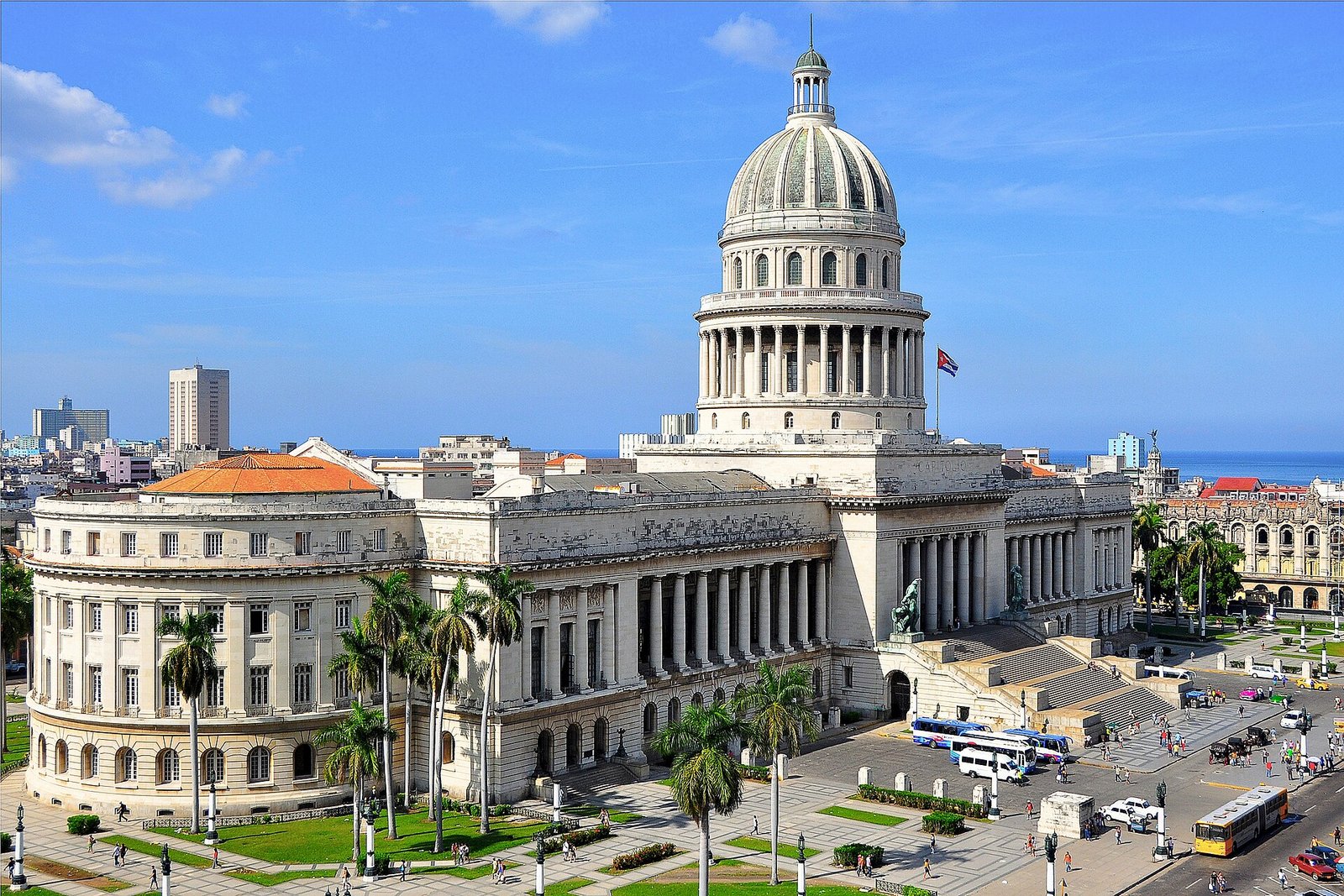
Rising above the rooftops of Old Havana, the National Capitol of Cuba is one of the most imposing public buildings in the Caribbean. Completed in 1929 after just over three years of construction involving more than five thousand workers, El Capitolio was conceived as a monument to Cuban sovereignty and republican ambition. Its 92-metre dome was inspired by the Pantheon in Paris and Bramante’s Tempietto in Rome, while the overall composition draws on the vocabulary of Washington’s Capitol and French Beaux-Arts planning. At the building’s geographical heart, embedded in the floor of the Salon de los Pasos Perdidos, a 25-carat diamond marks Kilometre Zero of Cuba’s national highway network. Today El Capitolio houses the National Assembly of People’s Power and stands as one of Havana’s defining landmarks.
At a glance
- Type
- Public building / former legislature
- Period
- 1926–1929
- Style
- Neoclassical / Beaux-Arts
- Location
- Paseo del Prado, Old Havana, Cuba
- Coordinates
- 23.14° N, 82.36° W
- Architect(s)
- Eugenio Rayneri Piedra
Overview
El Capitolio occupies a commanding position at the edge of Old Havana, its gleaming white dome visible from across the city. Measuring 207 metres long and 91 metres wide, the building was the largest and most expensive construction project in Cuban history when completed. Commissioned by President Gerardo Machado as a symbol of the republic’s modernity and ambition, it served as the seat of the Cuban Congress until the 1959 Revolution, after which it housed the Academy of Sciences. A meticulous restoration campaign completed in 2019 returned the building to its original splendour and current function as seat of the National Assembly.
History
Construction began in 1926 under President Gerardo Machado, who sought to project an image of national progress. The project was completed in exactly three years, three months, and twenty days at a cost of approximately 17 million US dollars. During the republican era the building functioned as the beating heart of Cuban legislative life. After Fidel Castro’s revolution in 1959, the Congress was dissolved and the Capitolio repurposed as headquarters of the Academy of Sciences of Cuba. Decades of deferred maintenance took a toll, but a major restoration programme began in 2013 and was substantially complete by 2019, restoring gilded interiors and the iconic dome and returning the building to use as seat of the National Assembly.
Architecture & Design
The building’s silhouette is dominated by its steel-framed dome, clad in stone and rising nearly 92 metres, the tallest structure in Havana until 1956. The dome’s profile was drawn from the Pantheon in Paris, filtered through Bramante’s Tempietto in Rome. Inside, the Salon de los Pasos Perdidos is a vast hall lined with bronze lamps and marble floors. Its centrepiece is the Statue of the Republic, a 15-metre bronze figure by Angelo Zanelli covered in 22-carat gold leaf and weighing 49 tonnes, the third-largest indoor statue in the world. Set into the floor of the same hall is the famous 25-carat diamond marking Kilometre Zero, stolen in 1946 and mysteriously returned two years later.
Cultural significance
El Capitolio is the architectural symbol of Cuban national identity, as recognisable internationally as the Malecon or the colonial plazas of Old Havana. Its construction marked Cuba’s ambition to rank among the great republics of the Americas, and its survival through revolution, Cold War isolation, and economic crisis speaks to its enduring importance. The building anchors Havana’s urban fabric and draws hundreds of thousands of visitors annually as part of the UNESCO World Heritage Site designation of Old Havana.
Visiting today
El Capitolio is open to visitors most days, with guided tours available through the ground floor and the Salon de los Pasos Perdidos. The dome can be viewed from the exterior terrace. Entrance fees apply and are payable in Cuban pesos. Photography is permitted in public areas. The building is best approached on foot from Parque Central or the Paseo del Prado promenade.
Getting there
El Capitolio sits on Paseo del Prado at the junction with Brasil Street in Central Havana, a short walk from Parque Central. Classic 1950s taxis and coco-taxis serve the area; the nearest bus stops are on Neptuno and San Martin streets. The building is within easy walking distance of most Old Havana hotels and the ferry terminal on the harbour.
Sources & resources
Do you know more?
On this page we have published what we were able to verify. If you know El Capitolio, Havana first-hand — you work there, have studied it, or remember how it used to be — and can add a detail, a date, a story or an old photograph, write to Sofia, who looks after these pages. Photographs of the place are welcome too: you can send them with the form at the bottom of this page.
Write to Sofia
or send a message on WhatsApp
Please start your message with the title of this page, so it reaches the right file. Every contribution is checked against independent sources before it goes on the page, and we always say where a piece of information came from.
Find it on the map
See this place and what’s around it →📷 Become a Cultural Heritage Online photographer
Share your photos of places: they stay published under your name as the author. The more they're seen, the more you get noticed — and soon a contest will reward the most appreciated photos.
Log in or sign up free to add a photoIs this page about you?
This page is read by travellers and heritage enthusiasts who find it on Google. Tell us how you are connected to this place and we will take it from there.