
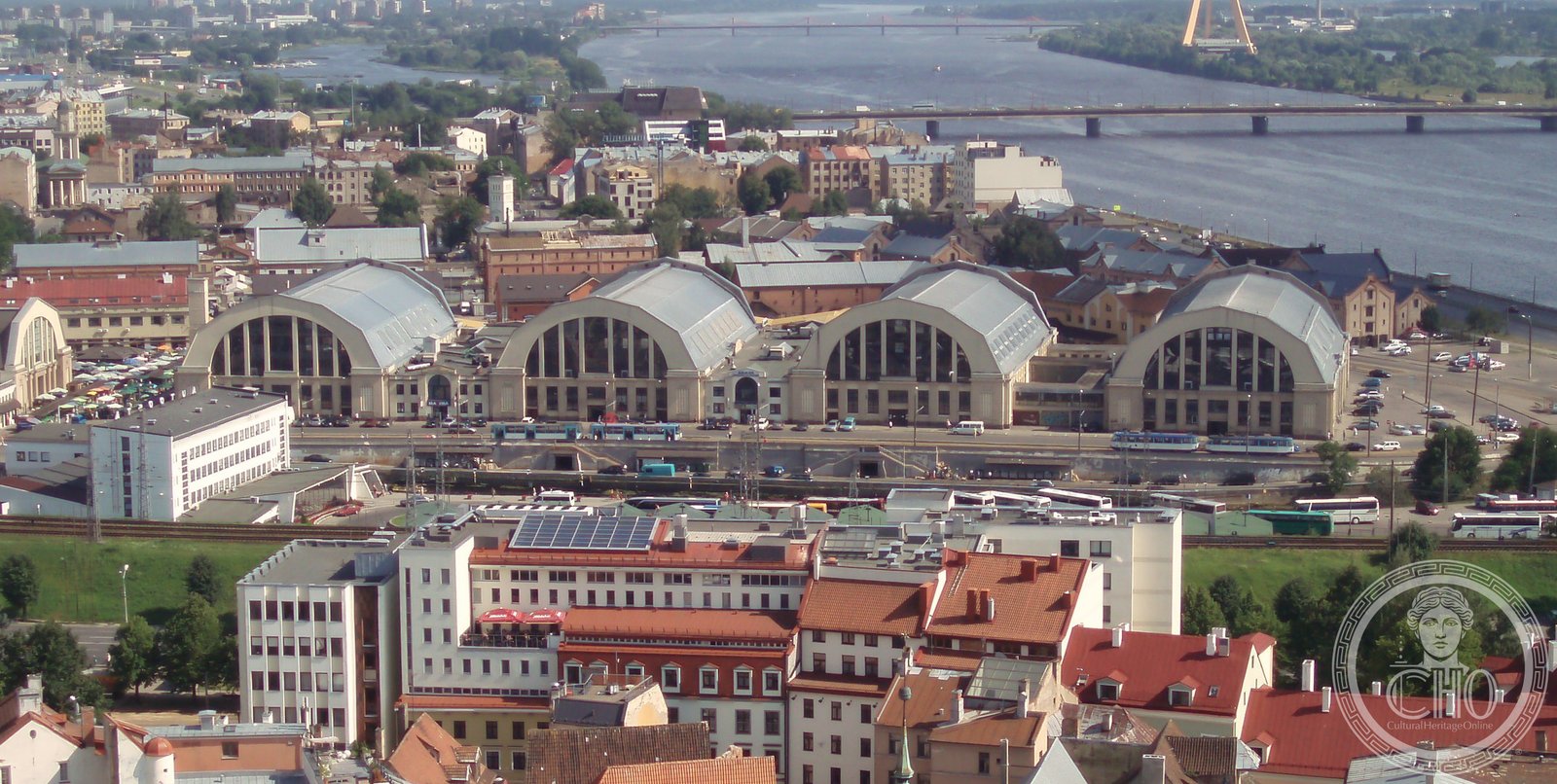
Riga Central Market is one of the most extraordinary market complexes in Europe and one of the most inventive acts of architectural reuse of the twentieth century. Built between 1924 and 1930, it repurposes five enormous German Zeppelin hangars left behind after the First World War, encasing them within facades that blend Neoclassical order with Art Deco ornament and Baltic Functionalist rigour. At over 72,000 square metres, it was the largest market in Europe at the time of its inauguration, a fact that spoke directly to the ambitions of the newly independent Latvian Republic. Today the market is a UNESCO World Heritage Site as part of the Historic Centre of Riga, and remains a living institution at the intersection of the city’s old town and its residential districts. Thousands of vendors sell produce, fish, meat, dairy, and goods under the vast barrel-vaulted roofs every day.
At a glance
- Type
- Market / Bazaar
- Period
- Planned 1922, built 1924–1930
- Style
- Art Deco / Baltic Functionalism / Neoclassicism
- Location
- Negu iela 7, Riga, Latvia
- Coordinates
- 56.944° N, 24.115° E
- Architect(s)
- Pavils Dreijmanis (lead); Zeppelin hangars repurposed
Overview
Riga Central Market occupies a singular place in European market architecture. Five Zeppelin hangars, originally built at Vainodes airfield, were dismantled and transported to Riga after the First World War, where architects adapted them into the main pavilions of a vast new market. Each pavilion specialises in a different category of goods: meat, fish, dairy, vegetables, gastronomy. Together they serve tens of thousands of customers daily. The market is owned by the Riga municipality and remains, nearly a century after its completion, the commercial and social hub of a large section of the city’s population.
History
Planning for a new central market began in 1922, shortly after Latvia gained independence following the First World War and the subsequent War of Independence. The decision to recycle the Zeppelin hangars was as much pragmatic as visionary: they offered vast clear-span enclosures that no new construction budget could have produced. Construction ran from 1924 to 1930, with the market inaugurated in a ceremony that celebrated both the facility and the young Latvian state’s capacity for modern infrastructure. The market survived Soviet occupation and continued operating throughout the post-war decades, becoming an integral part of Riga’s urban identity. Its UNESCO inscription in 1998 as part of the Historic Centre of Riga brought international recognition.
Architecture & Design
The five pavilions are among the largest market structures in Europe, their barrel-vaulted Zeppelin-hangar roofs spanning up to 80 metres without intermediate support. The facades added to these industrial shells are a confident synthesis of styles: Neoclassical pilasters and cornices frame arched entrances, while Art Deco detailing in tile, metalwork, and carved stone gives each pavilion a distinct character. The Latvian state wished the complex to project modernity and civic ambition, and the architects achieved this by domesticating the industrial scale of the hangars with a layer of ornamental refinement. The outdoor stalls and surrounding shed market add another layer of texture, creating a gradient from monumental indoor halls to the informal street trade beyond.
Cultural significance
Riga Central Market is one of the defining monuments of interwar Baltic architecture, a project that demonstrated the creative potential of adaptive reuse on a grand scale decades before the term entered the architectural vocabulary. For Latvia, it was also a political statement: a young republic claiming its modernity through an infrastructure project of European ambition. Its UNESCO listing confirms its status as an irreplaceable element of the city’s cultural heritage, while its continued daily operation as a working market ensures it remains embedded in the life of the city rather than preserved as a museum piece.
Visiting today
Riga Central Market is open daily from early morning until late afternoon, with some pavilions closing earlier; hours vary by season. Entry is free. The market is best visited in the morning when produce is fresh and the atmosphere is liveliest. Each of the five pavilions offers different goods, and the outdoor sections around the main halls extend the experience into surrounding streets. The market also houses cafes and cooked-food stalls where visitors can eat alongside local shoppers.
Getting there
Riga Central Market is located a ten-minute walk from Riga Old Town and directly adjacent to Riga International Bus Station and Riga Central Station. Trams and trolleybuses stop immediately outside. From Riga International Airport, the X36 express bus connects to the city centre in approximately 30 minutes, with onward connections by foot or tram to the market.
Sources & resources
Find it on the map
See this place and what’s around it →📷 Become a Cultural Heritage Online photographer
Share your photos of places: they stay published under your name as the author. The more they're seen, the more you get noticed — and soon a contest will reward the most appreciated photos.
Log in or sign up free to add a photoIs this page about you?
This page is read by travellers and heritage enthusiasts who find it on Google. Tell us how you are connected to this place and we will take it from there.