
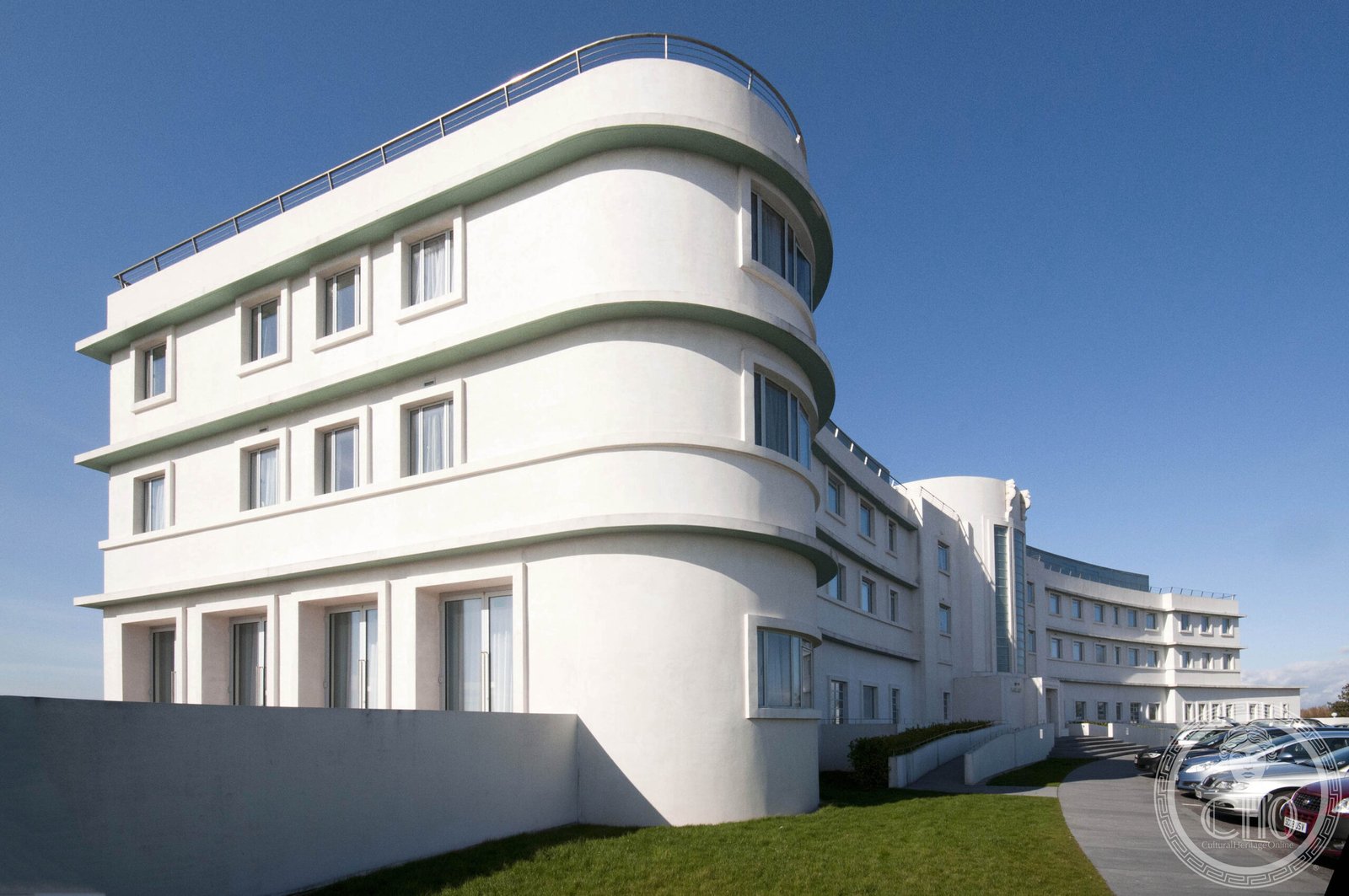
Curving elegantly along the seafront promenade of Morecambe Bay, the Midland Hotel is one of England’s most celebrated examples of Streamline Moderne architecture and a defining landmark of the interwar Art Deco movement in Britain. Commissioned by the London, Midland and Scottish Railway and designed by Oliver Hill, the hotel opened in July 1933 as a gleaming symbol of modernity and leisure, its sweeping white concrete form and circular entrance tower perfectly complementing the broad arc of Morecambe Bay. Adorned with sculptures by the eminent artist Eric Gill and originally graced with murals by Eric Ravilious — painted over during the Second World War — the building brought high art into the seaside hotel. After years of decline and near-dereliction, a meticulous restoration completed in 2008 returned the Midland to its former brilliance. Managed today by English Lakes Hotels, it remains a Grade II* listed building and one of the great architectural treasures of the north of England.
At a glance
- Type
- Hotel
- Period
- 1933 (restored 2006–2008)
- Style
- Streamline Moderne / Art Deco
- Location
- Marine Road West, Morecambe, Lancashire, England
- Coordinates
- 54.0721° N, 2.8754° W
- Architect(s)
- Oliver Hill (original); Union North (restoration)
Overview
The Midland Hotel stands on Morecambe’s seafront as a supreme example of what the Streamline Moderne tendency within Art Deco could achieve at its most refined. Its three-storey curved body, flat roof, horizontal banding, and dramatic circular entrance tower projecting over the promenade embody the movement’s love of speed, modernity, and organic form. Unlike many Art Deco buildings that rely primarily on surface ornament, the Midland derives much of its power from the sculptural quality of the building mass itself. The integration of fine art — Eric Gill’s relief sculptures of Triton and a sea serpent on the facade, and seahorse panels in the entrance — elevates it beyond a mere hotel into a complete aesthetic statement. The panoramic views across Morecambe Bay to the Lake District fells add a natural grandeur to the setting.
History
The Midland Hotel replaced two earlier railway establishments on the site: the North Western Hotel, built in 1848 and renamed the Midland in 1871, and the Heysham Towers, converted in 1896. The London, Midland and Scottish Railway commissioned Oliver Hill to design an entirely new building, which opened in July 1933. During the Second World War the hotel served as the hospital for RAF Morecambe from February 1940, treating thousands of service personnel; Eric Ravilious’s decorative murals were painted over at this time. Following railway nationalisation the British Transport Commission sold the hotel in 1952, and it passed through several owners during subsequent decades, suffering periods of neglect. A restoration programme began in 2006, and the hotel reopened in 2008 under the management of English Lakes Hotels, with the Gill sculptures carefully conserved.
Architecture & Design
Oliver Hill’s design for the Midland Hotel is a masterpiece of Streamline Moderne, the variant of Art Deco that drew inspiration from aerodynamic forms and industrial engineering. The main building sweeps in a gentle curve to follow the seafront promenade, its white rendered surfaces articulated by continuous horizontal window bands and a flat roofline that emphasises the horizontal. The centrepiece is a cylindrical entrance tower housing the lobby and a circular staircase, its form both sculpturally bold and functionally elegant. Eric Gill contributed two large relief sculptures to the exterior — a figure of Triton and a sea serpent — as well as a series of seahorse decorations within the entrance hall. The 2008 restoration was guided by historic photographs and surviving fabric to recover as much of Hill’s original vision as possible.
Cultural significance
The Midland Hotel holds a cherished place in British cultural memory both as an architectural landmark and as an emblem of the golden age of railway travel and seaside tourism. Its association with Eric Gill — one of the most important British artists of the twentieth century — and with Eric Ravilious, whose wartime-obscured murals remain a source of fascination, gives it a particular resonance in art history. The hotel appeared in the 1960 film The Entertainer, starring Laurence Olivier, and in episodes of Agatha Christie’s Poirot. Its Grade II* listing and its successful restoration have made it a reference point for debates about the conservation and regeneration of significant modernist buildings in seaside towns.
Visiting today
The Midland Hotel is fully operational as a four-star hotel, and non-residents are welcome to visit the bar, restaurant, and public areas. Afternoon tea with views across Morecambe Bay is a popular choice. The exterior sculptures by Eric Gill are freely visible from the promenade at all times. The hotel hosts regular events and is a popular venue for weddings and private functions. Booking well in advance is recommended for overnight stays, particularly during summer weekends.
Getting there
Morecambe railway station is approximately a ten-minute walk from the hotel, with regular services from Lancaster, which connects to the West Coast Main Line. By car, Morecambe is accessible via the M6 motorway (junction 34) and the A683. The seafront promenade is pedestrian-friendly, and the hotel is easily reached on foot from the town centre. Car parking is available in nearby public car parks on the seafront.
Sources & resources
Find it on the map
See this place and what’s around it →Record researched and written by Luigi De Marchi for Cultural Heritage Online, 2026.
📷 Become a Cultural Heritage Online photographer
Share your photos of places: they stay published under your name as the author. The more they're seen, the more you get noticed — and soon a contest will reward the most appreciated photos.
Log in or sign up free to add a photoIs this page about you?
This page is read by travellers and heritage enthusiasts who find it on Google. Tell us how you are connected to this place and we will take it from there.