
El Encanto was the largest and most celebrated department store in Cuba, occupying a commanding corner on the intersection of Galiano and San Rafael in the heart of Havana. Originally founded in 1888, the store was progressively transformed into a gleaming Art Deco showcase through a series of expansions and renovations in the 1930s and 1940s. With five retail floors, mirrored atria, and sumptuous display windows that drew Havana society from across the island, El Encanto embodied the aspirations of a prosperous mid-century Cuba. Its story ended abruptly on 13 April 1961, when an arson attack destroyed the building entirely, erasing one of Latin America's finest commercial landmarks.
At a glance
- Location
- Corner of Galiano and San Rafael, Centro Habana, Cuba
- Style
- Art Deco (commercial)
- Original construction
- 1888
- Art Deco renovation
- 1930s–1940s
- Floors
- Five retail storeys
- Function
- Department store
- Fate
- Destroyed by arson, 13 April 1961
- Current site
- Fe del Valle Park
Overview
El Encanto — “The Enchantment” — stood as Cuba's pre-eminent retail destination for over seven decades. Spread across five floors at the corner of Galiano and San Rafael in Centro Habana, it employed around 930 people and stocked goods ranging from haute couture to household appliances. International fashion houses maintained counters there, and the store's elegant tearoom and beauty salon made it a social hub for Havana's middle and upper classes. Nationalised in 1959 following the Cuban Revolution, El Encanto continued operating under state management until the April 1961 fire obliterated it, leaving only a park in its place.
History
Founded in 1888, El Encanto grew from a modest dry-goods shop into a full department store over the following decades. Successive Spanish and Cuban proprietors expanded the premises, and by the 1930s the store underwent a comprehensive overhaul in the fashionable Art Deco idiom, modernising its facade, entrance lobbies, and shop floors. The store thrived during the 1940s and 1950s, when Havana was one of the wealthiest cities in Latin America. After the 1959 Revolution the new government nationalised the business. Less than two years later, on the eve of the Bay of Pigs invasion, an operative named Carlos González Vidal planted incendiary devices in the tailoring department. The resulting fire killed supervisor Fe del Valle and injured eighteen others, gutting the building beyond repair. The site was later converted into a park named in her honour.
Architecture & Design
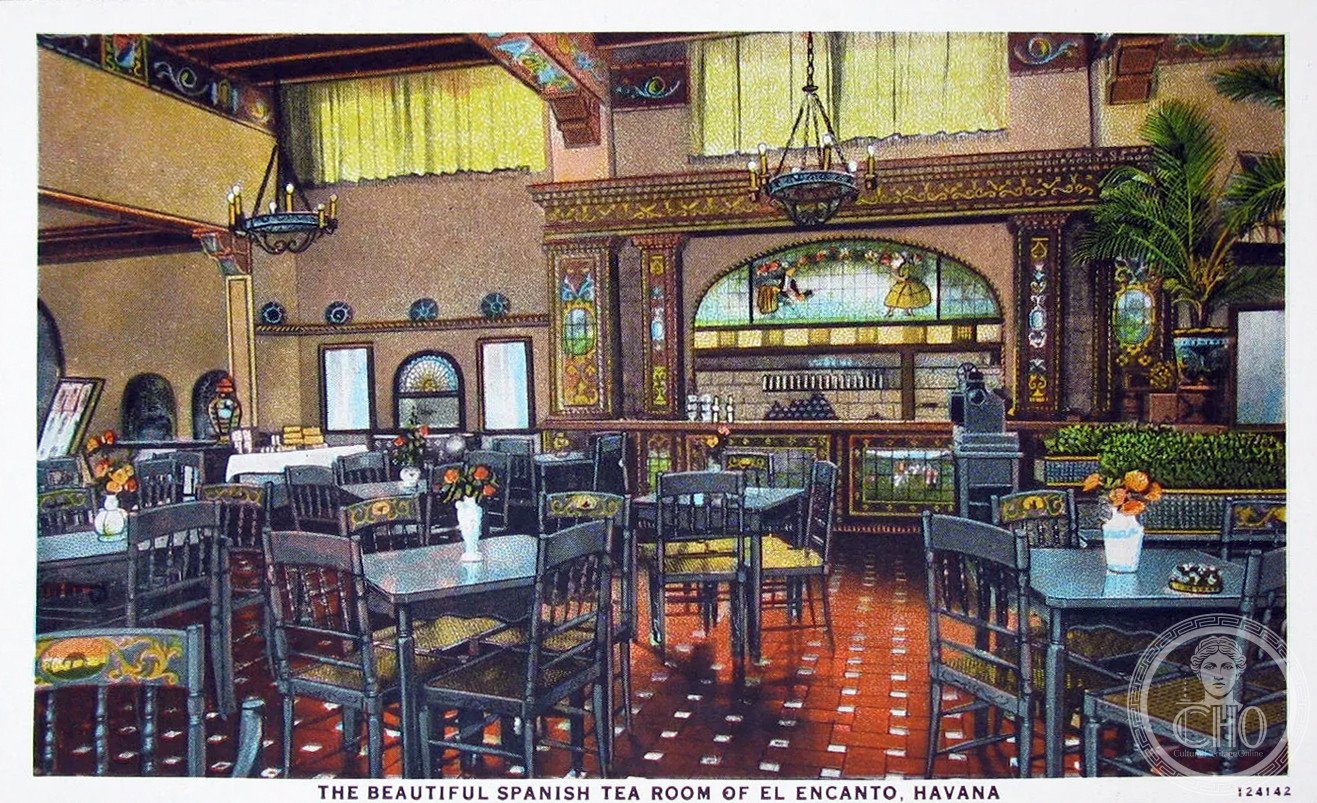
El Encanto's 1930s–1940s renovation reflected the streamlined Art Deco aesthetic that swept through Cuban commercial architecture during that era. The building's remodelled facade featured geometric terracotta ornament, bold cornices, and display windows framed in polished metal — hallmarks of the Deco style as applied to large-scale retail. Inside, the five-storey volume was organised around a central light well with chrome railings and terrazzo floors. Mirrored fitting rooms, patterned tile, and carefully proportioned display islands brought a sense of luxury that rivalled department stores in New York and Paris. The Spanish Tea Room on an upper floor, documented in period postcards, showed ornate tilework merged with Deco linearity — a synthesis characteristic of Cuban commercial interiors of the period.
Cultural significance
El Encanto occupied a central place in Cuban cultural memory long after its destruction. For many Cubans of the pre-revolutionary generation it represented a lost world of cosmopolitan aspiration — an island metropolis capable of hosting a shopping experience that matched any in the Americas. Its destruction, widely attributed to CIA-linked operatives in the context of the Cold War, transformed the store into a symbol of loss and political conflict that resonated for decades. Today the park that marks its site, named for Fe del Valle — the sole fatality — stands as a quiet memorial to both the building and the woman who died there.
Visiting today
El Encanto no longer exists as a physical structure. Its former footprint at the corner of Galiano and San Rafael is occupied by Fe del Valle Park, a modest green space in Centro Habana. The surrounding pedestrian stretch of Calle Galiano — once Havana's premier shopping boulevard — still retains several Deco-era commercial facades that offer a sense of what the streetscape looked like during the store's heyday. Local guided tours of Art Deco Havana occasionally include the site as a point of historical commentary.
Getting there
The former El Encanto site sits on the corner of Calle Galiano (Avenida de Italia) and Calle San Rafael in Centro Habana, easily walkable from the Parque Central and the Prado. The nearest bus routes along Galiano serve the Centro Habana district from across the city. The Habana Libre hotel (former Hilton) is one block north on Calle L, providing a useful orientation landmark. Walking from Old Havana takes approximately fifteen to twenty minutes along San Rafael.
Sources & resources
Find it on the map
See this place and what’s around it →📷 Become a Cultural Heritage Online photographer
Share your photos of places: they stay published under your name as the author. The more they're seen, the more you get noticed — and soon a contest will reward the most appreciated photos.
Log in or sign up free to add a photoDo you manage this place?
This page is read by travellers and heritage enthusiasts who find it on Google. Keep it accurate — and make it work for you. Free for non-profit heritage institutions.