
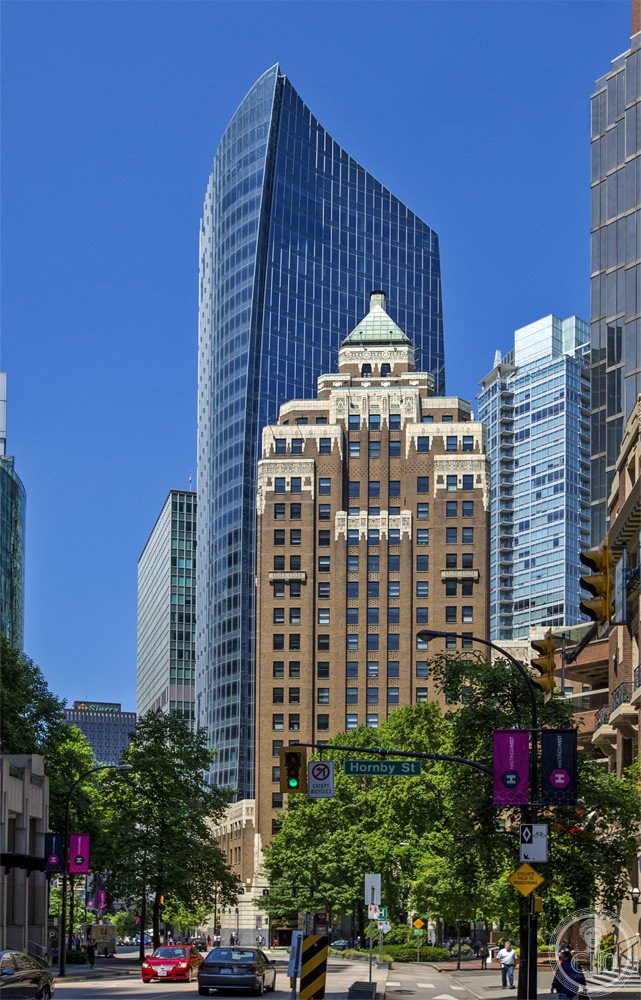
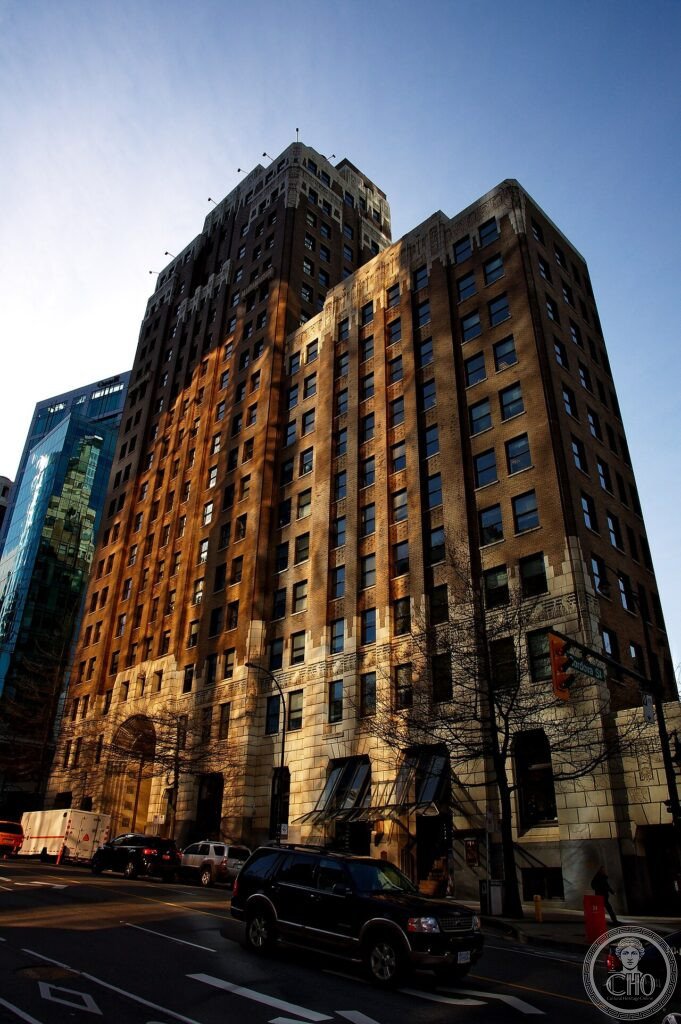
The Marine Building at 355 Burrard Street in downtown Vancouver is one of Canada’s finest examples of Art Déco architecture, standing among the most celebrated skyscrapers of its era anywhere in the world. Completed in October 1930 and rising 97.8 metres across 22 storeys, it was conceived as a tribute to Vancouver’s maritime heritage and commercial ambitions following the opening of the Panama Canal. Designed by McCarter Nairne and Partners, the tower was envisioned as a great sea crag adorned with tidal creatures, navigational symbols, and ocean flora — a building whose ornamental programme was as much poem as architecture. Commissioned by entrepreneur J.W. Hobbs and constructed at a cost of $2.3 million, it was Vancouver’s tallest structure until 1939 and remains one of the city’s most admired landmarks, widely cited by architectural historians as among the greatest Art Déco towers in the world.
At a glance
- Type
- Commercial skyscraper
- Period
- 1929–1930
- Style
- Art Déco
- Location
- 355 Burrard Street, Downtown Vancouver, British Columbia, Canada
- Coordinates
- 49.2875° N, 123.1169° W
- Architect(s)
- McCarter Nairne and Partners
Overview
Rising 97.8 metres above the Coal Harbour waterfront, the Marine Building is a 22-storey Art Déco tower that blends commercial ambition with an extraordinarily rich decorative vocabulary drawn entirely from the sea. Built at a cost of $2.3 million — considerably over its original budget — it opened in October 1930 just as the Great Depression tightened its grip on North American economies. Despite this inauspicious timing, the building endured and became a beloved civic landmark. It held the title of Vancouver’s tallest structure until 1939 and remains, nearly a century on, one of the city’s most admired buildings. Its architects drew inspiration partly from the Chrysler Building then rising in New York, and sought to create a monument of comparable ambition for Canada’s Pacific gateway city.
History
The Marine Building was commissioned by Toronto entrepreneur Lt. Commander J.W. Hobbs, who recognised that the 1914 opening of the Panama Canal had positioned Vancouver as a pivotal Pacific trade hub. Construction began on 13 March 1929, just months before the Wall Street crash. When completed in October 1930, its $2.3 million cost — $1.1 million over budget — proved impossible to recoup in Depression-era Vancouver, and the property was sold to the Irish Guinness family for just $900,000. Renovations between 1982 and 1989 updated building systems while restoring key interior features. The building later served as the management centre for the Oneworld airline alliance from May 2000 until June 2011, when that office relocated to New York City. Its 2023 assessed value reached $153 million, reflecting its enduring prestige.
Architecture & Design
McCarter Nairne and Partners conceived the Marine Building as a structure evoking, in their own words, “some great crag rising from the sea, clinging with sea flora and fauna, tinted in sea-green, touched with gold.” The exterior is encrusted with terracotta reliefs depicting seahorses, crabs, turtles, scallops, seaweed, and navigational imagery including zeppelins and period transport vessels — a marine-themed decorative programme of exceptional richness. The lobby features elevator walls inlaid with twelve varieties of local hardwood, and brass door panels adorned with further sea creatures. Zodiac signs were originally rendered on elevator floors, and the entrance once featured battleship linoleum imported from Scotland, later replaced with marble during the 1980s renovation. The building is regarded by architectural critics as one of the finest Art Déco structures in the world.
Cultural significance
The Marine Building occupies a singular place in Vancouver’s architectural identity, representing the moment the city sought to announce itself through monumental design. It has appeared in numerous film and television productions, including standing in for the Daily Planet in the TV series Smallville, and featuring in Blade: Trinity, both Fantastic Four films (2005 and 2007), the Netflix series Altered Carbon, and the finale of Timecop. Beyond popular culture, the building is cited by architectural historians as among the finest Art Déco towers on earth, drawing visitors and scholars from around the world. Its survival and careful stewardship across nearly a century make it a rare example of an early-twentieth-century commercial tower preserved largely in its original form.
Visiting today
The Marine Building remains an active office tower and is not generally open to public tours, but visitors may freely enter the spectacular lobby during business hours to admire its hardwood-inlaid elevator doors, brass sea-creature relief panels, and Art Déco detailing. The exterior is accessible at all times and best appreciated on foot along Burrard Street. The Coal Harbour waterfront promenade nearby offers excellent views of the building’s upper facades and marine-themed terracotta cladding. No admission is charged for lobby access, making this one of Vancouver’s most rewarding architectural stops.
Getting there
The Marine Building is located at 355 Burrard Street in downtown Vancouver, a short walk from Burrard SkyTrain Station on the Expo and Millennium Lines. Several TransLink bus routes serve Burrard Street directly. Waterfront Station, connecting SkyTrain, West Coast Express commuter rail, and SeaBus ferry services, is also within easy walking distance. Street parking is limited in the area; paid parking garages are available in the surrounding Financial District.
Sources & resources
Gallery
Find it on the map
See this place and what’s around it →
Record researched and written by Luigi De Marchi for Cultural Heritage Online, 2026.
📷 Become a Cultural Heritage Online photographer
Share your photos of places: they stay published under your name as the author. The more they're seen, the more you get noticed — and soon a contest will reward the most appreciated photos.
Log in or sign up free to add a photoIs this page about you?
This page is read by travellers and heritage enthusiasts who find it on Google. Tell us how you are connected to this place and we will take it from there.