
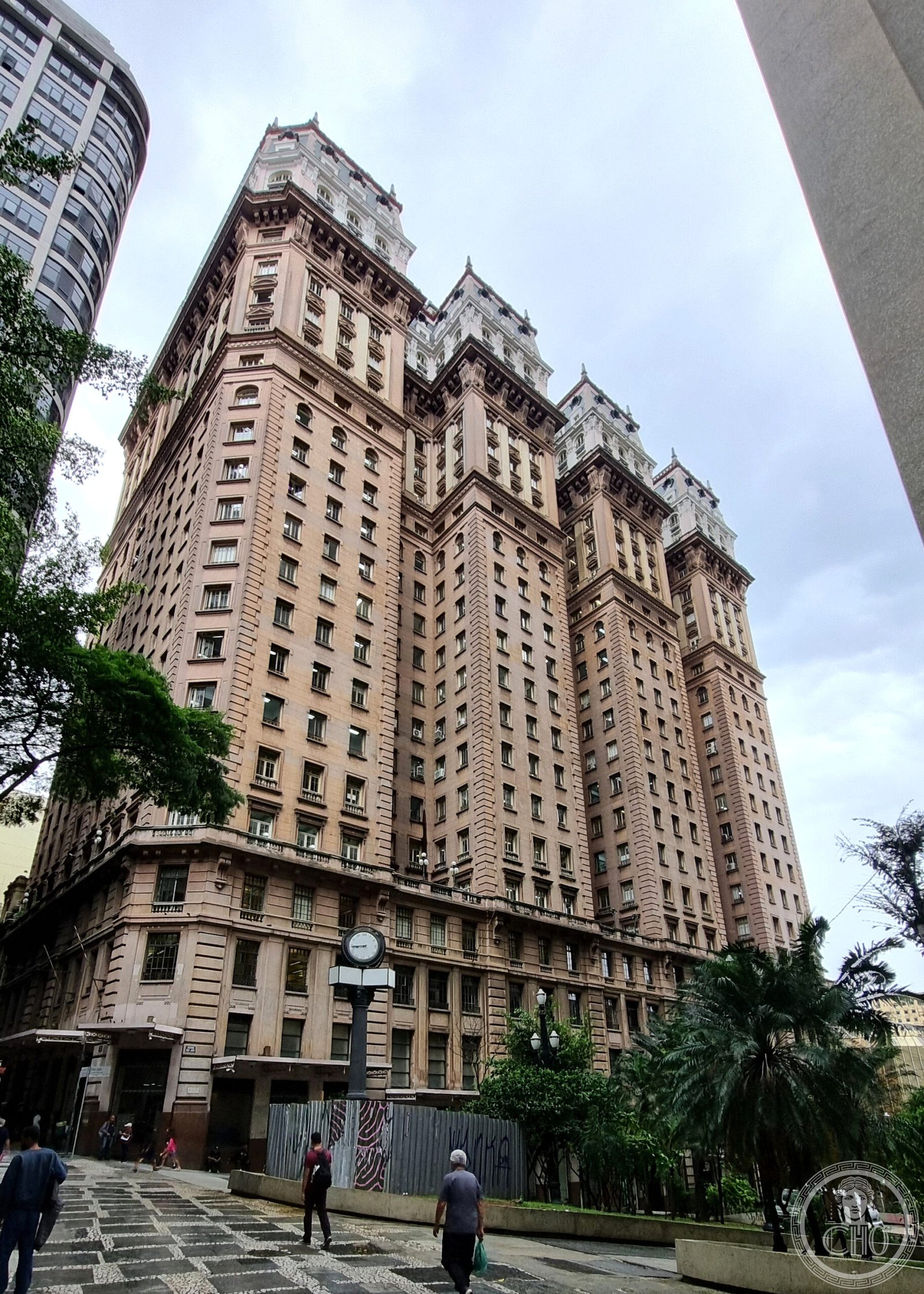
The Edifício Martinelli is a monumental Art Déco skyscraper in the heart of São Paulo’s historic centre, recognised as the first true skyscraper built in Brazil. Commissioned by Italian-born entrepreneur Giuseppe Martinelli and completed in 1929 to a design by architect Vilmos Fillinger, the 28-storey, 105-metre tower held the distinction of tallest building in Latin America from its inauguration until 1947, and at the time of its opening was also the largest concrete-framed structure in the world. Rising from the city’s central financial district, it embodied São Paulo’s explosive early-twentieth-century growth fuelled by coffee wealth and immigration. Today it houses municipal offices and a handful of commercial spaces, while its rooftop terrace offers a panoramic view over the sprawling metropolis below.
At a glance
- Type
- Mixed-use office and commercial skyscraper
- Period
- 1924–1929 (construction)
- Style
- Art Déco
- Location
- Rua Líbero Badaró, Centro, São Paulo, Brazil
- Coordinates
- 23.5456° S, 46.6352° W
- Architect(s)
- Vilmos (William) Fillinger
Overview
Standing 105 metres tall across 28 floors, the Martinelli Building dominates the skyline of central São Paulo in a way that still commands attention nearly a century after its completion. The project was conceived by Giuseppe Martinelli — an Italian immigrant who had made a fortune in São Paulo — as a statement of personal ambition and civic pride. Designed by Hungarian-born architect Vilmos Fillinger, the structure broke ground in 1924 and opened in 1929. At that moment it was the tallest building in Latin America, a title it held until 1947, and the largest reinforced-concrete-framed building anywhere in the world — a remarkable engineering achievement for its era.
History
Giuseppe Martinelli arrived in São Paulo from Italy and built a commercial empire through the early decades of the twentieth century. His decision to erect a record-breaking skyscraper was both a business venture and a personal monument. Construction began in 1924, and the formal planning had been set down in 1922. The building opened in 1929 — the same year as the global financial crash — yet it survived and functioned continuously. Its tallest-in-Latin-America status lasted until 1947 when it was surpassed. A major remodelling programme carried out between 1975 and 1979, during the administration of Mayor Olavo Setúbal, modernised its interiors while preserving the landmark exterior. The building was subsequently handed over to house municipal departments including Housing and Planning, Emurb, and Cohab-SP.
Architecture & Design
Fillinger’s design draws on the decorative and compositional vocabulary of Art Déco, with a stepped massing that tapers toward a distinctive rooftop crown — a silhouette immediately recognisable across the São Paulo skyline. The reinforced-concrete structure was a feat of early-twentieth-century engineering, requiring construction techniques and a material scale not previously attempted in Brazil. Ornamental details in terracotta and stone punctuate the façade, balancing the tower’s vertical thrust with horizontal banding at key floors. The rooftop level was designed to function as a belvedere and has historically been open to visitors, providing an unobstructed panorama of the city spreading in every direction.
Cultural significance
The Martinelli Building is inseparable from São Paulo’s identity as a city of ambition, reinvention, and immigrant energy. It represents the moment when São Paulo announced its arrival as a major world metropolis, projecting its aspirations in steel, concrete, and Art Déco ornament. The building stands as physical evidence of the coffee-era economic boom that transformed São Paulo from a provincial town into a continental powerhouse in barely three decades. For the descendants of European and Middle Eastern immigrants who populated the city’s early-twentieth-century growth, the Martinelli remains a landmark of collective memory. Its current role housing municipal services ensures it remains active at the heart of the city’s civic life.
Visiting today
The Martinelli Building is listed as a tourist attraction in São Paulo. Its ground-floor spaces include commercial tenants, and upper floors house municipal offices. The rooftop terrace is periodically open to the public and offers one of the best panoramic views over São Paulo’s historic centre — the occasion is particularly popular during heritage open days. The building has an official website with visiting information in Portuguese. Access to the upper floors and roof is typically arranged through guided visits or special cultural events organised by the municipal government.
Getting there
The building is located in São Paulo’s Centro district, within easy walking distance of several Metro stations. São Bento station on Line 3-Red is the closest, lying just a few minutes on foot. Anhangabaú station on Line 3-Red and Praça da Sé station, where Lines 1-Blue and 3-Red intersect, are also nearby. Extensive bus routes converge on the central area from all parts of the city. The surrounding neighbourhood is a historic walking district with many early-twentieth-century buildings, civic institutions, and cultural landmarks.
Sources & resources
Find it on the map
See this place and what’s around it →Record researched and written by Luigi De Marchi for Cultural Heritage Online, 2026.
📷 Become a Cultural Heritage Online photographer
Share your photos of places: they stay published under your name as the author. The more they're seen, the more you get noticed — and soon a contest will reward the most appreciated photos.
Log in or sign up free to add a photoIs this page about you?
This page is read by travellers and heritage enthusiasts who find it on Google. Tell us how you are connected to this place and we will take it from there.