

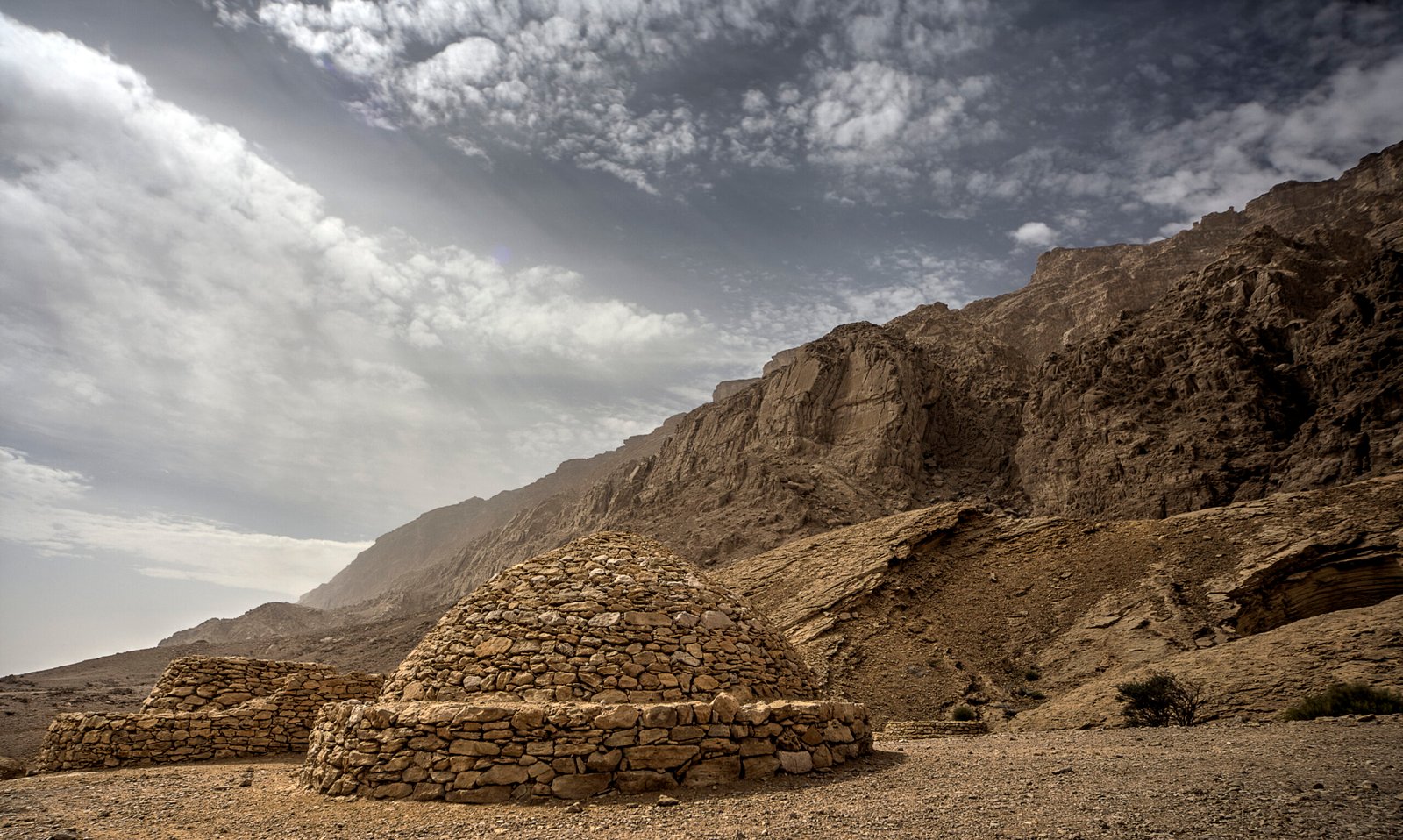
A desert oasis city where human settlement has endured without interruption for over 4,000 years — from Bronze Age beehive tombs and Umm al-Nar communal burial chambers to living date-palm gardens still watered by ancient falaj channels.
At a glance
The Cultural Sites of Al Ain (Hafit, Hili, Bidaa Bint Saud and Oases Areas) form a UNESCO World Heritage cluster in Abu Dhabi emirate, UAE, inscribed in 2011. The property documents one of the oldest known agricultural settlements in southeastern Arabia, shaped by the ingenuity of a Bronze Age people who engineered underground irrigation channels to sustain life in one of the harshest desert environments on Earth. Al Ain — “the spring” in Arabic — is also the birthplace of Sheikh Zayed bin Sultan Al Nahyan, the founding father of the United Arab Emirates.
Key facts
- UNESCO inscription: 2011, serial property
- Location: Al Ain, Abu Dhabi emirate, UAE (GPS: 24.2075°N, 55.7447°E)
- Component areas: Hafit (beehive tombs, c. 3200–2600 BCE), Hili (Umm al-Nar culture, c. 2500–2000 BCE), Bidaa Bint Saud (tomb landscape), Al Ain Oasis (living falaj gardens)
- Outstanding Universal Value: Exceptional continuity of human habitation from Bronze Age to present; earliest evidence of permanent architecture in southeastern Arabia; living falaj irrigation system
- Period of significance: c. 2500 BCE to present day
- Country: United Arab Emirates
History
The story of Al Ain begins around 3200–2600 BCE with the Hafit period — named for Jebel Hafeet, the prominent mountain that towers over the oasis. Here, Bronze Age communities erected hundreds of beehive-shaped stone tombs on the rocky hillsides, some of the oldest monumental funerary structures in southeastern Arabia. These small, corbelled chambers are found in clusters that suggest a settled, organised society capable of sustained collective effort.
By approximately 2500 BCE, the Umm al-Nar culture had developed at Hili, just north of modern Al Ain city. The Hili complex contains communal tombs with remarkable carved decorations — scenes of humans, animals, and geometric patterns — alongside evidence of permanent walled settlements with irrigated fields. Archaeological excavation has revealed connections to the Indus Valley civilisation and Mesopotamia through trade goods, indicating that Hili was integrated into the wider Bronze Age world.
The most transformative technology in Al Ain’s history is the falaj system — underground channels that tap the water table and direct it by gravity to the surface, without pumps, over distances of many kilometres. The falaj principle was known across the ancient Middle East, but Al Ain’s examples are among the oldest continuously functioning examples in the world. The Al Ain Oasis, sustained by these channels, has been cultivated without interruption from prehistory into the 21st century. Today some 147,000 date palms grow within the oasis boundaries, divided among traditional farm plots by low mud-brick walls that trace field boundaries unchanged over millennia.
Al Ain’s modern history is inseparable from Sheikh Zayed bin Sultan Al Nahyan (1918–2004), who was born in Al Ain and served as its governor before becoming the ruler of Abu Dhabi and then the first President of the UAE. His formative years in the oasis shaped his conviction that water, land, and heritage were the foundations of national identity.
What you see
The UNESCO property is a dispersed serial site — its components lie across a broad area of the Al Ain region and require transport between them. Each component offers a distinctly different encounter with the site’s layered past.
At Jebel Hafeet, some 500 beehive tombs dot the lower slopes of a 1,340-metre limestone mountain. The tombs are small corbelled stone chambers, each just large enough to shelter a single body with grave goods. From a distance they read as grey stone mounds punctuating the pale desert hillside; close up, the careful dry-stone construction reveals significant skill in circular walling without mortar.
The Hili Archaeological Park is the most visitor-ready component, with excavated and conserved remains of Bronze Age circular tombs whose facades bear some of the earliest narrative relief carvings found in the Arabian Peninsula. The Grand Tomb of Hili is partially reconstructed and open for close inspection.
The Al Ain Oasis is a living, working landscape — a 1,200-hectare expanse of date palms, fig trees, and cultivated plots in the heart of the city, criss-crossed by narrow irrigation channels that still carry water from the falaj system. The oasis is cool, shaded, and fragrant in a way that makes its contrast with the surrounding desert dramatic and immediate. Interpretive signage explains the falaj engineering and the crop varieties grown for centuries.
Practical information
- Entry: Al Ain Oasis is open daily and free to enter; Hili Archaeological Park has a nominal entrance fee; Jebel Hafeet access is free
- Hours: Al Ain Oasis open approximately 08:00–23:00 daily; Hili Park closed on Tuesdays
- Best time to visit: October to April (temperatures 20–30°C); summer temperatures exceed 40°C
- Photography: Permitted throughout; no restrictions at archaeological sites
- Dress code: Conservative attire recommended; shoulders and knees covered
- Visitor centre: Al Ain National Museum, adjacent to the oasis, provides essential archaeological context (closed Tuesdays)
Getting there
Al Ain lies approximately 160 km east of Abu Dhabi city and 120 km south-east of Dubai. The most convenient connection is by car or bus along well-maintained highways (Abu Dhabi E22 motorway, roughly 90 minutes; Dubai via E66, roughly 90–120 minutes). Etihad Bus operates regular daily services from Abu Dhabi Central Bus Station to Al Ain Bus Station. There is no rail link. Once in Al Ain, a hire car or taxi is recommended to visit the dispersed UNESCO components.
Nearby
The Al-Ahsa Oasis in Saudi Arabia (UNESCO WHS 2018) lies roughly 200 km north-west and is the world’s largest natural oasis. Bat, Al-Khutm and Al-Ayn in Oman (UNESCO WHS 1988) documents a closely related Bronze Age landscape with beehive tombs and towers just across the eastern frontier — together with Al Ain they form a coherent portrait of the Umm al-Nar culture across southeastern Arabia. In Al Ain itself, the 19th-century Al Jahili Fort is open to visitors and houses a permanent exhibition on explorer Wilfred Thesiger’s travels in Arabia.
Sources
- UNESCO World Heritage Centre — Cultural Sites of Al Ain: whc.unesco.org/en/list/1343
- Wikipedia — Al Ain: en.wikipedia.org/wiki/Al_Ain
- Department of Culture and Tourism, Abu Dhabi — Al Ain Oasis visitor information
- Potts, D.T. (1990). The Arabian Gulf in Antiquity. Oxford: Clarendon Press.
Find it on the map
See this place and what’s around it →📷 Become a Cultural Heritage Online photographer
Share your photos of places: they stay published under your name as the author. The more they're seen, the more you get noticed — and soon a contest will reward the most appreciated photos.
Log in or sign up free to add a photo