
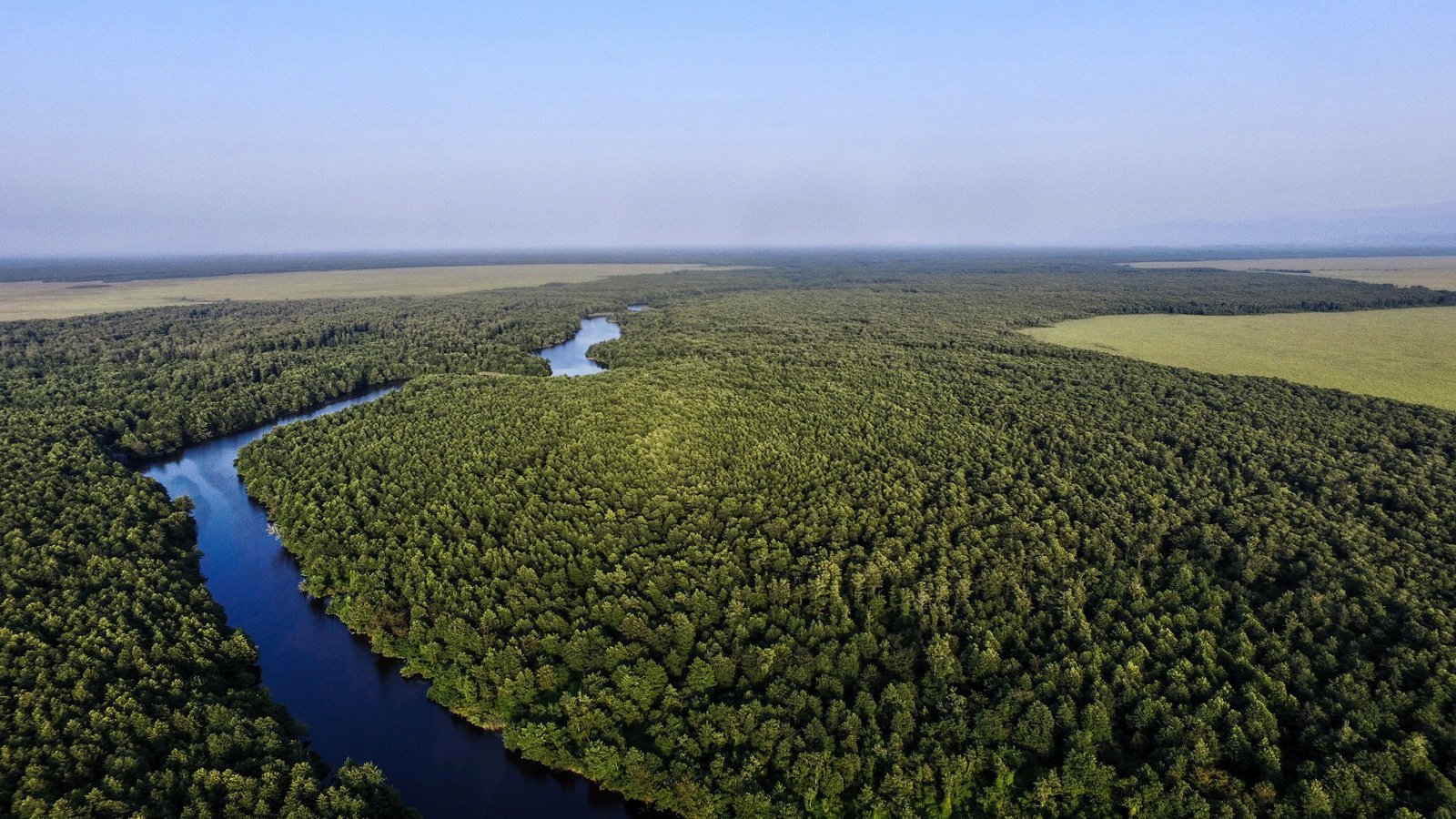
A glacial refugium on the Black Sea coast: the forests of ancient Colchis survived the Ice Ages when most of Europe’s subtropical woodland did not, preserving a living archive of plant life that vanished elsewhere 2.5 million years ago.
At a glance
The Colchic Rainforests and Wetlands of western Georgia represent the last significant remnants of the subtropical forests that once blanketed much of southern Europe before the Pleistocene glaciations. Growing in the river valleys and coastal lowlands of western Georgia — the ancient land of Colchis, where Greek mythology placed the Golden Fleece — and on the southern slopes of the Greater Caucasus, these forests were inscribed as a UNESCO World Heritage Site in 2021. A single hectare of Colchic forest may contain more than 50 tree species, a biodiversity density that dwarfs even the richest central European woodlands.
Key facts
- UNESCO inscription: 2021 (Natural World Heritage)
- Location: Ajara, Guria, Samegrelo, and Racha regions of western Georgia; southern slopes of the Greater Caucasus
- Character: Relict Tertiary subtropical rainforest (glacial refugium)
- Tree diversity: 50+ species per hectare; among the highest in the Palearctic
- Dominant species: Colchic pontic oak (Quercus pontica), Turkish hazel (Corylus colchica), Colchic wingnut (Pterocarya fraxinifolia), Caucasian cherry-laurel, Caucasian strawberry tree, multiple endemic rhododendron species
- Key fauna: Brown bear, lynx, roe deer, Caucasian salamander, numerous endemic invertebrates
- Protected areas included: Kolkheti National Park, Mtirala National Park, Kintrishi Protected Areas, and others
- Georgian name: Kolkhuri tye (Colchic forest)
Geological and cultural history
The survival of the Colchic forests is a story of geography triumphing over climate catastrophe. During the Pleistocene ice ages (2.5 million–12,000 years ago), most of Europe’s subtropical and warm-temperate forests were destroyed by advancing glaciers and the dramatic cooling of the climate. The Caucasus mountain range acted as a barrier against cold northern air masses, while the Black Sea retained warmth and moisture along the western Georgian coast. The result was a refugium — a place of survival — where Tertiary-era plant communities persisted while they vanished from the rest of the continent.
The region’s mythological significance is ancient and deep. In Greek mythology, Colchis — the land of the Colchic forests — was the destination of Jason and the Argonauts in their quest for the Golden Fleece. The legendary fleece may have referenced the practice of using sheepskins to pan for gold in Colchic rivers, a method still practised in some areas until recently. The Colchian civilisation of antiquity was a sophisticated Bronze and Iron Age culture that maintained trade contacts with Greece and the Near East.
What you see
Entering a Colchic forest is entering a biological time machine. The canopy is a multi-layered tangle of ancient trees draped with hanging mosses, ferns, and epiphytic plants. Light filters down in shafts through a dense understory of cherry-laurel, Ruscus (butcher’s broom), and climbing Smilax. Enormous Pterocarya (wingnut) trees spread their canopies over seasonal floodplains; ancient yews and box trees survive in the deep shade of sheltered ravines.
The rhododendron displays in spring — particularly the Rhododendron ponticum and R. ungernii — can transform entire hillsides into walls of purple and pink blossom. The wetland components of the inscribed site include the coastal lagoons of Kolkheti National Park, a mosaic of reed beds, alder carr, and shallow lakes that provide critical habitat for migratory waterbirds including spoonbills, herons, and cormorants.
Practical information
- Best time to visit: May–June for rhododendron bloom and spring foliage; September–October for autumn colours and drier conditions
- Main access point: Kobuleti and Batumi (Ajara region) for Kolkheti National Park; Chakvi visitor centre for guided forest walks
- Visitor facilities: Kolkheti National Park has visitor centres, guided trail systems, and boat tours through the lagoons; Mtirala National Park offers ecotourism trekking routes
- Recommended: Guided walks are strongly advised — the forest is dense and trails can be unclear without local knowledge
- Note: The forests can be extremely wet year-round; waterproof clothing and footwear are essential
Getting there
Batumi, the capital of the Ajara Autonomous Republic, is the main regional hub with an international airport. From Batumi, Kobuleti is approximately 30 km north on the Black Sea coastal road (marshrutka minibuses run frequently). Kutaisi, Georgia’s second city, provides access to the northern portions of the inscribed area. The Georgian Military Highway connects Tbilisi to the region via the Surami Pass.
Nearby
Batumi’s Old Town and botanical garden (one of the oldest in the Caucasus) are within easy reach. The ancient Georgian cave city of Vardzia lies in the south of the country. The Prometheus Cave near Kutaisi — a spectacular limestone cave system — is a major regional attraction. The entire Black Sea coast of Georgia offers a blend of subtropical nature and millennia of maritime cultural history.
Sources
Find it on the map
See this place and what’s around it →📷 Become a Cultural Heritage Online photographer
Share your photos of places: they stay published under your name as the author. The more they're seen, the more you get noticed — and soon a contest will reward the most appreciated photos.
Log in or sign up free to add a photo