
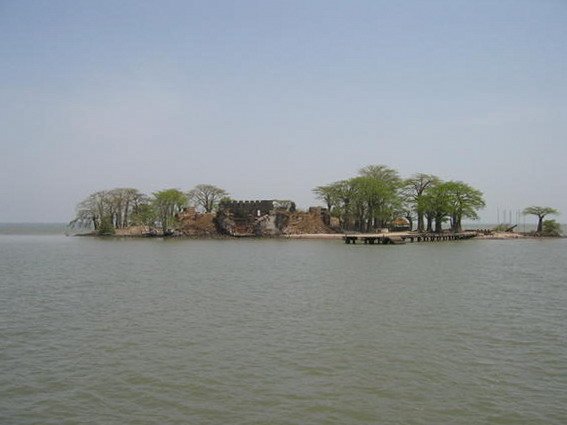
A cluster of five sites on the Gambia River that collectively document the transatlantic slave trade — from the British slave-trading fortress of Fort James to the Mandinka village of Juffureh, home of Kunta Kinte.
At a glance
James Island (now officially Kunta Kinteh Island) is a tiny coral outcrop in the Gambia River, 30 km inland from the river mouth. Between 1661 and 1779 CE, Fort James — built here first by Courland settlers, then handed to the Dutch, then taken and developed by the British — operated as one of the principal slave-trading posts of the British Empire in West Africa. Enslaved Africans were held in the fort’s dungeons before being shipped across the Atlantic Ocean. UNESCO inscribed the island and four related mainland sites as a World Heritage Site in 2003, recognising their outstanding universal value as testament to one of the most traumatic chapters in human history. The island was renamed Kunta Kinteh Island in 2011 in honour of the Mandinka protagonist of Alex Haley’s Roots.
Key facts
- UNESCO inscription: 2003 (World Heritage Site)
- Location: Gambia River, approx. 30 km east of the river mouth, The Gambia
- Coordinates: 13°31′48″N 15°01′48″W
- Active period: 1661–1779 CE as a slave-trading fort
- Original name: James Island (after the Duke of York, later King James II)
- Current name: Kunta Kinteh Island (renamed 2011)
- Related sites: Juffureh village, Fort Bullen (1826), San Domingo, Dog Island
- Area: Island is approximately 1.4 hectares
History
The island’s recorded history begins with Courland (Latvian) settlers in the 1650s, who established a trading post. The Dutch took it briefly, and the British gained control in 1661, naming it James Island after the Duke of York (the future King James II) under whose auspices the Royal African Company operated its slave trade. Fort James was built and expanded over the following decades into a substantial fortified installation.
For nearly 200 years, the fort served as the operational hub of British slave trading on the Gambia River. Enslaved people captured or traded from across the Senegambian interior were funnelled to James Island, held in underground dungeons, and loaded onto ships bound for the Americas and Caribbean plantations. The fort was twice destroyed by French forces — in 1695 and again in 1779 — and never fully rebuilt after the second destruction. From 1779, the British shifted their operations to the mainland (Fort Bullen and Bathurst, today’s Banjul).
The wider significance of the site grew immensely in 1976, when Alex Haley published Roots: The Saga of an American Family, tracing his genealogy back to Kunta Kinte, a Mandinka man allegedly abducted from the village of Juffureh on the Gambia River in 1767. The subsequent TV adaptation (1977) was watched by an estimated 130 million Americans and transformed global awareness of the slave trade’s human reality. Juffureh — one of the related sites — became an international pilgrimage destination for African Americans researching their ancestry.
What you see
Fort James is a ruin. Parts of the bastioned walls have collapsed into the river due to erosion, and the visible remains are fragmentary — low stone walls, the outline of the fort’s plan, and a small cannon battery. The island itself is tiny: at high tide, little more than 1.4 hectares remains above water. The isolation of the ruins on a river island, visible only by boat, gives the site a haunting, desolate quality quite unlike conventional heritage monuments.
The related mainland site of Juffureh is a living Mandinka village. Fort Bullen, built in 1826 on the north bank of the river mouth to intercept slave ships after the abolition, preserves intact 19th-century military architecture. San Domingo and Dog Island are smaller ruins that complete the picture of the Gambia River’s role in the transatlantic slave network.
Why this matters
James Island and Related Sites represent one of the few tangible, geographically intact testimonies to the transatlantic slave trade in West Africa. Unlike the major Ghanaian forts (Elmina, Cape Coast) — which are better preserved and more visited — James Island’s remoteness and ruinous condition impose a particular emotional weight. The UNESCO inscription explicitly links the physical remains to the living memory of the African diaspora and the ongoing process of historical reconciliation. The renaming of the island as Kunta Kinteh Island in 2011 was a formal act of cultural restitution and recognition.
Practical information
- Access: By dugout canoe or small boat from Albreda or Juffureh (15–20 min); boats arrange from the ferry landing at Banjul or from resorts near Lamin Lodge
- Best combined with: Juffureh village (walk from Albreda ferry dock), Roots Festival (held every 2 years), Fort Bullen (north bank)
- Visitor facilities: Minimal — no infrastructure on the island itself; Juffureh has a small museum dedicated to Kunta Kinte and the slave trade
- Season: November–May (dry season) is most comfortable; river access possible year-round
- Note: The island is an active archaeological site; some areas are restricted
Getting there
The nearest hub is Banjul, the Gambian capital. From Banjul, take the north-bank ferry to Barra, then a shared taxi or hire vehicle to Albreda/Juffureh (approx. 25 km east along the north bank). Boat transport to Kunta Kinteh Island is arranged locally at Albreda. The journey from Banjul to the island takes approximately 2–3 hours in total. International flights serve Banjul (Yundum International Airport) from London, Brussels, and several West African cities.
Nearby
The Stone Circles of Senegambia (UNESCO WHS 2006) lie further east along the Gambia River — the largest grouping of megalithic monuments in West Africa. Abuko Nature Reserve and the Gambia River National Park offer exceptional birdwatching. The Atlantic beach resorts of Kololi and Senegambia are approximately 30 km south-west of Banjul.
Sources
- UNESCO World Heritage Centre — James Island and Related Sites (whc.unesco.org)
- Alex Haley, Roots: The Saga of an American Family, Doubleday, 1976
- Wikipedia — James Island and Related Sites
- National Council for Arts and Culture, The Gambia
Find it on the map
See this place and what’s around it →📷 Become a Cultural Heritage Online photographer
Share your photos of places: they stay published under your name as the author. The more they're seen, the more you get noticed — and soon a contest will reward the most appreciated photos.
Log in or sign up free to add a photo