
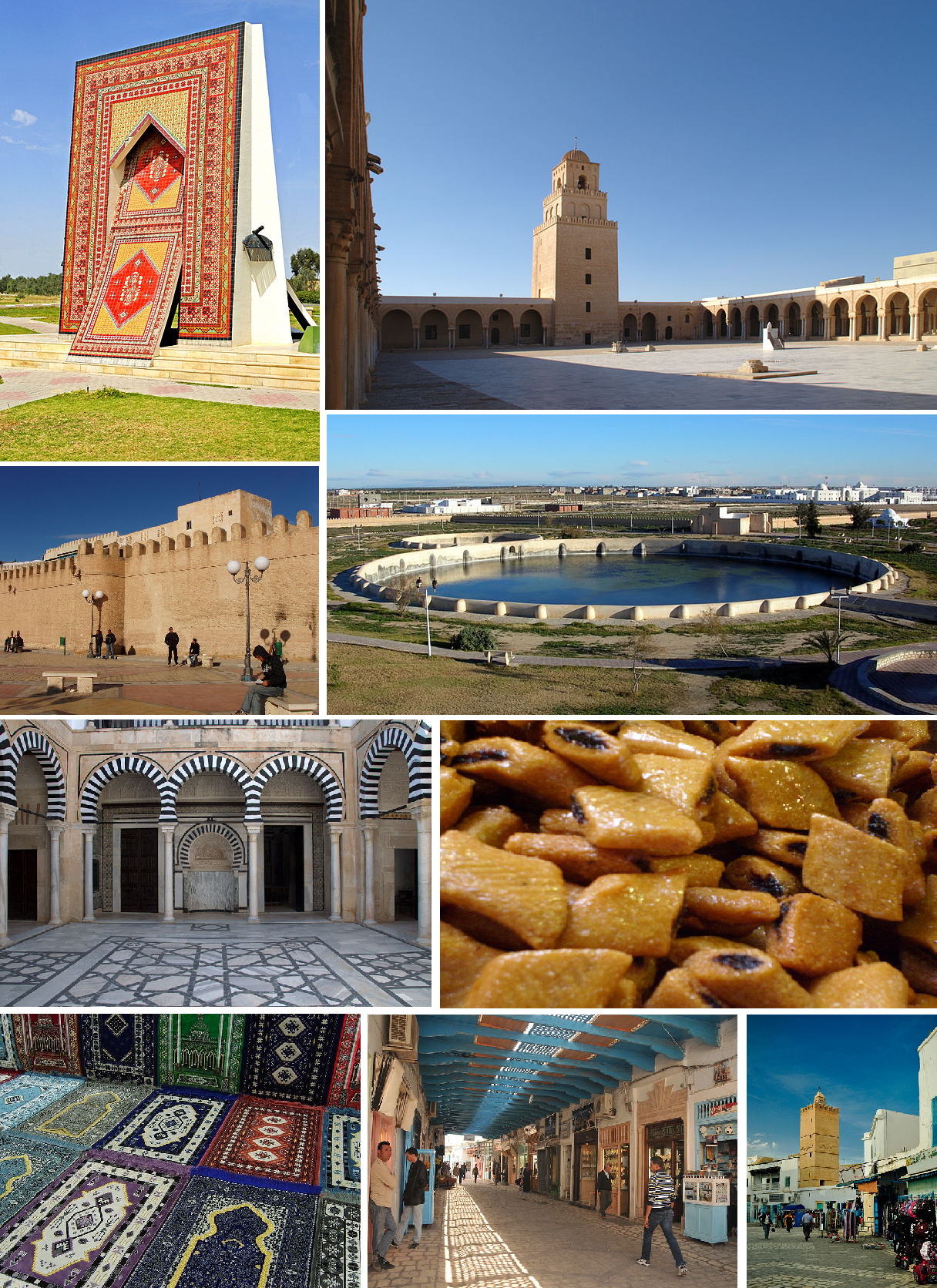
Founded in 670 CE and once the intellectual capital of the entire western Islamic world, Kairouan is among the most sacred cities in Islam — a labyrinthine medina where the oldest standing minaret in the world still calls the faithful to prayer.
At a glance
Kairouan was the first Arab-Muslim city founded in North Africa after the early Islamic conquests, established by the Umayyad commander Uqba ibn Nafi on a flat plain in modern-day central Tunisia. For four centuries it served as the capital of the western Maghreb and one of the foremost centres of Islamic scholarship, rivalling Baghdad and Cordoba. Its Great Mosque — rebuilt in its definitive form in 836 CE under the Aghlabid dynasty — is considered the mother mosque of the entire western Islamic world. The UNESCO inscription (1988) recognised not only the monuments but the entire medina fabric: mosques, mausoleums, cisterns, hammams, and traditional courtyard houses woven into an unchanged medieval street pattern.
Key facts
- UNESCO inscription: 1988, World Heritage Site
- Founded: 670 CE by Uqba ibn Nafi (Umayyad dynasty)
- Golden age: 7th–11th century (Aghlabid and Fatimid dynasties)
- Great Mosque: Original 670 CE; current form 836 CE (Aghlabid)
- Minaret: 31.5 m tall, 3 storeys — oldest standing minaret in the world
- Prayer hall columns: 414 marble and porphyry columns, mostly Roman spoils
- Great Cisterns: Largest basin 128 m diameter (9th century Aghlabid)
- Status: Active pilgrimage city; spiritual capital of Tunisia
History
Uqba ibn Nafi chose the site deliberately: remote from the sea to limit Byzantine naval raids, but connected to the major trans-Saharan caravan routes. The city grew rapidly as the administrative and military headquarters for the Umayyad conquest of North Africa and the subsequent campaigns into Iberia. Under the Aghlabid dynasty (800–909 CE), Kairouan reached its apogee. The Aghlabids rebuilt the Great Mosque in its definitive form in 836, constructed vast open-air cisterns to solve the chronic water shortage, and commissioned the Mosque of the Three Doors — whose carved facade of 866 CE remains the most ornate in the western Islamic world.
The city was the cradle of the Maliki school of Islamic jurisprudence in the West, and its scholars — Sahnun, Ibn Abi Zayd al-Qayrawani — shaped Islamic law across the Maghreb and Andalusia for centuries. When the Fatimid dynasty replaced the Aghlabids (909 CE) and later moved the capital to Cairo (973 CE), Kairouan lost political primacy but retained its spiritual authority. The city was sacked by the Banu Hilal Arab tribes in 1057 CE, never fully recovering its former size, but its sacred status endured unchanged.
What you see
The Great Mosque of Uqba is the centerpiece: its rectangular courtyard (127 x 77 m) is paved in marble and surrounded by a double portico of Roman columns. The prayer hall contains 414 columns of marble and porphyry stripped from Roman sites across Tunisia, creating a forest of varied capitals and shafts. The three-storey minaret (31.5 m), built in stages from 724 to 836 CE, is the oldest standing minaret anywhere; its square plan became the template for all subsequent minarets in the Maghreb, from Fez to Cordoba.
The Mosque of the Three Doors (866 CE) is a small neighbourhood mosque whose facade carries three horseshoe-arch doorways dense with Quranic inscriptions and floral interlace. The Aghlabid Cisterns (9th century) are two interconnected open-air reservoirs; the great cistern (128 m diameter) is among the most impressive hydraulic monuments of the ancient world. The Zawiya of Sidi Sahab — the Barber Mosque, housing relics of one of the Prophet companions — is an active pilgrimage shrine with a tiled 17th-century courtyard of exceptional beauty.
Practical information
- Access: Non-Muslims may visit the Great Mosque courtyard; prayer hall interior is generally closed to non-Muslims
- Best time: October–April (cooler temperatures; Kairouan summer averages 35 C)
- Dress code: Modest dress required; robes available at entrance
- Pilgrimage: Seven pilgrimages to Kairouan are traditionally equated with one Hajj in local Maliki tradition
- Duration: Half day for major monuments; full day to explore medina streets and souks
Getting there
- By road from Tunis: ~160 km south-west via A1/GP3 motorway; approximately 1.5 hours by car
- By bus: Regular SNTRI and regional services from Tunis Bab Alioua station; ~2.5 hours
- Nearest airport: Enfidha-Hammamet International (ENF), ~80 km north-east
- Louages: Shared taxis from Tunis and Sousse; faster than buses, depart when full
Nearby
- Ribat of Monastir (~60 km east) — 8th-century coastal fortified monastery, one of the earliest ribats in the Islamic world
- Medina of Sousse (~80 km east) — UNESCO-listed 9th-century medina with intact Aghlabid ribat and kasbah
- El Jem Amphitheatre (~65 km south-east) — UNESCO WHS; third-largest Roman amphitheatre in the world
- Sbeitla (Sufetula) (~110 km south-west) — extraordinarily well-preserved Roman forum with three Capitoline temples
Sources
- UNESCO World Heritage List: Kairouan (No. 499)
- Wikipedia: Kairouan
- Wikipedia: Great Mosque of Kairouan
Find it on the map
See this place and what’s around it →Historical events at this place (1)
📷 Become a Cultural Heritage Online photographer
Share your photos of places: they stay published under your name as the author. The more they're seen, the more you get noticed — and soon a contest will reward the most appreciated photos.
Log in or sign up free to add a photo