
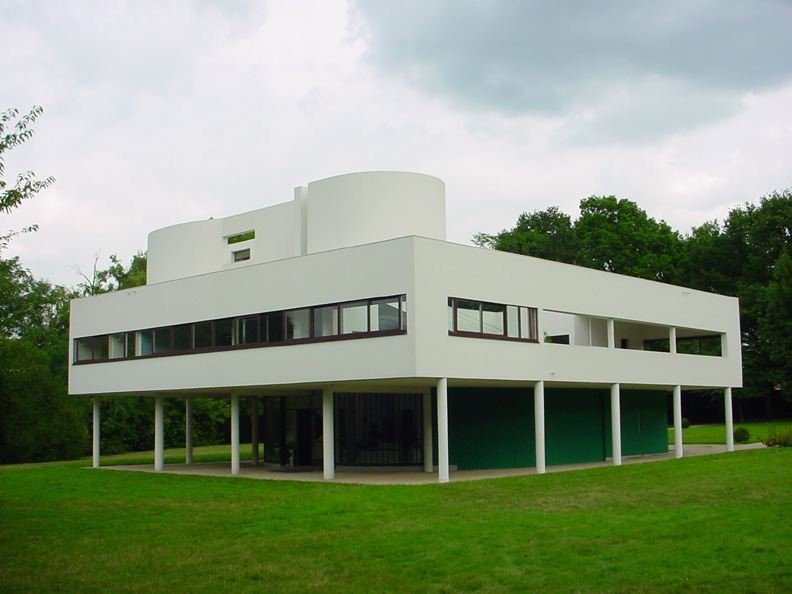
The most influential house of the 20th century — a pure white box floating on slender pilotis above a green lawn at Poissy, demonstrating Le Corbusier’s Five Points of a New Architecture and defining the International Style for all that followed.
At a glance
Built 1928–1931 as a weekend retreat for the Savoye family, the Villa Savoye at Poissy, 30 km north-west of Paris, is the definitive manifesto-building of Le Corbusier’s early career. Its design demonstrates all five of his theoretical “points of new architecture”: pilotis raising the house off the ground; a free plan unconstrained by load-bearing walls; a free facade without structural obligations; ribbon windows running the full length of every elevation; and a roof garden replacing the ground lost to the building’s footprint. UNESCO inscribed the villa in 2016 as part of the transnational Le Corbusier serial nomination.
Key facts
- Architect: Le Corbusier (with Pierre Jeanneret)
- Construction: 1928–1931
- UNESCO inscription: 2016 (transnational Le Corbusier serial site)
- Client: Pierre and Emilie Savoye
- Location: Poissy, Ile-de-France, 30 km north-west of Paris
- Movement: International Style / Purism
- Status: French historic monument (1965); open to the public as a museum
History
The Savoye family — wealthy industrialists — commissioned Le Corbusier and his cousin Pierre Jeanneret in 1928 to build a country house on a rural estate at Poissy. Le Corbusier saw it as the opportunity to demonstrate every principle he had been theorising since the early 1920s. The curve of the ground-floor facade was literally determined by the turning circle of a 1920s Citroen C5 — pragmatic precision elevated to architectural principle.
The family used the villa from 1931, but found it impractical and plagued by leaks. War intervened: the villa was occupied by German forces in 1940, then by US forces in 1944. The Savoye family never returned. After the war it became a school agricultural store, then a youth hostel. By the 1950s it was derelict and the municipality of Poissy wanted to demolish it to build a school. Andre Malraux — then Minister of Cultural Affairs — saved it in 1965 by classifying it as a historic monument. Restoration was completed by 1997 when it opened as a museum managed by the Centre des monuments nationaux.
What you see
The pilotis. The house appears to float — a white box suspended above a green lawn on slender round concrete columns. The ground floor is almost entirely open: a curved entrance drive, a servant’s apartment, and a chauffeur’s garage are tucked beneath the main living level, which sits at the height of the garden treetops.
The promenade architecturale. Le Corbusier designed the sequence of entry as a continuous architectural promenade. You drive in under the building, enter a hall, and ascend by a central ramp — not stairs, but a gently sloping walk that spirals through all three levels: ground floor, main living floor, and roof terrace. This ramp is the spine of the house.
The free plan. The main floor has no fixed walls dictated by structure. Rooms flow around a central core of bathrooms and services. The living room, dining area, kitchen, and three bedrooms are arranged freely, with glass sliding doors opening the living room onto a sheltered terrace above the garden.
The ribbon windows. Continuous horizontal strips of glazing run along all four elevations, giving even, diffused light and panoramic views across the Seine valley. The bands of white wall above and below the windows make the house read as horizontal layers.
The roof terrace. The flat roof is a garden room — a solarium with a curved windscreen wall, a ramp continuing the promenade up to a sun deck, and views across the Ile-de-France countryside. This is the “fifth point”: the roof garden replacing the ground.
Practical information
- Address: 82 Rue de Villiers, 78300 Poissy, France
- Status: Open to the public as a museum (Centre des monuments nationaux)
- Hours: Generally Tuesday–Sunday; closed Mondays; check monuments-nationaux.fr for current hours and admission
- Admission: Standard French national monument tariff; guided tours available
- Photography: Interior photography permitted; no tripods
Getting there
Villa Savoye is 30 km north-west of Paris. By train: RER A from Paris centre to Poissy station (approx. 40 minutes from Chatelet-Les Halles), then 15 minutes on foot or by taxi to the villa. By car: A13 autoroute west, exit at Poissy; follow signs to the villa. Versailles is 25 km south-east. Charles de Gaulle Airport is 40 km north-east.
Nearby
- Poissy town centre and the Collegiale Notre-Dame — Romanesque church where King Louis IX (Saint Louis) was baptised, 1 km from the villa
- Musee d’Art et d’Histoire de Poissy — local museum in the former royal priory
- Chateau de Versailles — 25 km south-east, the supreme expression of French classical architecture
Sources
Find it on the map
See this place and what’s around it →📷 Become a Cultural Heritage Online photographer
Share your photos of places: they stay published under your name as the author. The more they're seen, the more you get noticed — and soon a contest will reward the most appreciated photos.
Log in or sign up free to add a photoIs this page about you?
This page is read by travellers and heritage enthusiasts who find it on Google. Tell us how you are connected to this place and we will take it from there.