
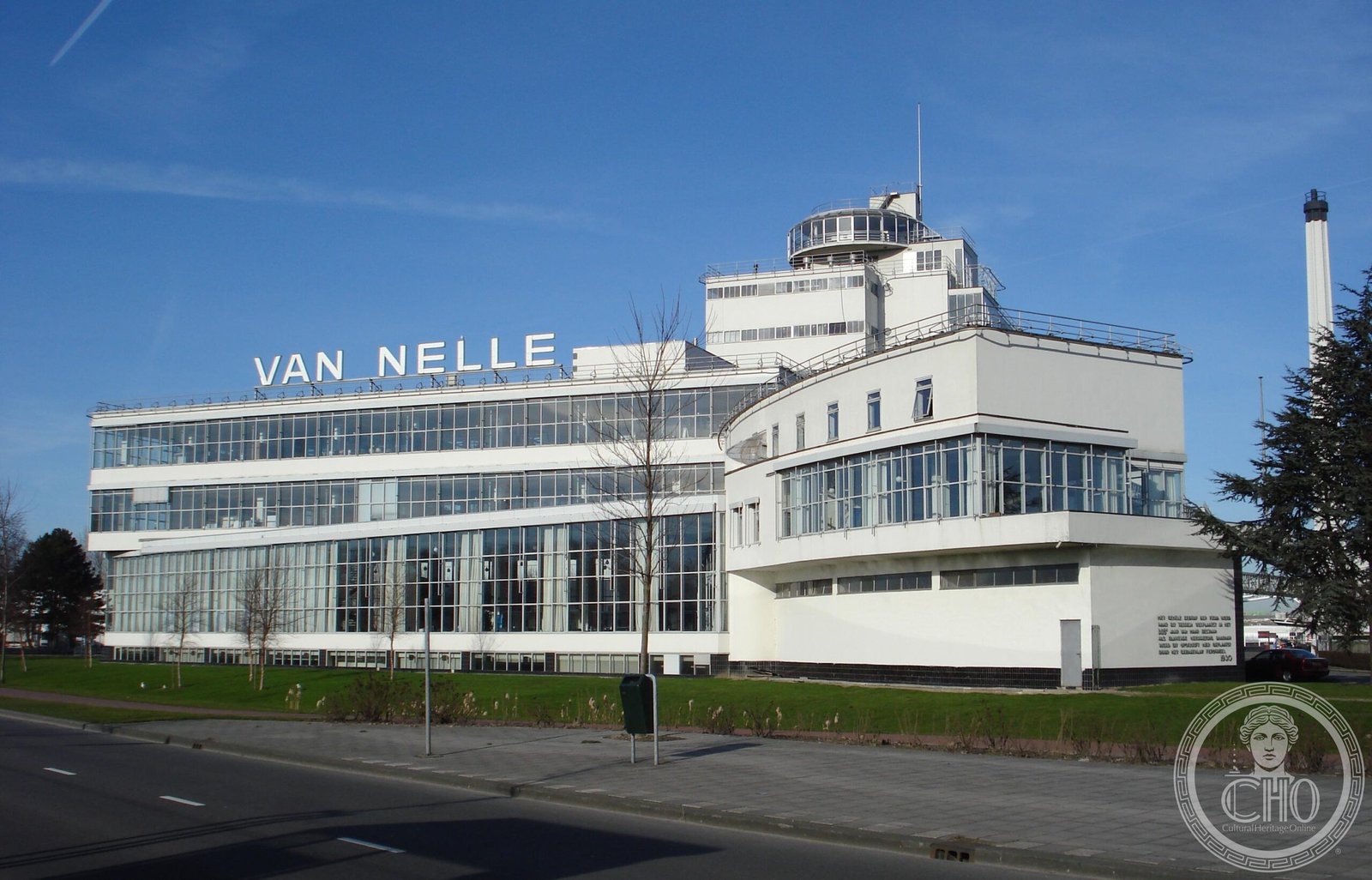
The most beautiful factory in the world — a cathedral of glass and steel in Rotterdam that turned the industrial workplace into a statement of Modernist idealism, and inspired factory design across the globe for a century.
At a glance
Van Nellefabriek is a former coffee, tea, and tobacco factory on the outskirts of Rotterdam, built between 1925 and 1931 by architects Johannes Brinkman and Leendert van der Vlugt (with the young Mart Stam contributing the concept). Its extraordinary glass curtain-walls — among the largest glass-and-steel facades built in the 1920s — flood the interior with natural light and make the production processes visible from outside. Le Corbusier famously called it the most beautiful factory in the world after his 1932 visit. The factory was converted to offices and creative industries in 2000, and in 2014 UNESCO inscribed it as a World Heritage Site, recognising it as a masterpiece of functional Modernism that influenced industrial and office architecture worldwide.
Key facts
- UNESCO inscription: 2014, as a masterwork of early 20th-century functional architecture
- Architects: Johannes Brinkman & Leendert van der Vlugt; concept input by Mart Stam
- Construction: 1925–1931
- Original use: Coffee, tea, and tobacco processing factory for the Van Nelle company
- Current use: Creative offices, events, conferences; the Polderdak (rooftop terrace) is a city landmark
- Location: Van Nelleweg 1, Rotterdam, Netherlands (northwest of the city centre, near the Schie canal)
- Style: Dutch functionalist Modernism (Nieuwe Zakelijkheid / New Objectivity)
History and context
The Van Nelle company was founded in Rotterdam in 1782, originally as a modest trading house. By the early 20th century it had grown into a major processor of imported colonial goods — coffee from the Dutch East Indies, tea from Ceylon, and tobacco from Sumatra. The company’s co-director C.H. van der Leeuw was a progressive industrialist influenced by the ideas of Frederick Winslow Taylor and Henry Ford: he wanted a factory that was not just efficient but healthy, transparent, and inspiring for workers and public alike.
Commissioned in 1924, the project went to the young Rotterdam architectural partnership of Brinkman & Van der Vlugt, who worked closely with Mart Stam — a Dutch architect just returned from Germany, where he had absorbed the principles of the Bauhaus and the avant-garde New Objectivity movement. The result was radical: three interconnected mushroom-columned production halls for the three product lines (coffee, tea, tobacco), linked by glazed overhead conveyor bridges and sheathed in floor-to-ceiling glass curtain walls.
The factory opened in 1931. Le Corbusier visited the following year and was so struck by its honesty and clarity that he described it as the embodiment of his own ideas about the machine for living. His praise cemented Van Nellefabriek’s international reputation. The factory continued producing until the 1980s, when manufacturing moved overseas. A long period of vacancy and uncertainty ended in 2000 when the building was converted to offices and event venues. Today it houses some 150 companies in the creative and knowledge sectors, making it one of the most productive adaptive-reuse projects in Europe.
What you see
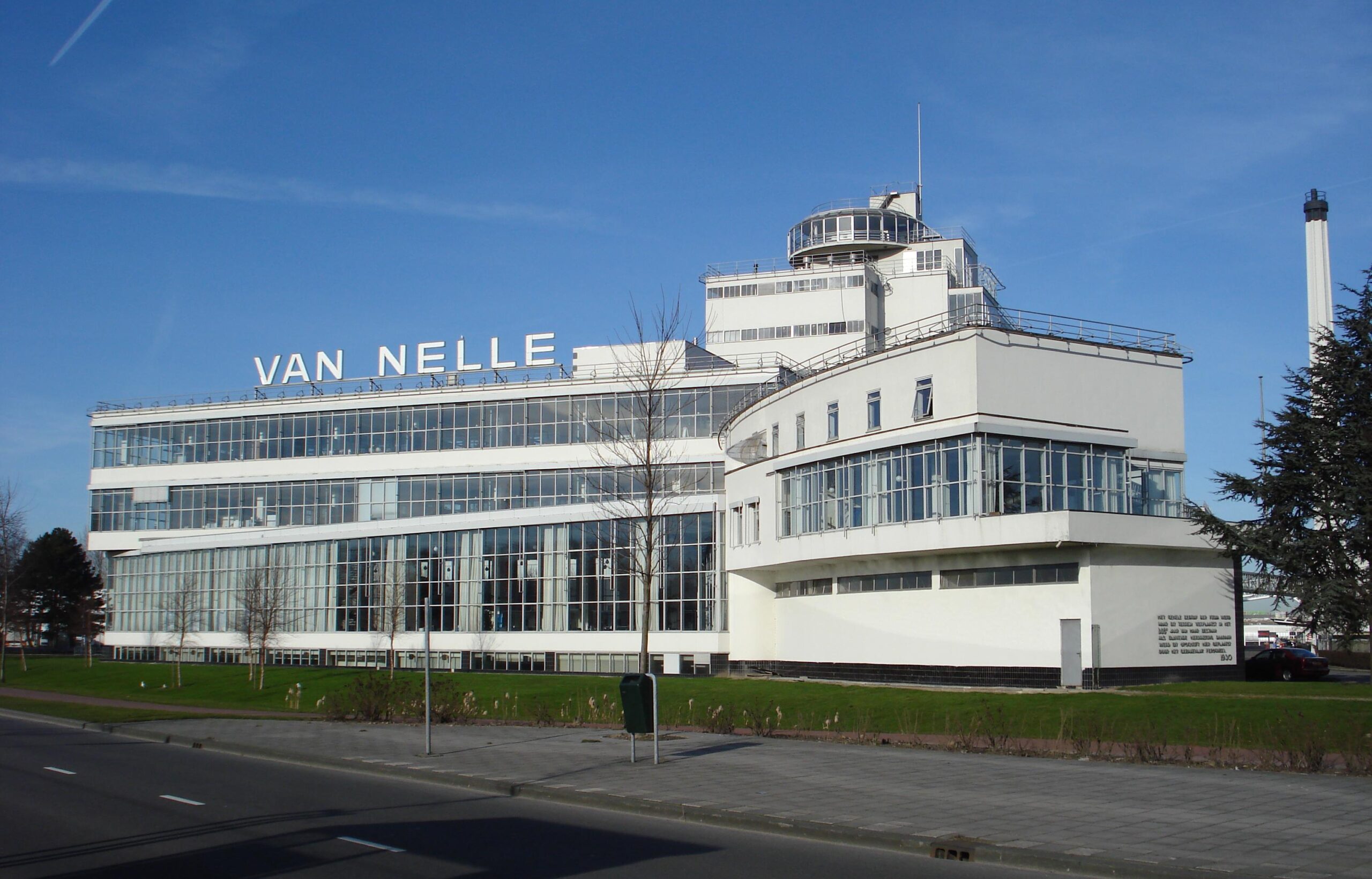
The building complex consists of three main factory blocks of different heights — the tallest for tobacco (seven floors), medium for tea, lowest for coffee — arranged in a slightly staggered formation and connected at upper levels by enclosed conveyor bridges that arch over the internal roadway. The facades are the defining feature: almost entirely composed of glass panes held in slender steel frames, they curve gently at the building’s corners, eliminating the traditional solid wall and making the entire production floor visible from the exterior.
Inside, the mushroom-shaped reinforced concrete columns allow completely open, flexible floor plates with no interior load-bearing walls. Natural light penetrates deep into every floor. The administrative building at the entrance is a fully glazed round tower, one of the first cylindrical glass towers in Europe. At the top of the tobacco building, a round glass mushroom dome served as the director’s office and belvedere — it is now a much-photographed silhouette. The rooftop Polderdak terrace, originally provided as a workers’ recreation space, now hosts public events. Details throughout — the terrazzo floors, the tubular steel canteen furniture designed by Mart Stam, the industrial lighting — survive in excellent condition.
Why it matters
Van Nellefabriek is the decisive proof that the Modernist ideals of the 1920s could work at industrial scale. Where most Modernist buildings were single houses or small cultural projects, Van Nelle demonstrated the vocabulary — open plan, curtain wall, pilotis, flat roof, continuous ribbon windows — working across a 100,000 m² factory complex. Its influence was direct and massive: it established the template for the glass office tower, the curtain-wall office park, and the open-plan industrial building that dominated European and North American construction from the 1950s onwards. For its social ambition — workers bathed in daylight, provided with sports facilities and a canteen, working in a factory whose processes were visible to the public — it is also a landmark in the history of progressive industrial management. UNESCO’s 2014 inscription recognised it as an outstanding example of the functionalist architecture of the Modern Movement.
Practical information
- Address: Van Nelleweg 1, 3044 BC Rotterdam, Netherlands
- Access: The building is occupied by private companies and not open to general visitors. Guided tours are available through the Van Nellefabriek office; check the official website for tour schedules (typically offered on selected weekends and for groups by appointment)
- Open days: The building participates in the annual Open Monumentendag (Open Heritage Day) in September, when parts of the interior are publicly accessible
- Visitor centre: A small exhibition about the building’s history is accessible during scheduled tours
- Photography: Exterior photography is freely permitted; interior photography during tours allowed
- Official website: vannellefabriek.com
Getting there
From Rotterdam Centraal station, take tram line 8 (direction Spangen/Marconiplein) to the stop Castorweg, then a 5-minute walk west along Van Nelleweg. By car, exit the A20 motorway at Kleinpolderplein and follow signs toward Spaanse Polder. The building is in the Spaanse Polder industrial district, west of the city centre. Cycling from Rotterdam Centraal via the Schie canal towpath takes approximately 20 minutes and offers excellent views of the building’s exterior.
Nearby
- Depot Boijmans Van Beuningen — the world’s first publicly accessible art-storage depot, a striking mirrored bowl by MVRDV in Rotterdam’s museum quarter, 4 km southeast
- Euromast — Rotterdam’s observation tower, 185 m tall, offering panoramic views over the port and the Van Nelle complex, 3 km south
- Markthal Rotterdam — the iconic arched covered market by MVRDV (2014), a showcase of contemporary Dutch architecture, 5 km southeast near the old harbour
- Kinderdijk Windmills — UNESCO World Heritage Site; 19 historic windmills on the Alblasserwaard polder, 15 km east by car or waterbus
Sources
- UNESCO World Heritage List — Van Nellefabriek (whc.unesco.org/en/list/1441)
- Brinkman & Van der Vlugt, original architectural drawings and project documentation, Nederlands Architectuurinstituut (NAI) / Het Nieuwe Instituut, Rotterdam
- Liane Lefaivre & Alexander Tzonis, Architecture of Regionalism in the Age of Globalization, Routledge, 2012
- Wikipedia — Van Nellefabriek (en.wikipedia.org/wiki/Van_Nellefabriek)
- Van Nellefabriek official website (vannellefabriek.com)
Gallery
Find it on the map
See this place and what’s around it →📷 Become a Cultural Heritage Online photographer
Share your photos of places: they stay published under your name as the author. The more they're seen, the more you get noticed — and soon a contest will reward the most appreciated photos.
Log in or sign up free to add a photoIs this page about you?
This page is read by travellers and heritage enthusiasts who find it on Google. Tell us how you are connected to this place and we will take it from there.