
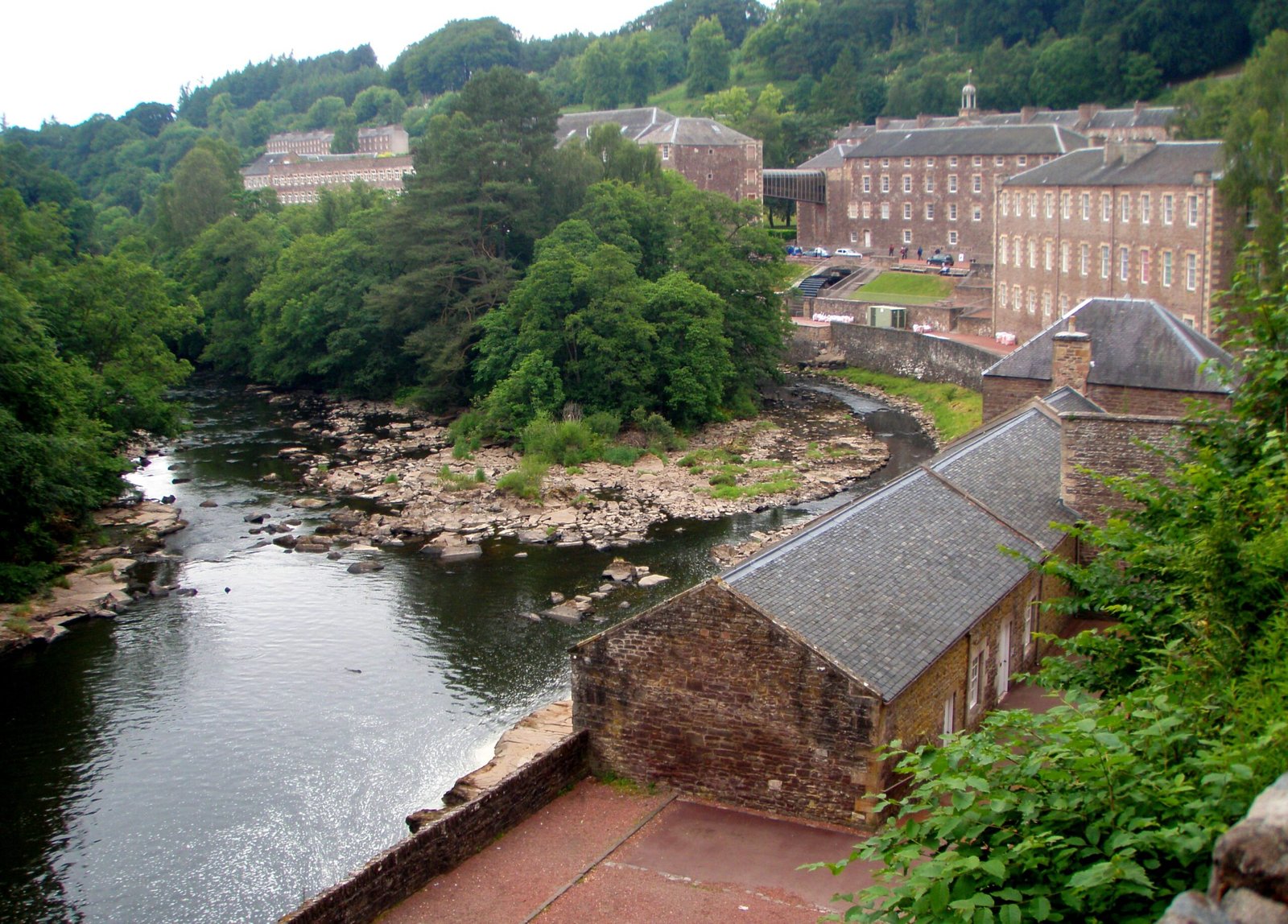
A working cotton mill village beside a Scottish waterfall — where Robert Owen turned the world’s first planned industrial community into a laboratory for infant education, workers’ rights, and the cooperative movement that still shapes economies today.
At a glance
New Lanark World Heritage Site, inscribed by UNESCO in 2001, is a remarkably intact cotton-spinning mill village built in 1786 beside the Falls of Clyde in South Lanarkshire, Scotland. It owes its fame to Robert Owen (1771-1858), who managed the mills from 1800 and transformed them into the world’s first planned workers’ community — with the world’s first infant school, a co-operative shop, adult education, sick pay, and profit-sharing for employees. All four original mill buildings, the workers’ tenements, Owen’s house, the Institution for the Formation of Character, the Village Store, and the school survive, making New Lanark one of the most complete Georgian industrial villages in existence. Today it operates as a living heritage site with a hotel, youth hostel, and working museum.
Key facts
- UNESCO inscription: 2001 (Cultural, criteria ii, iv, vi)
- Location: New Lanark, South Lanarkshire, Scotland, 1.6 km from Lanark town
- Founded: 1786 by David Dale and Richard Arkwright
- Peak workforce: c. 2,500 workers (c. 1815); included 500 pauper apprentice children from Edinburgh and Glasgow poorhouses
- Robert Owen period: 1800-1825 CE — world’s first infant school (1816), first co-operative shop, profit-sharing, no children under 10 in mills
- Cotton production: 1786-1968 CE (continuous operation)
- Restoration: New Lanark Trust established 1974; restoration ongoing since 1975
History
New Lanark was founded in 1786 by the Glasgow merchant David Dale in partnership with the English inventor Richard Arkwright, who had just developed the water frame spinning machine. The site was chosen for its dramatic position beside the Falls of Clyde, whose hydraulic power drove the mill machinery. Dale built four large sandstone spinning mills and housing for his workforce, including hundreds of pauper apprentice children sent from Edinburgh and Glasgow poorhouses — a common and accepted practice of the era. By the 1790s New Lanark was the largest cotton-spinning complex in Scotland.
Robert Owen, a young Welsh factory manager, married Dale’s daughter Caroline and took over management of New Lanark in 1800. He immediately began a radical experiment in social organisation. Convinced that human character was entirely shaped by environment, he set out to prove that decent conditions, education, and community welfare would produce more productive and morally superior workers — and generate profits at the same time. His innovations between 1800 and 1825 are a foundational list for the modern welfare state: he reduced working hours and raised wages; stopped employing children under 10 in the mills; opened the world’s first infant school (1816) for children aged 1-6, with no corporal punishment and learning through song, dance, and play; built the Institution for the Formation of Character (1816) as a combined adult education centre, recreation hall, concert venue, and community meeting room; and established the Village Store — a shop selling goods at cost price rather than for profit, the direct precursor of the modern cooperative movement.
Owen’s ideas radiated globally. He visited the United States, established the utopian community New Harmony in Indiana (1825), and inspired the British cooperative movement (the Rochdale Pioneers of 1844 were directly influenced by his New Lanark model). He is considered one of the founders of socialism and the labour movement. Cotton spinning at New Lanark continued under successive owners until 1968, when the mills finally closed. The buildings were acquired by the New Lanark Trust in 1974 and systematically restored from 1975 onward. UNESCO inscribed the site in 2001 under criteria ii, iv, and vi.
What you see
The village sits in a narrow gorge cut by the River Clyde, completely hidden from the surrounding farmland until you descend the steep access road. The four mill buildings — massive, multi-storey sandstone structures with rows of small windows — line the river bank. Behind them, climbing the valley slopes, are Owen’s workers’ tenements: long rows of stone housing that set the model for decent industrial worker accommodation. The Institution for the Formation of Character (1816) is a prominent civic building with a classical facade. The Village Store and Owen’s own house (Braxfield House) are both accessible to visitors. The waterfall — the Falls of Clyde — is a short walk upstream, passing through a Scottish Wildlife Trust nature reserve. A visitor centre with an introductory film and the Annie McLeod Experience (a ghost-ride through mill history) occupies one of the restored mill buildings.
Practical information
- Visitor centre: New Lanark Mill Hotel and Visitor Centre — open daily year-round
- Admission: Village free to walk; Visitor Centre attraction tickets approx. GBP 10 adults, GBP 6 children
- Accommodation: New Lanark Mill Hotel (in original mill building) and youth hostel on site
- Season: Year-round; Falls of Clyde most spectacular in autumn/winter flood conditions
- Language: All exhibits in English
Getting there
New Lanark is 1.6 km from Lanark town centre, accessible on foot via a steep downhill path (20 minutes) or by the New Lanark bus service from Lanark. Lanark is 45 minutes by train from Glasgow Central. By car, take the M74 motorway to junction 7, then follow signs to Lanark and New Lanark. There is a pay car park at the village entrance.
Nearby
- Falls of Clyde: Series of four waterfalls immediately upstream, within a Scottish Wildlife Trust nature reserve — habitat for breeding peregrine falcons
- Lanark: Historic market town; Wallace Memorial and William Wallace connections
- Craignethan Castle: 16th-century tower house (Historic Environment Scotland), 10 km northwest
- Glasgow: 45 minutes by train; Kelvingrove Museum contains context on the Scottish industrial revolution
Sources
- UNESCO World Heritage List — New Lanark (2001)
- New Lanark Trust — official site, newlanark.org
- Donnachie, Ian. Robert Owen: Owen of New Lanark and New Harmony (2000)
- Wikipedia EN — New Lanark, Robert Owen, Co-operative movement
Find it on the map
See this place and what’s around it →📷 Become a Cultural Heritage Online photographer
Share your photos of places: they stay published under your name as the author. The more they're seen, the more you get noticed — and soon a contest will reward the most appreciated photos.
Log in or sign up free to add a photo