
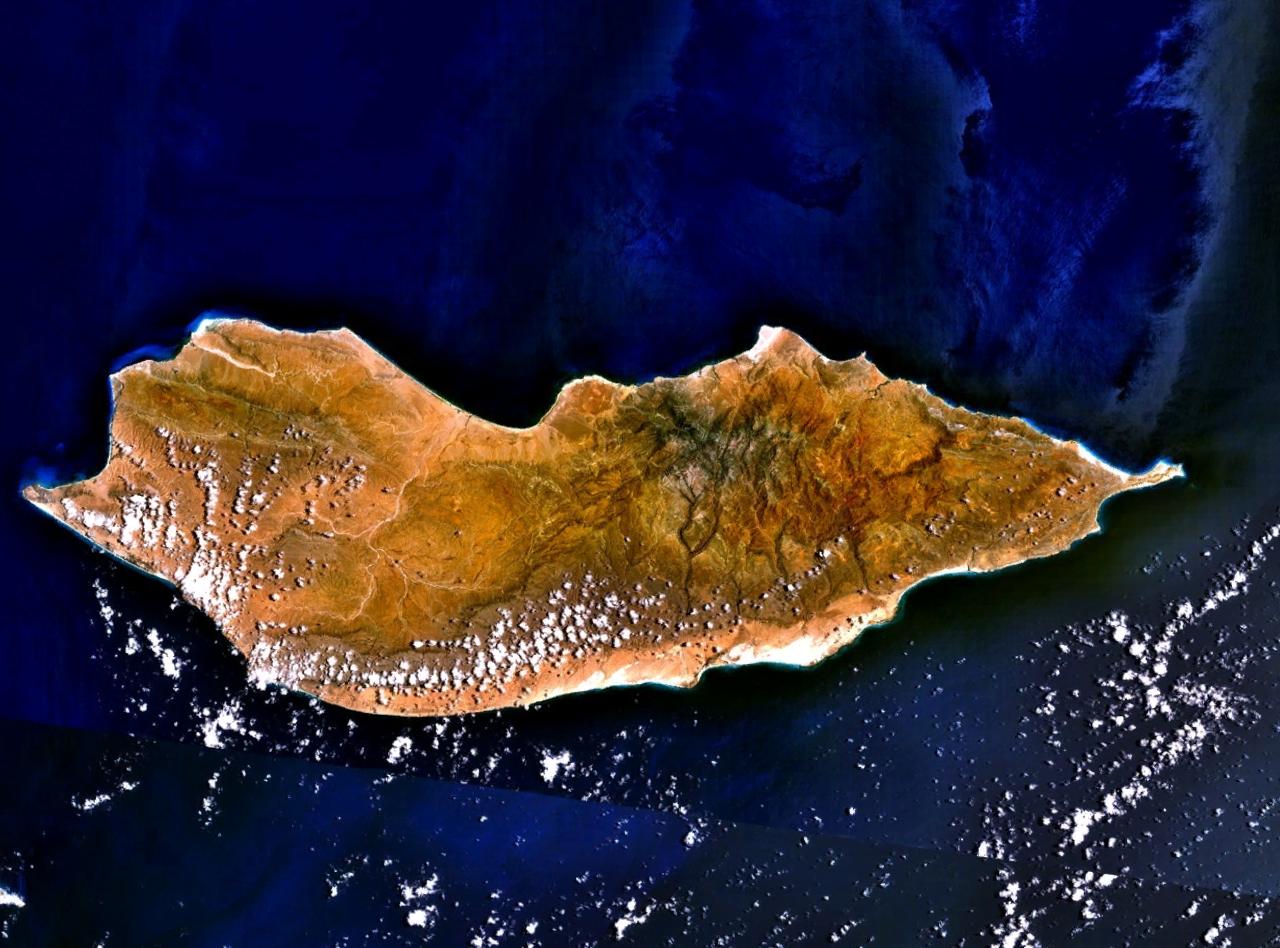
Socotra Archipelago
An extraordinary island group in the northwest Arabian Sea, isolated for 20 million years and home to dragon blood trees, bottle-trunked desert roses, and levels of biological endemism that rival the Galapagos.
At a glance
Socotra is an archipelago of four main islands lying approximately 240 km east of the Horn of Africa, technically part of Yemen. Inscribed as a UNESCO Mixed World Heritage Site in 2008, it is recognised simultaneously for its outstanding natural beauty and its exceptional value as a living laboratory of evolution. The main island measures roughly 250 km east-to-west and rises to the Hajhir Mountains at 1,503 metres. The capital, Hadibo, holds most of the island population of approximately 70,000. Despite the ongoing Yemen civil war, Socotra remains one of the most biologically extraordinary places on Earth, a place where deep geological isolation has produced a living museum of species found nowhere else.
Key facts
- UNESCO inscription: 2008 (Mixed Natural and Cultural)
- Islands: Socotra, Abd al Kuri, Samha, Darsa and smaller islets
- Area: approx. 3,600 sq km (main island)
- Highest point: Jebel Skand, 1,503 m (Hajhir Mountains)
- Plant endemism: 37% of plant species found nowhere else on Earth
- Reptile endemism: 90% of reptile species endemic
- Land snail endemism: 95% of land snail species endemic
- Iconic species: Dragon Blood Tree (Dracaena cinnabari); Desert Rose (Adenium obesum socotranum); Cucumber Tree (Dendrosicyos socotranus)
- Language: Socotri (unwritten South Arabian language) plus Arabic
- First inhabited: at least c. 1000 BCE
History
Socotra human history stretches back at least three millennia. By c. 1000 BCE the island was inhabited by a people speaking Socotri, an ancient South Arabian language that survives today as an oral tongue with no traditional written script. The island occupied a strategic position on the ancient incense trade route connecting South Arabia, East Africa, and India. Classical Greek and Roman sources mention Socotra (as Dioscorida) as a source of dragon blood resin, used medicinally across the ancient world.
The 1st-century CE Periplus of the Erythraean Sea describes Socotra as commercially valuable, inhabited by a mix of Arabs, Indians, and Greeks. Portuguese explorers established a brief presence in the 16th century CE before abandoning their fort in 1511 CE. The Mahra sultanate held sovereignty over Socotra until 1967, when the island became part of newly independent South Yemen. After Yemeni unification in 1990, Socotra passed to the Republic of Yemen. Since 2018, the archipelago has been partially occupied by UAE-backed forces during the ongoing civil war.
What you see
The defining visual experience of Socotra is its alien landscape, dominated by the Dragon Blood Tree (Dracaena cinnabari). Growing at mid-altitude on the Hajhir plateau and rocky limestone escarpments, the trees form dense groves with their characteristic inverted umbrella-shaped crowns, a form evolved to channel coastal fog and morning dew to the shallow root system in thin rocky soil. When cut, the bark weeps a thick dark-red resin, the famous dragon blood used for two millennia as a medicinal compound, dye, and varnish.
At lower elevations, the Desert Rose (Adenium obesum socotranum) punctuates the landscape with its grotesquely swollen water-storing trunk, topped with clusters of vivid pink flowers. The Cucumber Tree (Dendrosicyos socotranus), the world only tree-form member of the cucumber family, grows on rocky hillsides. The coastline offers white sand beaches, turquoise lagoons, and dramatic dune fields that spill into the sea at Arher. The Diksam plateau in the island interior is the epicentre of dragon blood tree groves.
Practical information
- Entry: Yemeni visa required; access complicated by civil war since 2014. Check current travel advisories before planning.
- Flights: Socotra Airport (SCT) near Hadibo; connections from Abu Dhabi and Dubai operate intermittently.
- Best season: October to April (dry northeast monsoon). May to September: island largely inaccessible due to southwest monsoon.
- Accommodation: Basic guesthouses and eco-camps in Hadibo and at key sites; infrastructure is limited.
- Currency: Yemeni Rial (YER); USD widely accepted.
- Safety: FCO and US State Dept classify Yemen as Do Not Travel; consult specialist operators for current access conditions.
Getting there
Socotra is reached by air via Socotra Airport (IATA: SCT) near Hadibo. From the UAE, Air Arabia and Felix Airways have historically operated routes from Sharjah and Abu Dhabi, though schedules vary with the political situation. There is no regular ferry service from the Yemeni mainland. All travel should be arranged through specialist operators with current knowledge of safety and access conditions.
Nearby
- Abd al Kuri Island: westernmost island in the archipelago, closest to the Horn of Africa, with distinct endemic species
- Samha and Darsa Islands: uninhabited sister islands with pristine marine ecosystems
- Qalansiyah Lagoon: a sheltered coastal lagoon on Socotra western tip, one of the most photographed landscapes
- Arher Dunes: towering sand dunes meeting the sea on the northeast coast
Sources
- UNESCO World Heritage List, Socotra Archipelago (2008): whc.unesco.org/en/list/1263
- Miller, A.G. and Morris, M. (2004). Ethnoflora of the Soqotra Archipelago. Royal Botanic Garden Edinburgh.
- Naumkin, V. (1993). Island of the Phoenix: An Ethnographic Study of the People of Socotra. Ithaca Press.
Find it on the map
See this place and what’s around it →📷 Diventa un fotografo di Cultural Heritage Online
Condividi le tue foto dei luoghi: restano pubblicate con la tua firma come autore. Più vengono viste, più ti fai conoscere — e presto un concorso premierà le foto più apprezzate.
Accedi o registrati gratis per aggiungere una foto