
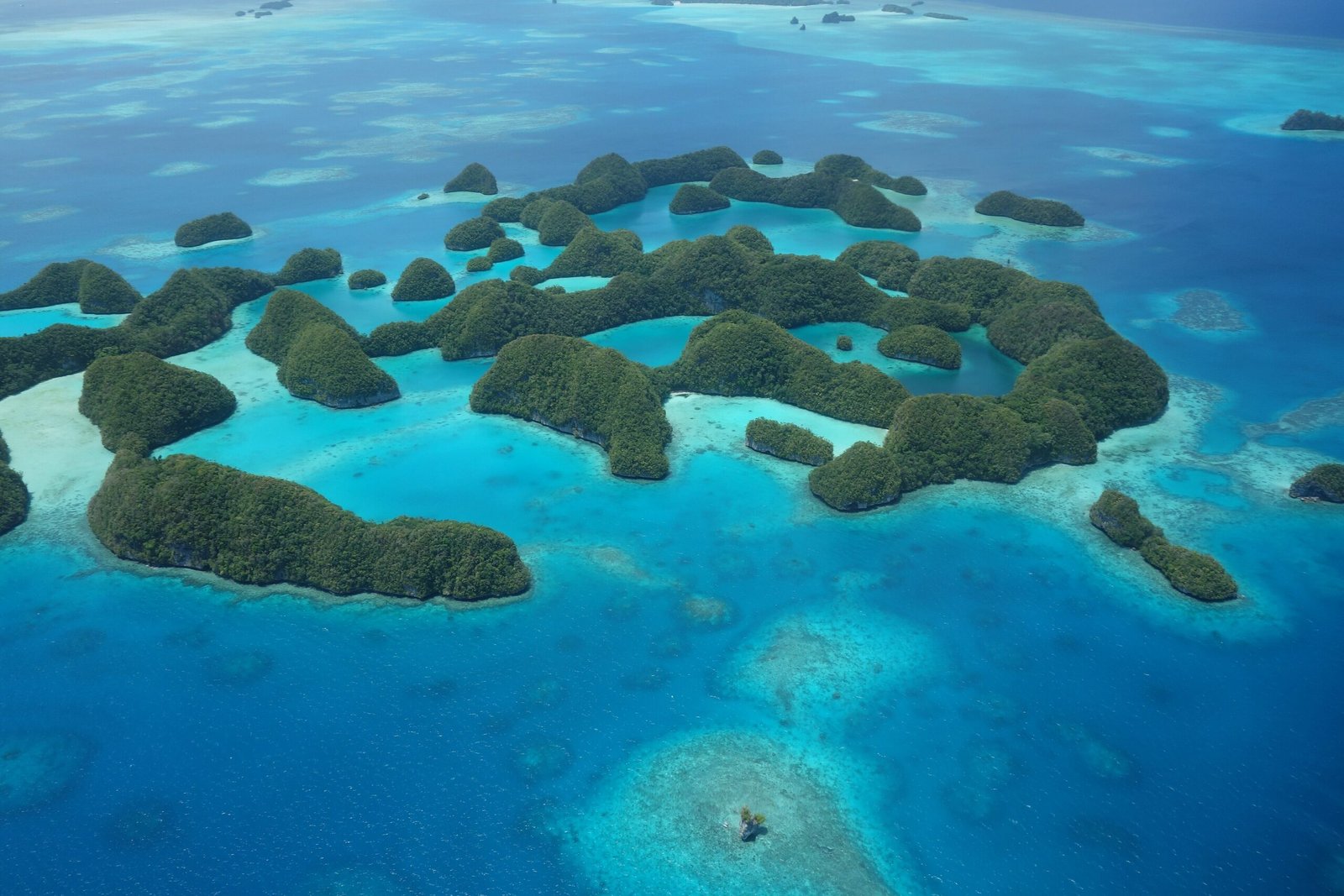
Rock Islands Southern Lagoon
Roughly 445 uninhabited limestone islands floating on a turquoise lagoon in Micronesia — their undercut mushroom silhouettes masking one of Earth s most biodiverse marine ecosystems, three millennia of Palauan culture, and the scars of one of the Pacific War s bloodiest battles.
At a glance
Inscribed on the UNESCO World Heritage List in 2012 as a Mixed Cultural and Natural site, the Rock Islands Southern Lagoon covers approximately 100,000 hectares of reef, channel, and lagoon in the Republic of Palau, a small island nation in the western Pacific Ocean. The site contains 445 uninhabited islets that are ancient coral reefs uplifted by tectonic movement roughly 10,000 years ago, subsequently sculpted by wave erosion into their characteristic broad-topped, narrow-waisted forms — the mushroom profile now synonymous with Palau in travel photography worldwide. Beneath the surface, the lagoon holds extraordinary marine biodiversity: endemic species, coral gardens, and a series of landlocked marine lakes hosting unique stingless jellyfish populations found nowhere else on Earth. Above the waterline, over 50 burial caves, cave paintings, and submerged remnants of ancient Palauan stilt villages document human habitation stretching back at least 5,000 years.
Key facts
- UNESCO inscription: 2012 (Mixed Cultural and Natural WHS)
- Location: Koror State and Peleliu State, Republic of Palau, western Pacific Ocean (Micronesia)
- Size: approx. 100,000 hectares of lagoon; 445 uninhabited limestone islets
- Marine lakes: over 50 anchialine lakes, including the famous Jellyfish Lake
- Geological origin: ancient coral reefs uplifted ~10,000 years ago, then undercut by wave erosion
- Human habitation: earliest evidence c. 3000 BCE; traditional Palauan modekngei communities
- WWII significance: adjacent to Peleliu Island, site of the Battle of Peleliu (Sep–Nov 1944)
- Shark sanctuary: Palau declared one of the world s first national shark sanctuaries in 2009
- Marine biodiversity: 700+ coral species, 1,300+ fish species, endemic stingless jellyfish
History
The earliest confirmed human presence in the Rock Islands region dates to approximately 3000 BCE, when Austronesian-speaking peoples arrived from Island Southeast Asia as part of the great Pacific migration wave. These early Palauans established modekngei communities and built their settlements on wooden stilt platforms over the lagoon, some of which are now partially submerged and visible as underwater ruins.
For millennia, Palauan clans used the Rock Islands caves, channels, and lagoons as fishing grounds, navigational corridors, and burial sites. Over 50 burial caves have been documented, many still containing human remains and grave goods. The cave paintings found across the islands depict bai (traditional meeting house) imagery and traditional Palauan symbols, representing a visual record of chiefly society and spiritual belief that remained largely uninterrupted until Spanish contact in the 17th century.
The islands became strategically critical during World War II. Peleliu Island — immediately adjacent to the Rock Islands WHS boundary — was the site of the Battle of Peleliu (15 September–27 November 1944), one of the most costly engagements of the Pacific campaign. US Marines and Army soldiers suffered over 9,800 casualties. Today, Peleliu still contains visible aircraft wrecks, tank hulks, and pill boxes largely untouched in the jungle.
Palau achieved independence in Compact of Free Association with the United States in 1994. In 2009 Palau declared all its waters a shark sanctuary. The UNESCO Mixed WHS inscription in 2012 recognised both the outstanding natural value of the marine ecosystem and the cultural significance of ancient Palauan heritage embedded in the landscape.
What you see
Above the waterline, the Rock Islands present a surreal seascape: hundreds of rounded, forest-capped limestone domes rising directly from flat turquoise water, their bases undercut into pale grey concave curves by centuries of wave action. The dense canopy of tropical forest on each island is home to Palau s endemic Nicobar pigeon, fruit bats, and a range of seabirds. Beaches of powdery white coral sand appear unexpectedly on the sheltered sides of islands.
The marine lakes hidden within the larger islands are the site s most otherworldly feature. Jellyfish Lake on Eil Malk Island contains an estimated five to thirteen million golden jellyfish — a subspecies found only here, which has lost its stinging capacity through millennia of isolation and follows the sun across the lake in daily migrations.
Underwater, the outer reef walls drop precipitously to 300 metres and are covered with pristine hard and soft corals hosting over 700 coral species and 1,300 fish species. The Blue Corner and Blue Hole dive sites are regularly listed among the world s top ten dive locations. Manta rays, reef sharks, barracuda schools, and sea turtles are common encounters.
The marine lakes
The anchialine lakes of the Rock Islands — bodies of seawater connected to the ocean only through underground passages — represent one of the most remarkable evolutionary laboratories on Earth. Each lake is effectively a closed ecosystem that has developed in isolation over thousands of years, producing species and subspecies found nowhere else. Palau has at least five named marine lakes open to research: Jellyfish Lake, Spooky Lake, Clear Lake, Shark Lake, and others.
The stingless jellyfish of these lakes have evolved their docility through the absence of predators. The population in Jellyfish Lake fluctuates dramatically: a 1998 El Nino event caused a mass die-off; the population recovered, then collapsed again in 2016, and has partially recovered since. Access to Jellyfish Lake requires a Rock Islands permit; swimming (but not scuba diving) is permitted.
Practical information
- Entry permits: All visitors require a Rock Islands Permit (approx. USD 100 for foreigners); separate fees apply for Jellyfish Lake
- Access: By boat from Koror only; day trips and liveaboard dive tours depart from Koror harbour
- Diving: Requires PADI/equivalent certification; local dive operators mandatory within the WHS
- Best time to visit: November–April (dry season, calmer seas)
- No overnight stays: The islands are uninhabited; all accommodation in Koror town
- Conservation rules: No fishing, no coral touching, no collection of marine organisms; reef-safe sunscreen mandatory
- Currency: US Dollar (USD); major cards accepted in Koror
Getting there
Palau is served by Roman Tmetuchl International Airport (ROR) in Airai on Babeldaob Island, approximately 20 minutes by road from Koror. Direct flights operate from Manila, Seoul (Korean Air), Taipei, and Tokyo Narita. From Koror, all Rock Islands access is by boat — either through a guided tour operator or by hiring a private boat with a licensed local guide. Most visitors book day tours through Koror-based dive and tour operators; multi-day liveaboard diving charters are available.
Nearby
- Peleliu Island — site of the 1944 Battle of Peleliu; open-air WWII museum with original tank wrecks and aircraft fuselages in the jungle; 45 minutes by speedboat from Koror
- Babeldaob Island — Palau s largest island; home to the Badrulchau monolith field, Ngardmau Waterfall, and the Ngerulmud capital complex
- Belau National Museum, Koror — principal repository of Palauan cultural heritage; traditional bai meeting house reconstructions and historical artefacts
Sources
- UNESCO World Heritage Committee, Rock Islands Southern Lagoon — Outstanding Universal Value statement, Decision 36COM 8B.9 (2012)
- Palau Visitors Authority — Rock Islands permit regulations and marine lake access rules
- Colin, P.L., Marine Environments of Palau (1988)
- Hamner, W.M. & Hamner, P.P., Stratified Marine Lakes of Palau, Islands vol. 50 (1998)
- Wikipedia, Rock Islands — general reference
Find it on the map
See this place and what’s around it →📷 Diventa un fotografo di Cultural Heritage Online
Condividi le tue foto dei luoghi: restano pubblicate con la tua firma come autore. Più vengono viste, più ti fai conoscere — e presto un concorso premierà le foto più apprezzate.
Accedi o registrati gratis per aggiungere una foto