

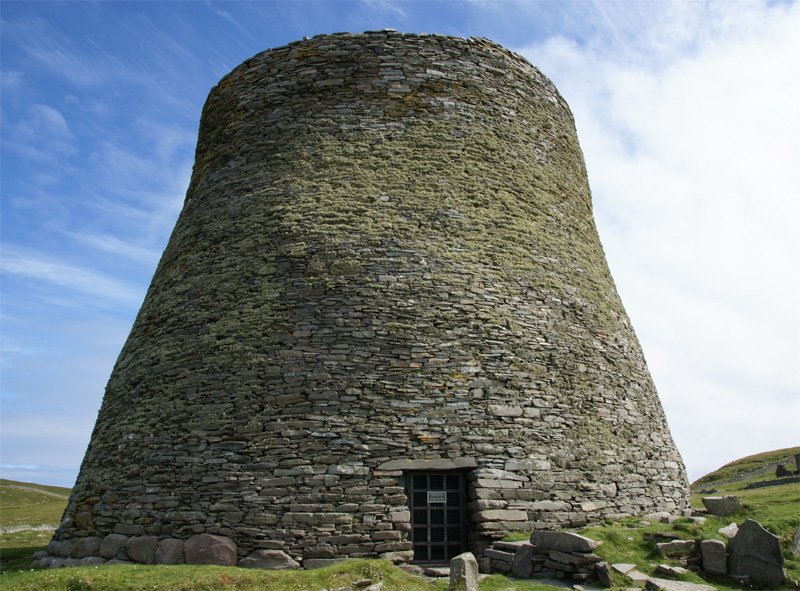
Rising 13 metres from the Shetland shore, Mousa Broch is the best-preserved Iron Age broch in the world — a circular drystone tower whose hollow double walls and internal staircase have survived two millennia of North Atlantic storms intact.
At a glance
Brochs are circular drystone hollow-walled towers unique to Scotland, built during the Iron Age, and Mousa is the finest surviving example of around 500 known. Standing on a low promontory on the uninhabited island of Mousa off the east coast of Shetland, the tower tapers from a base diameter of approximately 15 metres and walls up to 5 metres thick to a narrower top, reaching 13.3 metres — the tallest standing prehistoric building in Scotland. Built without mortar, its double-wall construction encloses an intra-mural gallery and a stone staircase that still spirals to the wallhead. The interior corbelled ledges once supported timber floors, and the narrow entrance passage at ground level is still walkable today.
Key facts
- Built: c. 100 BCE – 100 CE (Scottish Iron Age)
- Height: 13.3 metres — tallest standing broch in Scotland
- Wall thickness at base: up to 5 metres
- Construction: Drystone; hollow double-wall with intra-mural staircase and galleries
- Interior diameter: approximately 6 metres at ground level
- Location: Uninhabited island of Mousa, Shetland, Scotland
- Designation: Scheduled Ancient Monument; Historic Environment Scotland
- Literary record: Named in two Norse sagas (Egils saga and Orkneyinga saga) as a place of refuge
- Wildlife: Significant storm petrel (Hydrobates pelagicus) nesting colony in the walls
History
Brochs were built across Atlantic Scotland — the northern and western isles, Caithness, Sutherland, and Argyll — during the late Iron Age, with the greatest density in Shetland and Caithness. Their exact function remains debated: fortified towers of local elites, refuges for farming communities under threat of raid, or multifunctional structures. The sophisticated engineering of the double-wall system — distributing structural load, providing internal circulation, and insulating the interior — argues for a highly skilled specialist building tradition.
Mousa Broch’s historical record extends beyond archaeology into Norse literature. The Egils saga (13th-century Icelandic, set c. 900 CE) describes the broch as the hiding place of an eloping couple — Bjorn Brynjolfsson and Thora — who took refuge in Moseyjarborg against her father’s wishes. The Orkneyinga saga records a 12th-century siege of the broch, noting it was an unhandy place to attack. These references make Mousa one of very few prehistoric British monuments named in medieval literary sources. No systematic excavation of the interior has been carried out; floor deposits remain largely undisturbed.
What you see
The exterior is built of flat, coursed sandstone slabs laid without mortar, slightly battered inward for structural stability. The entrance is a low, narrow passage through the full wall thickness, with a door check and bar hole indicating a heavy timber door once secured it. Inside, the ground-floor interior — circular, approximately 6 metres across — is open to the sky. The intra-mural staircase winds upward between the two walls to the wallhead, accessing galleries at three levels. Corbelled scarcements projecting from the interior wall once supported timber floors, creating a multi-storey living space. Unusually, the wallhead survives close to its original height, still capped with original stones on one side.
Storm petrels: a living monument
The cavities between the inner and outer walls provide nesting sites for one of Scotland’s most significant European storm petrel (Hydrobates pelagicus) colonies — a small seabird that emerges only at night to avoid gull predation. Historic Environment Scotland runs guided night-time boat trips from Sandwick in June and July specifically to hear the petrels returning to their nests inside the ancient walls, combining a prehistoric monument, northern midsummer twilight, and close-range wildlife in one unforgettable experience.
Practical information
- Access: Seasonal ferry from Sandwick pier, south Shetland mainland (approx. 15 min). April–September; booking essential.
- Ferry: Tom Jamieson’s Mousa Boat. Also runs evening wildlife trips for storm petrel watching (June–July).
- On the island: No facilities. Bring food and water. Nature reserve: keep to paths during nesting season.
- Admission: Free to enter the broch; ferry fare is the main cost.
- Best time: June–September; June–July for the night petrel trips.
Getting there
Mousa Island lies off the east coast of Shetland, roughly 22 km south of Lerwick. The ferry departs from Sandwick village, reached by the A970 road. Lerwick connects to Aberdeen by overnight NorthLink ferry (12–14 hours) and by Loganair flights from several Scottish and UK airports. A hire car is recommended for Shetland travel; buses serve Sandwick from Lerwick.
Nearby
- Jarlshof (Sumburgh, c. 30 km south): Multi-period site with Neolithic, Bronze Age, Iron Age, Norse, and medieval remains — the most remarkable prehistoric site in Scotland outside Orkney.
- Clickimin Broch (Lerwick, c. 22 km north): A broch on a small loch within Lerwick; less well-preserved but easily accessible.
- Shetland Museum (Lerwick): Superb context for Iron Age, Norse, and maritime heritage, including artefacts from excavated brochs.
- Sumburgh Head RSPB Reserve: Puffins, gannets, and Arctic skuas at close range; panoramic views to Fair Isle.
Sources
- Historic Environment Scotland — Mousa Broch scheduled monument record
- Armit, I. (2003). Towers in the North: The Brochs of Scotland. Tempus.
- MacKie, E. W. (2007). The Roundhouses, Brochs and Wheelhouses of Atlantic Scotland. BAR.
- Egils saga (Icelandic, c. 13th century CE); Orkneyinga saga (c. 1200 CE)
- Wikipedia: Mousa Broch
Find it on the map
See this place and what’s around it →📷 Become a Cultural Heritage Online photographer
Share your photos of places: they stay published under your name as the author. The more they're seen, the more you get noticed — and soon a contest will reward the most appreciated photos.
Log in or sign up free to add a photo