
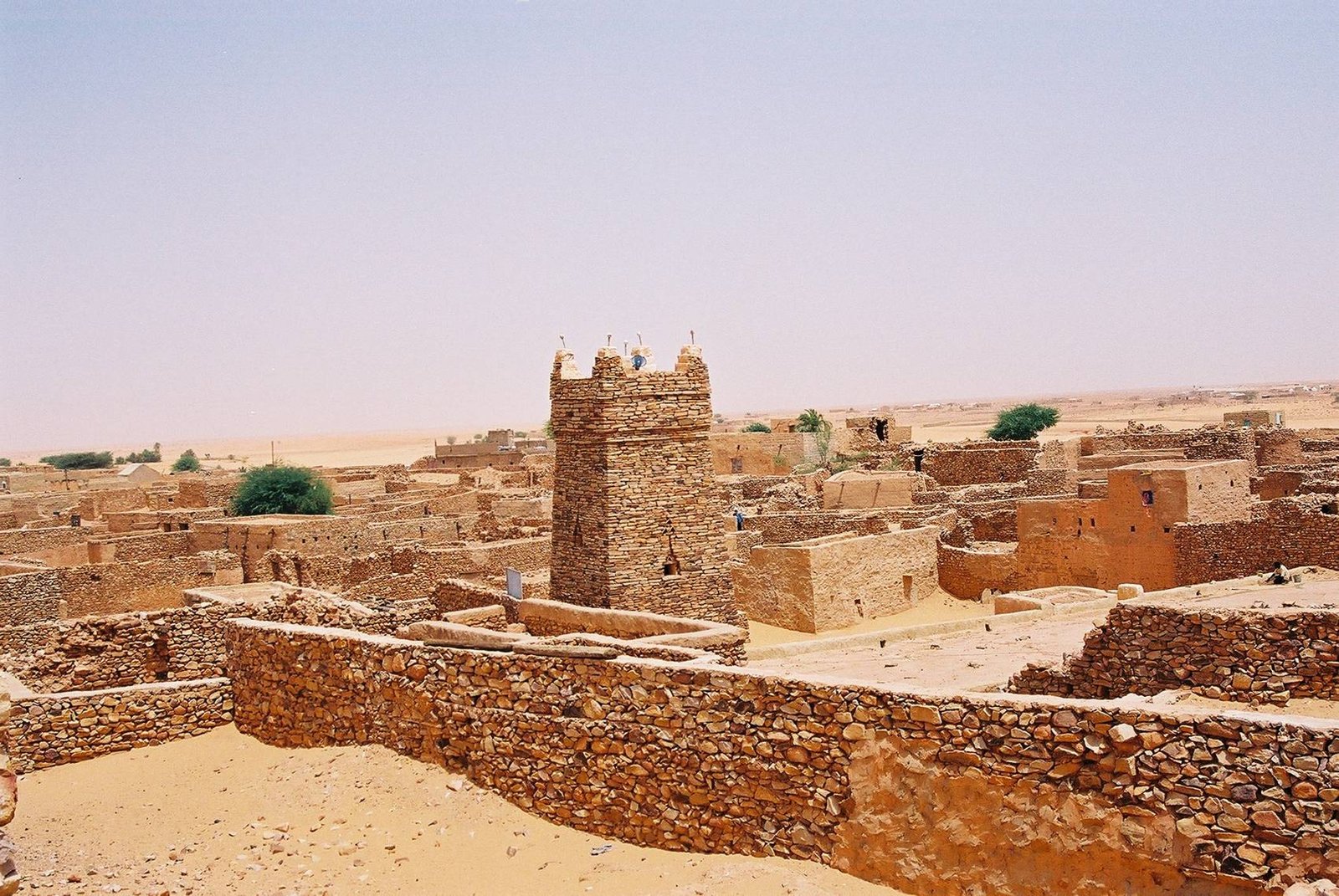
Chinguetti
The “seventh holy city of Islam” and the gathering point of West African pilgrims to Mecca — a medieval Saharan library city whose manuscript collections preserve centuries of Islamic learning as the dunes slowly reclaim its streets.
At a glance
Chinguetti lies in the Adrar Plateau region of central Mauritania, roughly 100 km east of the oasis town of Atar. Inscribed as UNESCO World Heritage Site in 1996 as part of the “Ancient Ksour of Ouadane, Chinguetti, Tichitt and Oualata” designation, it was for several centuries the principal assembly point in sub-Saharan West Africa for the annual trans-Saharan pilgrimage to Mecca. Today it is honoured as the seventh holy city of Islam. Five private family libraries preserve an estimated 3,000 to 5,000 manuscripts from the 13th to the 19th centuries. The old city survives in its southern quarter; the northern third has been buried under advancing Saharan dunes.
Key facts
- Founded: c. 13th century AD, Almohad/Marinid period
- Peak: 15th–17th centuries as pilgrimage hub and Islamic scholarship centre
- UNESCO: World Heritage Site 1996 — Ancient Ksour of Ouadane, Chinguetti, Tichitt and Oualata
- Manuscripts: approx. 3,000–5,000 surviving; theology, astronomy, mathematics, medicine, and law
- Threat: advancing Saharan dunes have buried the northern third of the old city
- Location: Adrar Region, Mauritania; approx. 100 km east of Atar
- Landmark: stone mosque with ostrich-egg-crowned minaret
History
Chinguetti was established around the 13th century as a waystation on the trans-Saharan caravan routes of the Adrar Plateau, founded by Berber traders who recognised the plateau’s water sources as an ideal staging ground for caravans linking the gold and salt trades of West Africa with Morocco and the Mediterranean world. The city grew rapidly as Muslim merchants formalised it into the principal pilgrimage station of sub-Saharan West Africa: for hundreds of years, pilgrims from the kingdoms of Mali, Songhai, Hausa, Borno, and the states of Senegambia converged on Chinguetti each year before setting out together across the Sahara toward Egypt and Mecca. At its peak in the 15th and 16th centuries, Chinguetti hosted caravans of tens of thousands of pilgrims in the surrounding valleys, and the wealth generated by that traffic financed mosques, schools, and the manuscript libraries that became the city’s enduring intellectual legacy.
Decline began from the 17th century as trans-Saharan trade routes shifted and French colonial pressure disrupted the interior pilgrimage economy. The city shrank and its manuscript collections lost their custodians’ capacity for maintenance. The Sahara, which had always pressed against the northern edge of the city, began to advance in earnest: by the 20th century the dunes had buried the northern third of the old town. The manuscripts — stored in palm-leaf chests and leather boxes without climate control — face ongoing risk from humidity fluctuations, insect damage, inheritance-driven fragmentation, and age.
What you see
The surviving southern quarter of Chinguetti’s old city preserves the built texture of a medieval Saharan trading town in fragile but inhabited continuity. Houses of local red sandstone bonded with desert mortar present blank walls to narrow alleyways, with domestic life oriented inward around shaded courtyards. The great mosque at the heart of the old quarter defines the skyline: a square minaret in the Saharan style, crowned with protruding timber beams and a cluster of ostrich eggs (a traditional symbol of purity in Saharan Islamic architecture), is visible from across the settlement. Date-palm gardens watered by ancient seguia irrigation channels survive on the outskirts, a narrow green belt against the surrounding desert.
The manuscript libraries are accessible through private arrangements with the custodian families. The manuscripts — Arabic calligraphy on paper and vellum, bound in leather or stored loose in chests — range from major theological commentaries to local legal records and astronomical tables, representing the intellectual life of a Saharan city at the intersection of West African and North African Islamic scholarship. The northern edge of the old town shows the advancing dune front: walls protrude from the sand, rooflines are swallowed, and the boundary between medieval city and active desert moves visibly from year to year.
Practical information
- Access: 4WD and local guide essential; 100 km track east of Atar
- Best season: November to February; summer temperatures exceed 45°C
- Accommodation: small guesthouses in the new settlement and near the old town
- Manuscript visits: arrange through guesthouses or guides; a contribution to custodian families is customary
- Security: verify current travel advisories before travel
- Photography: permitted in public spaces; ask permission for manuscripts and private homes
Getting there
The nearest airport with scheduled service is Atar (ATR), with occasional flights from Nouakchott. From Atar a 4WD track of approximately 100 km leads east to Chinguetti (2–3 hours). Nouakchott is approximately 10 hours by 4WD via Atar. No public transport operates on this route; a driver-guide experienced in desert navigation is essential.
Nearby
- Ouadane — another of the four UNESCO ksour, approx. 90 km northeast; a medieval caravan city on a clifftop plateau
- Atar — regional capital of Adrar, 100 km west; main service base for exploring the plateau
- Terjit Oasis — a palm-shaded canyon oasis approx. 45 km southwest of Atar
- Richat Structure (Eye of the Sahara) — vast circular geological formation visible from space, approx. 50 km northwest of Ouadane
Sources
- UNESCO World Heritage Centre — “Ancient Ksour of Ouadane, Chinguetti, Tichitt and Oualata” (whc.unesco.org)
- Norris, H. T. — The Tuaregs: Their Islamic Legacy and Its Diffusion in the Sahel (1975)
- McDougall, E. Ann — “A Topsy-Turvy World: Slaves and Freed Slaves in the Mauritanian Adrar” (1988)
- Wikipedia — “Chinguetti” (en.wikipedia.org/wiki/Chinguetti)
- UNESCO Advisory Bodies evaluation, Mauritanian submission 1996
Find it on the map
See this place and what’s around it →📷 Diventa un fotografo di Cultural Heritage Online
Condividi le tue foto dei luoghi: restano pubblicate con la tua firma come autore. Più vengono viste, più ti fai conoscere — e presto un concorso premierà le foto più apprezzate.
Accedi o registrati gratis per aggiungere una foto