
The UNESCO World Heritage village site in northeastern Thailand that overturned the prevailing model of Bronze Age origins in Southeast Asia, and produced the most recognisable painted pottery tradition in prehistoric Asia.
At a glance
Ban Chiang is a village in Nong Han district, Udon Thani Province, northeastern Thailand, and the type site of the Ban Chiang culture (c. 2100–200 BC). Inscribed as a UNESCO World Heritage Site in 1992, it preserves stratigraphic evidence showing that the people of the Khorat Plateau were casting bronze tools and weapons as early as 2100 BC — making them among the earliest Bronze Age metallurgists in Southeast Asia, and raising fundamental questions about whether Bronze Age technology reached Southeast Asia from China or developed independently in the region. The site is today presented through the Ban Chiang National Museum, built over actual excavation trenches that visitors can observe directly through glass.
Key facts
- Location: Nong Han district, Udon Thani Province, northeastern Thailand; approximately 50 km east of Udon Thani city
- Period: c. 2100–200 BC; Bronze Age from c. 2100 BC, Iron Age from c. 500 BC
- UNESCO status: World Heritage Site 1992
- Discovery: 1966 by US Peace Corps volunteer Stephen Young; excavated 1974–75 by the Fine Arts Department of Thailand and the University of Pennsylvania
- Deposit depth: Approximately 5.4 metres, spanning approximately 1,800 years of continuous occupation
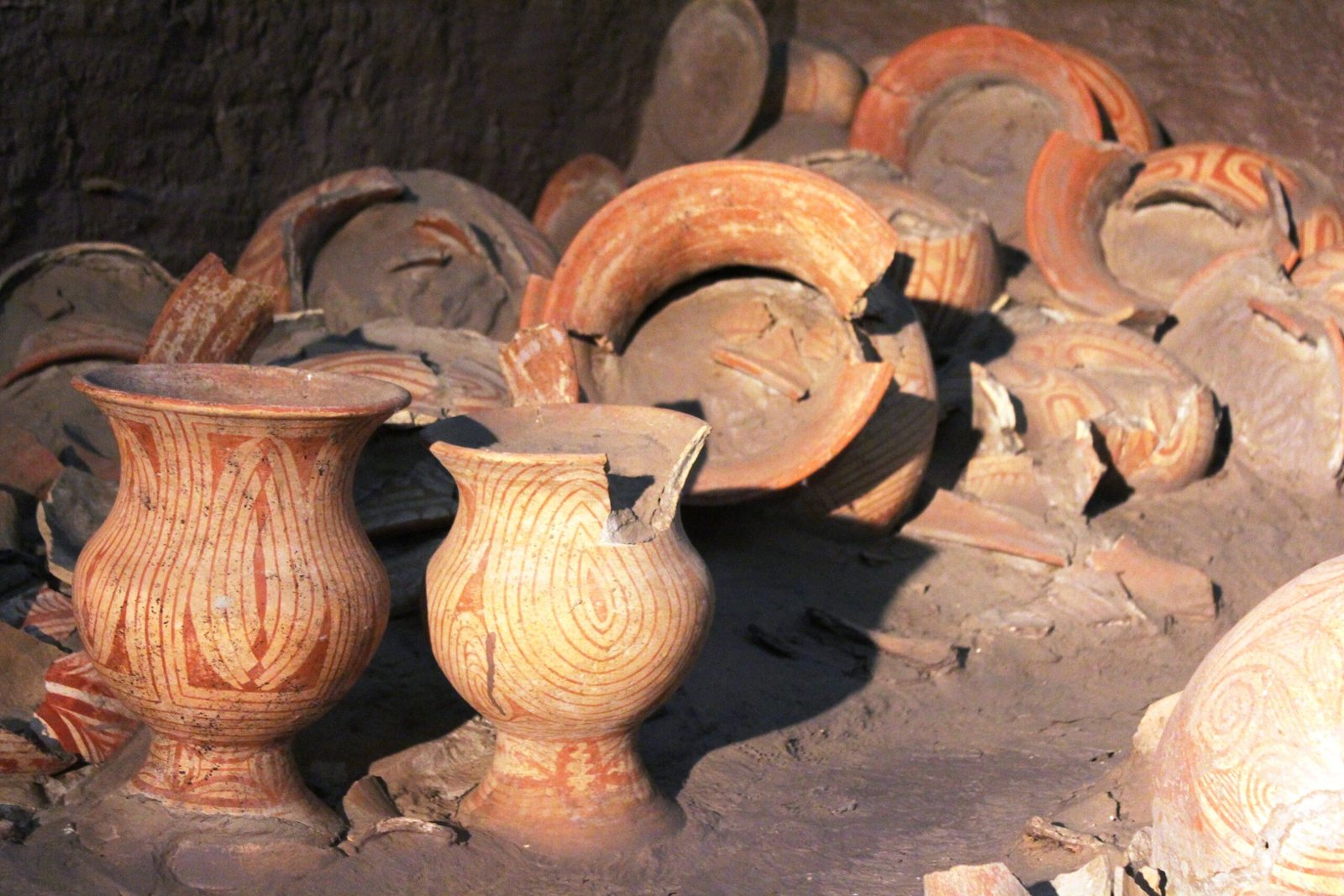
- Signature artefact: Coil-built pottery with swirling red-on-buff painted designs, unparalleled in any other Bronze Age culture of the region
- Visitor presentation: Ban Chiang National Museum on-site with glazed-floor excavation trenches showing burials and artefacts in original position
History
The site was discovered in 1966 when Stephen Young, a US Peace Corps volunteer, tripped over an exposed pot rim while walking through the village. Recognising the objects emerging from the ground as potentially ancient, he alerted authorities; the ensuing investigations eventually brought together the Fine Arts Department of Thailand and a University of Pennsylvania team led by Chester Gorman and Pisit Charoenwongsa for the definitive excavation of 1974–75. The excavators found a stratified deposit approximately 5.4 metres deep containing materials spanning approximately 1,800 years: in the lowest levels, bronze tools and weapons of an early type (socketed axes, spearheads, bracelets); in the upper levels from approximately 500 BC, iron objects; and throughout the entire sequence, the painted pottery that became the cultural hallmark of the site.
Initial radiocarbon dates, published in the 1970s, suggested that Ban Chiang’s bronze began as early as 3600 BC, which would have made it the world’s earliest known Bronze Age. Subsequent thermoluminescence dating and recalibration revised this to c. 2100 BC, still among the oldest in Southeast Asia and significantly earlier than previous assumptions. The debate about whether Bronze Age metallurgy here represents independent invention or diffusion from the north remains productive: current scholarly consensus favours independent development in the region, supported by the absence of transitional forms in the stratigraphic record that would suggest gradual importation of the technology.
After the 1974–75 excavation, the site became a national museum site and was placed on the UNESCO World Heritage List in 1992 as evidence of the earliest human settlements in Southeast Asia and as the type site of a prehistoric culture whose painted pottery is recognised as one of the most sophisticated ceramic traditions in the prehistoric world.
What you see
The Ban Chiang National Museum presents the archaeology of the site in two principal ways. Inside the museum building, showcases display the full typological sequence of Ban Chiang painted pottery: early-period vessels with simple incised decoration, middle-period pieces with swirling red curvilinear designs on buff clay (the most celebrated phase), and late-period pottery with bolder, more schematic patterns. The bronze and iron objects are smaller in number but include the socketed axes and spearheads that documented the metallurgical sequence. The painted pottery is immediately recognisable — fluid red spirals and organic forms on a warm buff ground — and original pieces appear in major museums worldwide (including the Metropolitan Museum of Art and the Smithsonian), though the finest concentrations remain in Thailand.
The most extraordinary element of the museum is the excavation trenches preserved under glazed floors, which allow visitors to see the skeletal remains of Bronze Age burials accompanied by their grave goods — pottery vessels placed around the body, bronze bracelets still on the wrist bones — exactly as they were found during excavation. This in-situ presentation, relatively rare in Asian archaeological site museums, makes the continuity of occupation and the burial customs of the Ban Chiang people immediately legible to visitors without specialised knowledge.
Practical information
- Opening hours: Wednesday–Sunday 08:30–16:30; closed Monday and Tuesday
- Admission: 150 THB adults; 75 THB children; free for Thai nationals on Sundays
- Facilities: Museum shop with replica pottery; explanatory signage in Thai and English; guided tour available on request
- Photography: Permitted inside museum; no flash over the excavation trenches
- Time required: 1.5–2 hours for museum and outdoor grounds
Getting there
Ban Chiang village is approximately 50 km east of Udon Thani city in northeastern Thailand. The most practical approach from Udon Thani is by songthaew (shared taxi pickup truck) from the Udon Thani bus terminal towards Ban Chiang, a journey of approximately 1 hour. Private hire taxis or car rental from Udon Thani are also widely available. The nearest major airport is Udon Thani International Airport (UTH), with direct flights from Bangkok (Suvarnabhumi and Don Mueang) and connections to Chiang Mai; the airport is approximately 60 km from the site. From Bangkok, an overnight train from Hua Lamphong station reaches Udon Thani in approximately 11 hours.
Nearby
- Udon Thani: The provincial capital (50 km west) offers the region’s widest range of hotels, restaurants, and transport connections, and has its own smaller museum with Ban Chiang material
- Nong Khai: A Mekong River town on the Lao border (55 km north of Udon Thani), famous for the strange Buddha sculpture garden Sala Kaew Ku
- Khao Noi: A prehistoric mound site near Ban Chiang with surface finds of Ban Chiang-style pottery, accessible as a short excursion for specialists
- Luang Prabang, Laos: The UNESCO World Heritage city is reachable by bus from Nong Khai across the Friendship Bridge, for travellers extending a northeast Thailand itinerary
Sources
- UNESCO World Heritage Centre: Ban Chiang Archaeological Site (whc.unesco.org/en/list/575)
- Gorman, C. & Charoenwongsa, P. (1976). “Ban Chiang: a mosaic of impressions from the first two years.” Expedition 18(4): 14–26. University of Pennsylvania Museum.
- White, J. C. (1982). Ban Chiang: Discovery of a Lost Bronze Age. University of Pennsylvania Museum of Archaeology and Anthropology.
- Higham, C. (1989). The Archaeology of Mainland Southeast Asia. Cambridge University Press.
- Fine Arts Department of Thailand / Thai National Museum: Ban Chiang National Museum permanent collection documentation.
Find it on the map
See this place and what’s around it →📷 Become a Cultural Heritage Online photographer
Share your photos of places: they stay published under your name as the author. The more they're seen, the more you get noticed — and soon a contest will reward the most appreciated photos.
Log in or sign up free to add a photo