
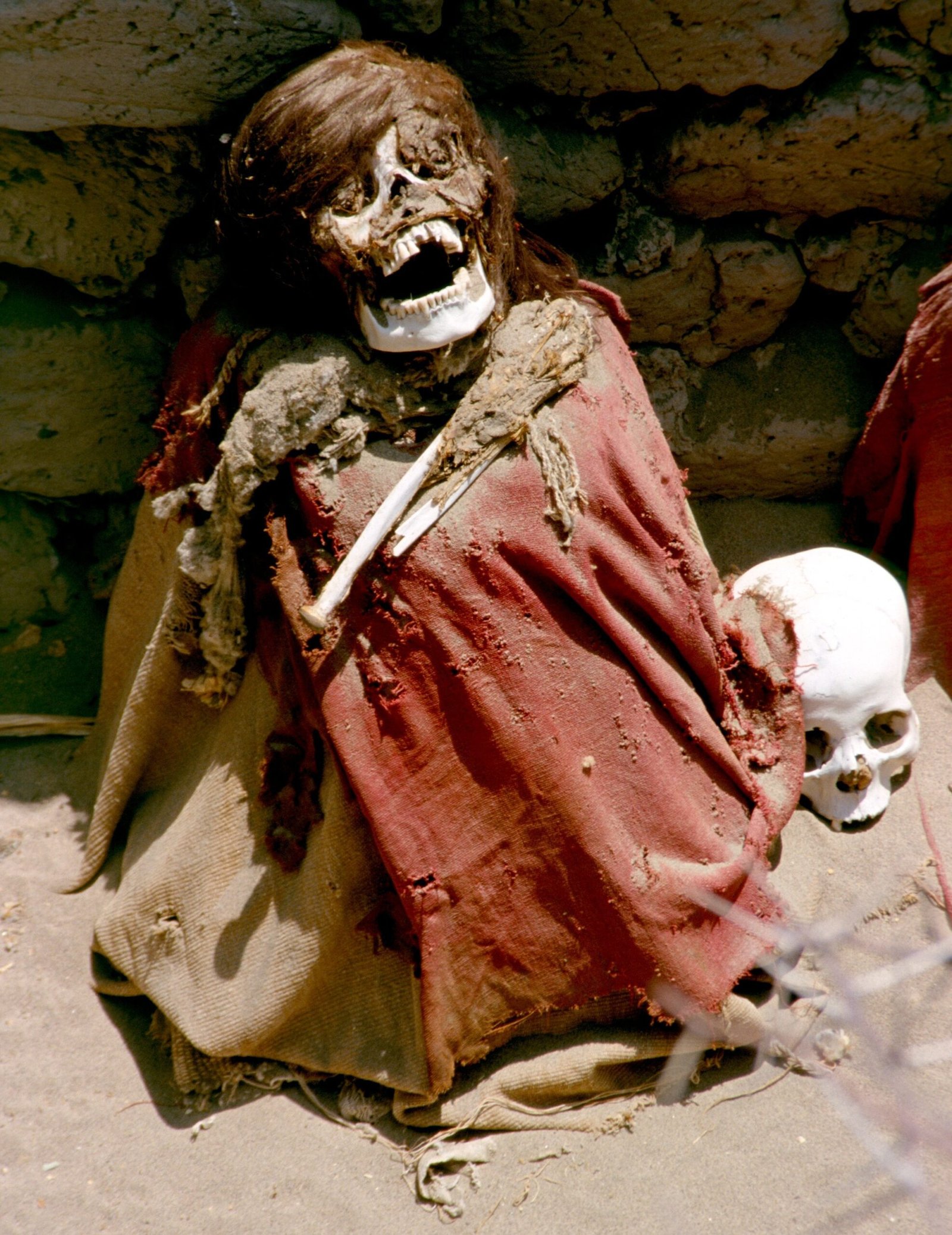
Chauchilla Cemetery
An open-air desert necropolis where Nazca culture mummies — skin, hair, and painted textiles intact — have rested in their original burial positions for over a thousand years under the Peruvian sun.
At a glance
Approximately 30 km south of the city of Nazca in the Ica Region of southern Peru, the Chauchilla Cemetery is one of the most visually arresting archaeological sites in the world. Burial pits cut into the desert floor hold mummified individuals from the Nazca culture (c. 200–900 AD), preserved by the extreme aridity of the Atacama-adjacent environment. Seated with knees drawn to the chin and wrapped in layers of decorated textiles, the mummies retain long black hair, painted skin, and ceramic grave goods arranged exactly as they were placed over a millennium ago. After decades of looting scattered the site, Peruvian authorities consolidated and restored it in the 1990s, returning intact mummies to their pits under protective wire covers for visitors to observe.
Key facts
- Culture: Nazca (c. 200–900 AD)
- Location: Ica Region, Peru — 30 km south of Nazca city
- Preservation agent: Extreme desert aridity (Atacama-adjacent climate)
- Burial posture: Seated, foetal position — knees to chin, standard Andean rite
- Notable feature: Intact long hair exceeding one metre in length on some mummies
- Associated site: Nazca Lines, approximately 30 km north
- Discovery: Documented by scientists in the 1920s after extensive prior looting
History
The Chauchilla Cemetery served as a burial ground for the Nazca culture, a pre-Columbian civilisation that flourished in the river valleys of southern Peru between approximately 100 BC and 800 AD, and is best known today for the Nazca Lines — the vast geoglyphs etched into the pampa. The Nazca practiced a distinctive funerary tradition: the dead were seated in a foetal position, wrapped in successive layers of fine textiles, and interred in shallow pits in the desert, where the absence of moisture arrested decomposition. Ceramic vessels, weaving tools, and food offerings were placed alongside the body, and hair — sometimes supplemented with false extensions of additional human hair added after death as part of the burial ritual — was elaborately prepared.
When scientists from Lima arrived at Chauchilla in the 1920s, they found a landscape that had been systematically looted for generations by huaqueros (grave robbers): thousands of scattered bones and textile fragments littered the ground between the burial pits, and the intact contents of most tombs had been removed. The scientific value of the surviving intact burials was nonetheless extraordinary. A major consolidation effort in the 1990s cleared the surface debris, re-examined surviving burials, and established an organised open-air site with a defined visitor path, returning intact mummies to their original positions under protective wire-mesh covers that allow viewing while preventing further disturbance.
What you see
Visitors follow a defined path among approximately a dozen excavated burial pits, each containing one or more mummified individuals displayed in their original burial positions. The figures are unmistakably human: brown or dark skin drawn taut over bone, long black hair fanned around the skull or falling forward, and textile wrappings — patterned in geometric designs typical of Nazca weaving — still partially intact around the torso and legs. Ceramic vessels in characteristic Nazca polychrome (vivid red, black, white, and tan designs on a cream ground) are visible alongside the mummies. Some pits contain multiple individuals of different ages; the arrangement suggests family or community groups.
The wider landscape of the site bears evidence of the pre-consolidation looting: between the preserved pits, fragments of bone, textile, and ceramic remain visible on the desert surface. This contrast — between the protected, restored burials and the surrounding evidence of destruction — gives Chauchilla a particular historical charge. The desert setting itself is dramatic: flat, ochre-coloured pampa extending to distant mountains under an intense sun, with almost no vegetation. The dryness that preserved the mummies is immediately perceptible.
Practical information
- Access: Open daily; entrance fee applies (combined tickets with Nazca Lines available)
- Getting there: 30 km south of Nazca by taxi or tour vehicle — no public transport to the site
- Best time: Early morning or late afternoon to avoid midday heat; the desert sun is intense year-round
- Photography: Permitted; no flash inside protective enclosures
- Guides: Recommended — licensed guides explain the burial sequence and Nazca culture context
- Combined visit: Most visitors combine Chauchilla with the Nazca Lines overflight and the Maria Reiche Museum
Getting there
Chauchilla Cemetery is located 30 km south of Nazca city on the road toward Palpa. From Nazca, taxis and organised tour vehicles make the 30-minute journey. The site is not served by public buses. Most visitors to the Nazca region arrange a combined tour from Nazca that includes the Chauchilla visit and the Nazca Lines overflight; reputable agencies in the city offer half-day and full-day programmes. The nearest airport with regular connections is in Lima (approximately 450 km north); domestic flights from Lima to the Pisco / Ica area reduce overland travel time.
Nearby
- Nazca Lines — the enigmatic geoglyphs of the Nazca pampa, approximately 30 km north; best experienced from the air or from the viewing tower on the Pan-American Highway
- Cahuachi — the principal ceremonial centre of the Nazca culture, a large adobe pyramid complex on the south bank of the Nazca River, approximately 25 km west of Nazca city
- Maria Reiche Museum — documents the life and work of the German mathematician who devoted her career to studying the Nazca Lines; located near the Lines on the Pan-American Highway
- Ica Regional Museum — holds significant collections of Nazca ceramics, textiles, and human remains including mummies from the region
Sources
- Proulx, D.A. — A Sourcebook of Nasca Ceramic Iconography. University of Iowa Press, 2006
- Silverman, H. & Proulx, D.A. — The Nasca. Blackwell Publishers, 2002
- Wikipedia — “Chauchilla Cemetery” (en.wikipedia.org/wiki/Chauchilla_Cemetery)
- Ministerio de Cultura del Peru — official site administration records
- Museo Regional de Ica — documentation of Nazca funerary practices
Find it on the map
See this place and what’s around it →📷 Diventa un fotografo di Cultural Heritage Online
Condividi le tue foto dei luoghi: restano pubblicate con la tua firma come autore. Più vengono viste, più ti fai conoscere — e presto un concorso premierà le foto più apprezzate.
Accedi o registrati gratis per aggiungere una foto