
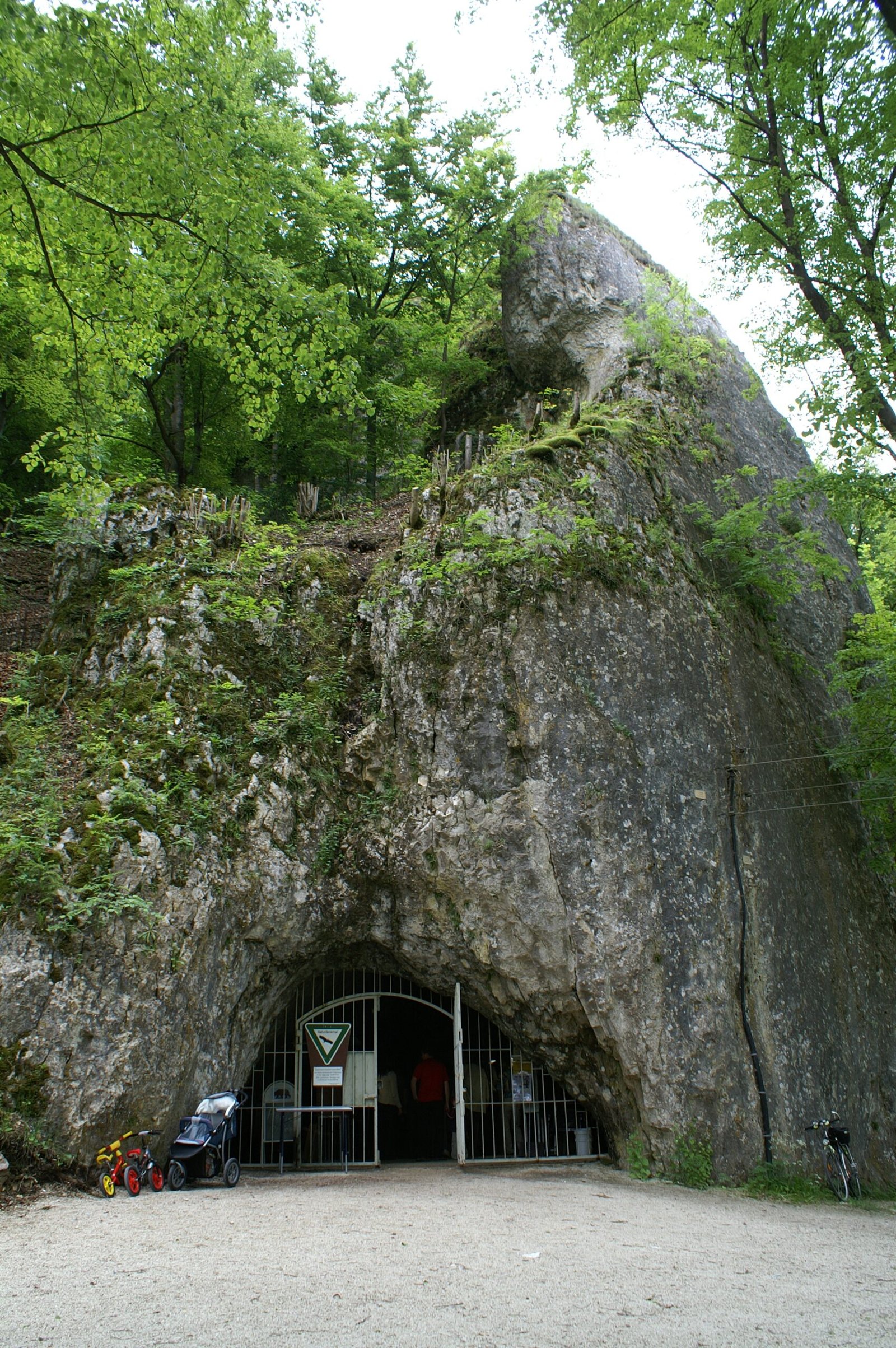
Approximately 700 prehistoric figures painted on white limestone walls in northwestern Bulgaria — using bat guano as pigment — include hunting scenes, solar symbols, erotic compositions unique in European prehistoric art, and a composition of 366 figures interpreted as a prehistoric solar calendar.
At a glance
Near the village of Rabisha in the Vidin Province of northwestern Bulgaria, approximately 30 km north of the town of Vidin and 4 km from the Romanian border, Magura Cave contains one of the most extensive and iconographically unusual collections of prehistoric cave art in southeastern Europe. Approximately 700 figures and compositions cover around 100 square metres of cave wall across multiple chambers, executed in a dark reddish-brown paste made from bat guano applied to the white limestone — a pigment source unique in known European prehistoric art. The paintings span multiple periods from approximately 10,000 to 1,600 BC, with the most numerous figures from the Late Neolithic and Early Bronze Age phases (c. 4,000–2,000 BC). Subjects include hunting scenes, solar symbols, ritual dancing figures, agricultural scenes, and — most unusually — explicitly erotic compositions of human couples, unparalleled in European prehistoric rock art. The cave is also a significant bat habitat, with protected species that continue to produce the guano pigment used by the site’s prehistoric inhabitants.
Key facts
- Figures: Approximately 700 individual figures across approximately 100 m² of cave wall
- Pigment: Bat guano — unique in European prehistoric cave art; applied as a dark reddish-brown paste
- Period: c. 10,000–1,600 BC (Palaeolithic through Early Bronze Age)
- Unique feature: Erotic compositions of human couples — unparalleled in European prehistoric art
- Calendar interpretation: A group of 366 figures has been proposed as a prehistoric solar calendar
- Location: Near Rabisha village, Vidin Province, northwestern Bulgaria; 30 km north of Vidin
- Cave length: Approximately 2.5 km of passages; major decorated gallery accessible by guided tour
History
Magura Cave was first explored systematically in 1921 by a Bulgarian geological survey, and the prehistoric paintings were documented beginning in the 1950s and 1960s by the archaeologist Aleksander Manov and colleagues from the Bulgarian Academy of Sciences. Radiocarbon and contextual dating placed the main body of paintings in the Chalcolithic and Early Bronze Age periods (approximately 4,000–2,000 BC), with some figures tentatively attributed to earlier phases based on style and superimposition. The cave was designated a natural landmark and opened to visitors in the 1960s, becoming one of Bulgaria’s most visited natural and archaeological sites.
The unusual pigment — bat guano rather than the red ochre, manganese dioxide, or charcoal used in most European prehistoric cave art — is explained by the cave’s ecology. Magura hosts several bat colonies whose accumulated droppings create a mineral-rich dark paste that the prehistoric painters appear to have collected and applied with fingers, sticks, or bone tools. The guano pigment was stable in the cave’s controlled humidity and temperature, preserving the images for thousands of years; the same bat species continue to inhabit the cave today, now protected under Bulgarian and EU law, and continue to produce guano in quantities that archaeologists estimate would have been ample for the historic painters.
A composition of 366 figures arranged in a specific spatial pattern was identified in the 1970s by the researcher Alexander Marshack and later by Bulgarian scientists as a possible prehistoric solar calendar — with subgroups of figures interpretable as months (groups of 30 or 31 figures), solstice and equinox markers, and an intercalary day. This interpretation, while not universally accepted, has been supported by subsequent statistical analyses of the figure groupings and has made the “Magura calendar” one of the most discussed claims in southeastern European prehistoric archaeology.
What you see
Magura Cave is a large karstic cave system approximately 2.5 km long, with several major chambers. The guided tour follows the decorated gallery, where the paintings cover the white limestone walls in a range of compositions from simple handprints and isolated geometric signs to multi-figure narrative scenes. The most striking images are the hunting scenes: running deer, ibex, wolves, and boars rendered in confident silhouette strokes that convey movement with economy. The solar symbols — circular discs with radiating spikes and concentric ring designs — are among the largest images, some measuring over a metre in diameter. The erotic compositions, located in a specific section of the gallery, are explicit by the standards of European prehistoric art and have attracted considerable academic and popular attention; they are not concealed from visitors.
The cave’s physical environment is dramatic: the entrance chamber is large enough to accommodate small concerts (the cave has been used for this purpose), and the temperature is a stable 12–14 degrees Celsius year-round. Lighting is installed throughout the tourist route. The cave also contains stalactites, stalagmites, and cave formations in the non-painted sections. Bat colonies are visible in the upper sections of the cave during certain seasons; the species present include Rhinolophus ferrumequinum and Myotis myotis, both protected under the EU Habitats Directive.
Practical information
- Address: Magura Cave, village of Rabisha, Belogradchik Municipality, Vidin Province, Bulgaria
- Hours: Open daily year-round; summer hours longer; check magura-cave.com for current times
- Admission: Ticketed guided tour; price approximately 10 BGN (c. 5 EUR) for adults
- Tour duration: Approximately 40–50 minutes guided tour of the decorated section
- Temperature: 12–14°C inside year-round; bring a jacket
- Photography: Permitted (no flash on paintings)
Getting there
The cave is located approximately 30 km north of Vidin, which is the largest city in northwestern Bulgaria. From Vidin, take Road 111 north towards Belogradchik, then follow signs to Rabisha and Magura Cave (approximately 40 minutes by car). Vidin is connected to Sofia by road (approximately 200 km, 3 hours) and by a Danube ferry crossing to Calafat, Romania, giving access from Romania via the Danube bridge. Public transport from Vidin to Rabisha is infrequent; a rental car or taxi is practical for a day trip. The nearest international airport is Sofia (SOF), approximately 215 km southeast.
Nearby
- Belogradchik Rocks (~20 km south) — dramatic red sandstone formations, a UNESCO-proposed natural site; Belogradchik Fortress is built among and onto the rock formations
- Vidin Medieval Fortress (Baba Vida) (~30 km south) — the best-preserved medieval fortress in Bulgaria, on the Danube bank; 10th–14th century construction
- Calafat, Romania (~35 km north, via Danube bridge) — access point for Oltenia region of Romania; the Danube here is at its most dramatic width
Sources
- Manov, A. (1960). The Cave Magura. Bulgarian Academy of Sciences, Sofia. (In Bulgarian)
- Marshack, A. (1972). The Roots of Civilization. McGraw-Hill, New York. (Includes discussion of Magura calendar hypothesis)
- Garvanov, I., & Garvanova, M. (2015). New dimensions of rock art at Magura Cave. Journal of Archaeological Science: Reports, 4, 394–405.
- Chokhadzhiev, S. (2007). Rock art in Bulgaria: Current state and perspectives. Archaeologia Bulgarica, XI(2), 1–20.
- Official website: magura-cave.com.
Find it on the map
See this place and what’s around it →📷 Become a Cultural Heritage Online photographer
Share your photos of places: they stay published under your name as the author. The more they're seen, the more you get noticed — and soon a contest will reward the most appreciated photos.
Log in or sign up free to add a photo