
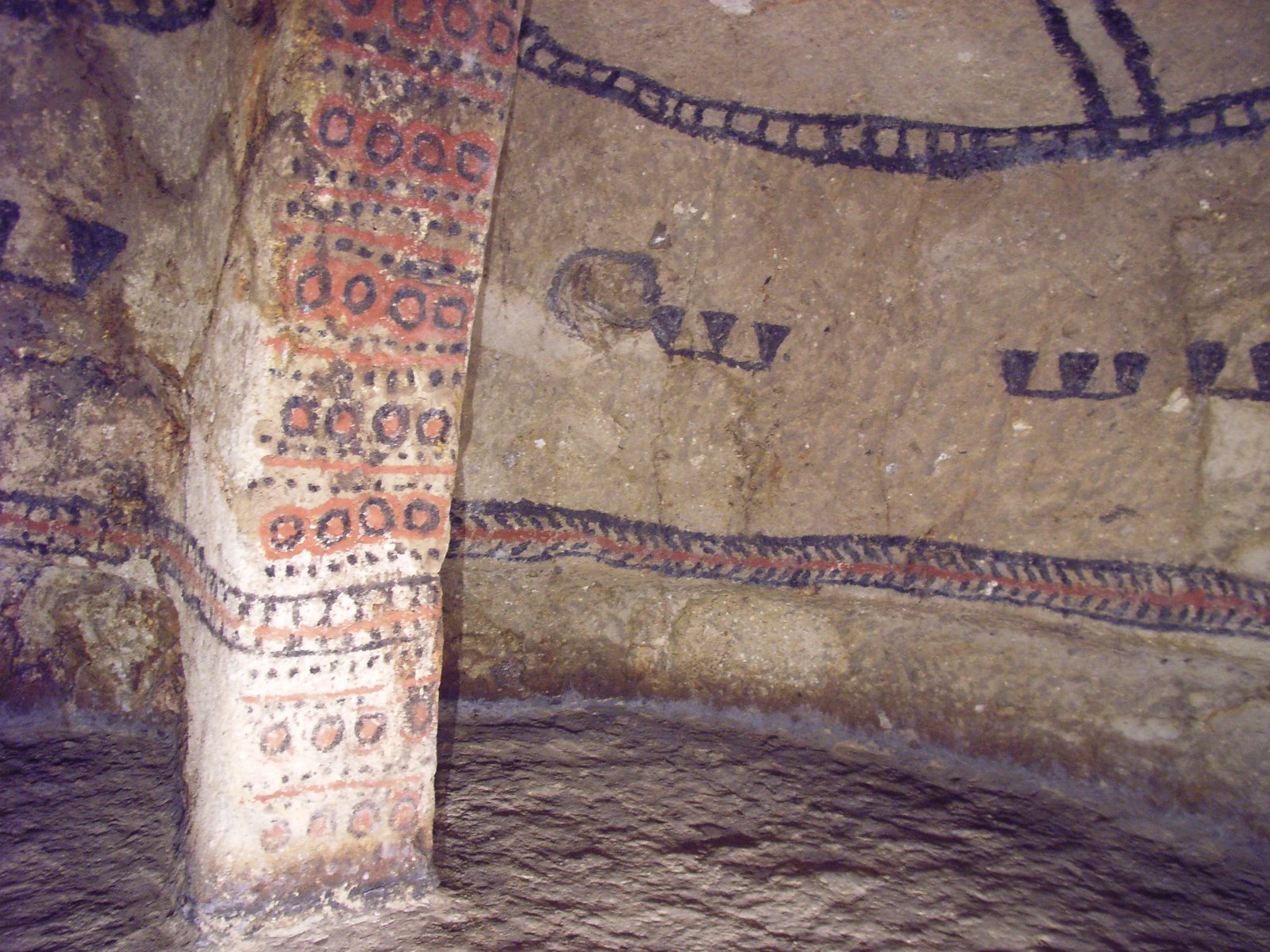
In the highland Andes of southwestern Colombia, the Tierradentro archaeological zone preserves over 100 documented underground burial chambers (hypogea) painted with vivid geometric and zoomorphic mineral-pigment designs — the most elaborate pre-Columbian tradition of underground funerary architecture in South America. UNESCO World Heritage Site 1995.
At a glance
Tierradentro lies in the Cauca Department of southwestern Colombia, in the area around the town of Inzá at altitudes between 1,700 and 2,700 metres. Its hypogea — carved into the volcanic tuff of steep Andean hillsides — date from approximately 600–900 AD and represent a funerary tradition with no exact parallel elsewhere in pre-Columbian America. More than 100 chambers are accessible to visitors, distributed across five major clusters spread across a dramatic landscape of terraced valleys and panoramic ridgelines. The culture that built Tierradentro is not identified with any historically named people; the site may represent ancestors of the present-day Nasa (Páez) indigenous people, though the link remains disputed.
Key facts
- Location: Inzá, Cauca Department, Colombia — 1,700–2,700 m altitude
- Period: c. 600–900 AD (pre-Columbian; culture not identified)
- Type: Underground hypogea (burial chambers) carved in volcanic tuff
- Scale: Over 100 accessible chambers; an estimated 400+ in the landscape
- Decoration: Geometric and zoomorphic paintings in red, black, and white mineral pigments
- UNESCO WHS: 1995 (alongside San Agustín Archaeological Park)
- Clusters: Segovia, El Duende, Alto de San Andrés, El Tablón, La Chaquira
History
The hypogea of Tierradentro were constructed between approximately 600 and 900 AD by a culture that left no written record and is not identified with any historically named pre-Columbian people. The region was inhabited before and after the florescence of the hypogea-building tradition, and the present-day Nasa (Páez) people of the Cauca highlands are sometimes proposed as descendants of the builders, though the Nasa themselves do not consistently claim the chambers as ancestral. The site was known to Spanish colonisers but not systematically studied until the 20th century, when archaeological investigation accelerated following Colombia’s cultural heritage legislation of the 1960s–70s.
The UNESCO inscription in 1995 — shared with San Agustín Archaeological Park 200 km to the south — recognised Tierradentro as an outstanding example of pre-Columbian funerary culture of exceptional universal value. The inscription prompted improved access infrastructure, though the site’s remote location in a mountainous zone affected by Colombian internal conflict has kept visitor numbers modest relative to its cultural significance.
What you see
The hypogea range from small shallow oval pits to large domed chambers up to 12 metres in diameter and 7 metres deep, accessed by a spiral staircase cut from the living volcanic rock. The largest chambers have domed ceilings supported by carved stone columns, with walls entirely covered in painted decoration: concentric diamonds, interlocking spirals, anthropomorphic figures with large circular eyes and elongated bodies rendered in red ochre, black manganese, and white calcium pigments that remain remarkably vivid despite 1,200 years of burial. The quality of carving and painting — achieved by lamplight in cramped underground conditions — represents an extraordinary commitment of skilled labour to funerary ritual.
Above ground, the five cluster sites also contain stone statuary and funerary urns associated with secondary burial practices. The La Chaquira cluster features petroglyphs on cliff faces above the river. Walking between clusters requires several hours on foot across steep terrain; the panoramic views from the hilltop burial grounds over the Cauca valley are among the most dramatic settings of any archaeological site in South America.
Practical information
- Admission: Site entrance fee applies; on-site museum included
- Hours: Generally 8:00–16:00 (confirm locally, hours vary by season)
- Museum: The Tierradentro Museum near Segovia displays ceramics, urns, and explanatory panels
- Guides: Local guides available and recommended for inter-cluster walks
- Altitude: Allow acclimatisation time; the site sits at 1,700–2,700 m
- Best season: Dry season (December–February, June–August) for easier path conditions
Getting there
Tierradentro is reached from Popayán (approximately 130 km to the southwest) or from Neiva (approximately 150 km to the east). By road, the journey from Popayán takes 4–5 hours; shared minibuses connect Popayán with Inzá and San Andrés de Pisimbalá, the village nearest the main clusters. The nearest airport is Guillermo León Valencia Airport in Popayán. There is no road connection between individual clusters — inter-site movement is on foot along steep dirt paths.
Nearby
- San Agustín Archaeological Park — UNESCO WHS 1995; monumental stone funerary sculpture approximately 200 km south
- Popayán — colonial White City of the Colombian Andes; historic centre and base for visiting Tierradentro
- Puracé National Park — volcanic landscape with sulphur fumaroles and Andean fauna, between Popayán and Tierradentro
- La Chaquira petroglyphs — pre-Columbian rock carvings within the Tierradentro zone itself
Sources
- UNESCO World Heritage List — Tierradentro, 1995: whc.unesco.org/en/list/743
- Chaves Mendoza, Álvaro & Puerta Restrepo, Mauricio — Tierradentro, Colcultura / El Áncora Editores, 1986
- Instituto Colombiano de Antropología e Historia (ICANH): icanh.gov.co
- Langebaek, Carl Henrik — Pre-Columbian Colombia in The Oxford Handbook of the Archaeology of Latin America, Oxford University Press, 2019
- Wikipedia — Tierradentro: en.wikipedia.org/wiki/Tierradentro
Find it on the map
See this place and what’s around it →📷 Become a Cultural Heritage Online photographer
Share your photos of places: they stay published under your name as the author. The more they're seen, the more you get noticed — and soon a contest will reward the most appreciated photos.
Log in or sign up free to add a photo