

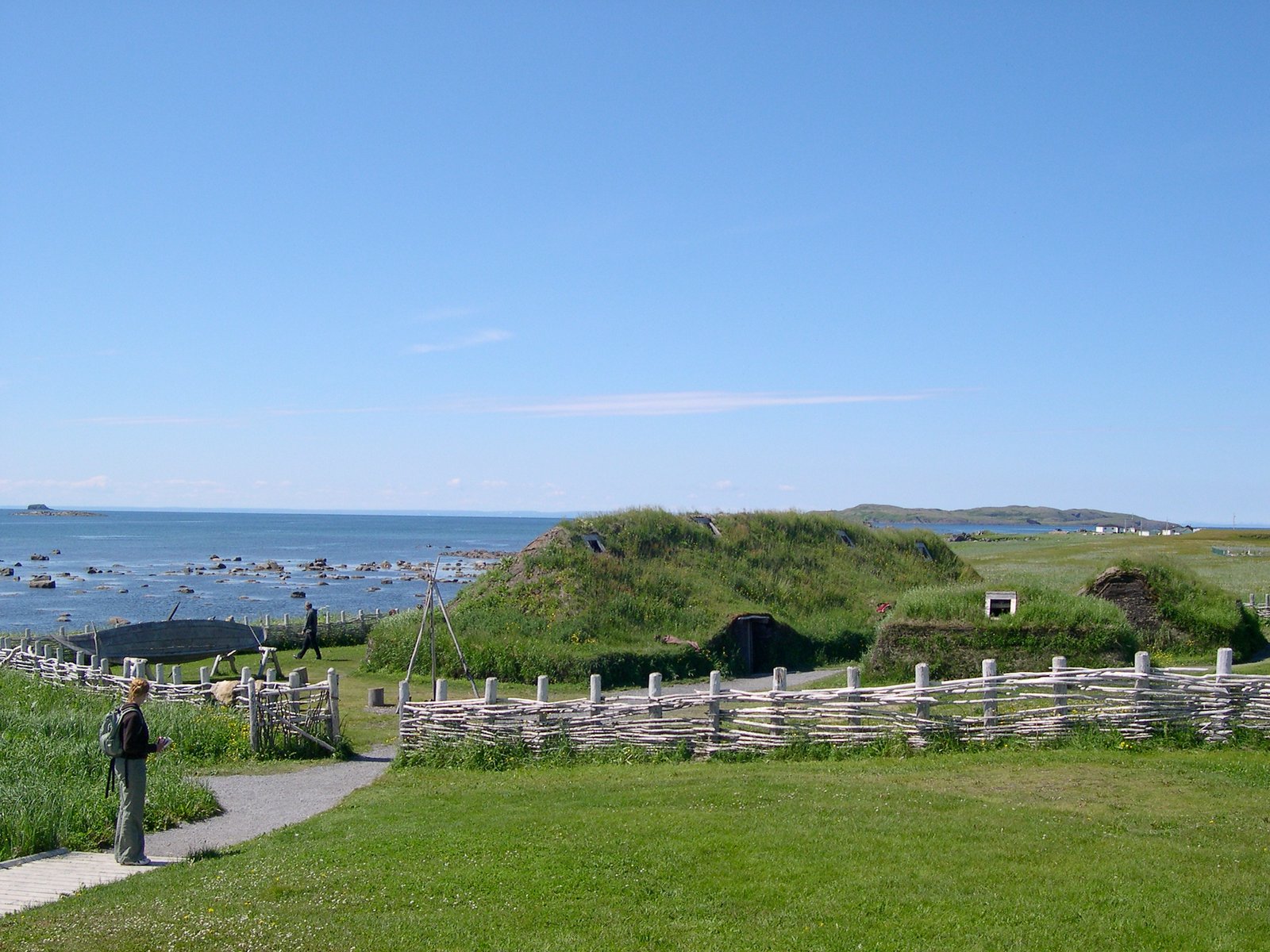
The only confirmed Norse settlement in North America, dated to c. 1000 AD — physical proof of a trans-Atlantic crossing 500 years before Columbus, matching the Vinland sagas of Leif Eriksson, and the first site in the world inscribed on the UNESCO World Heritage List in 1978.
At a glance
On the northernmost tip of Newfoundland, Canada, L'Anse aux Meadows contains the only confirmed physical evidence of Norse presence in North America approximately 500 years before Columbus. The site preserves eight turf-built structures — three large halls and five smaller buildings including a smithy and carpentry workshop — dated by radiocarbon to approximately 1000 AD. Discovered in 1960 by Norwegian explorer Helge Ingstad and archaeologist Anne Stine Ingstad, it matches the description in the Norse sagas of Leif Eriksson's Vinland base camp. It was the first site inscribed on the UNESCO World Heritage List in 1978 and remains the only proven Norse settlement site in North America.
Key facts
- Location: Épaves Bay, northern tip of Newfoundland, Canada
- UNESCO WHS: 1978 (first site ever inscribed on the World Heritage List)
- Period: c. 1000 AD, Norse (corresponding to the sagas of Leif Eriksson)
- Structures: 8 turf buildings (3 halls + 5 workshops including iron smithy)
- Key finds: Bronze ring-pin (Scandinavian type), stone oil lamp (Icelandic type), iron rivets, butternuts (indicating Norse travel 1,000 km further south)
- Discovery: Helge Ingstad & Anne Stine Ingstad, 1960; excavated 1961–1968
- Duration of occupation: Approximately 3–10 years
History
Norse expansion westward from Scandinavia followed a chain of island-stepping: the Faroe Islands (settled c. 800 AD), Iceland (c. 870 AD), Greenland (c. 985 AD, by Eirik the Red), and finally the coastline of North America itself. According to the Grœnlendinga saga and Íriks saga rauða, Leif Eriksson sailed west from Greenland around 1000 AD and established a base camp called “Vinland” — whose location was debated for centuries but is now confirmed as L'Anse aux Meadows. The site appears to have served as a staging post for further exploration southward rather than as a permanent colony, occupied for only a few years before being abandoned, likely due to conflicts with indigenous people the Norse called “Skraelings.”
The modern discovery came in 1960 when Helge Ingstad, searching for Vinland based on saga descriptions of the coastline, identified the site from a conversation with local resident George Decker. His wife, archaeologist Anne Stine Ingstad, led excavations from 1961 to 1968, recovering approximately 800 artefacts that unambiguously identified the site as Norse: a bronze ring-pin of a type used exclusively in Scandinavia in the 10th–11th centuries, a spindle whorl of soapstone (Scandinavian material), and butternuts whose northernmost natural range ends far south of Newfoundland, indicating the Norse explored at least as far as New Brunswick or Quebec. Radiocarbon dating confirmed the c. 1000 AD date. UNESCO inscribed the site in 1978 — as the very first cultural site on the World Heritage List — and it is now managed by Parks Canada as a National Historic Site.
What you see
The archaeological site consists of low turf mounds — the collapsed remains of eight buildings — in an open meadow above a small stream near Épaves Bay. The mounds are subtle: only a trained eye would identify them as structural remains without the interpretive signage provided by Parks Canada. Adjacent to the archaeological site, Parks Canada has constructed three full-scale reconstructions of Norse turf buildings based on the excavated floor plans and comparable Icelandic and Greenlandic structures of the period — large, dark turf-walled halls with low doorways and an interior lit by central hearths, giving visitors a visceral sense of the scale and atmosphere of a Norse base camp around 1000 AD.
The interpretive centre displays artefacts recovered during excavation, including replicas of the bronze ring-pin and the original soapstone spindle whorl, alongside detailed explanations of the Norse sagas and the Ingstad discovery narrative. Costumed interpreters in period Norse dress occupy the reconstructed buildings during summer months, demonstrating craftwork and answering questions from the viewpoint of the people who would have lived and worked here in 1000 AD.
Practical information
- Open: June–early October; limited off-season access
- Entry: Parks Canada fee; free with Discovery Pass
- Facilities: Visitor centre, interpretive centre with artefact displays, guided tours, reconstructed buildings
- Nearest town: St. Anthony, Newfoundland, approximately 35 km south
- Accessibility: Partially accessible; interpretive centre fully accessible
Getting there
L'Anse aux Meadows is approximately 35 km north of St. Anthony, Newfoundland, on Route 436. St. Anthony has a small regional airport with connections to St. John's. Alternatively, the Newfoundland ferry from North Sydney, Nova Scotia, arrives at Port aux Basques (a 13-hour drive south) or Channel-Port aux Basques, with a shorter ferry from Labrador also available. A car or rental is essentially required; no public transport serves the site. The Grenfell Historic Properties in St. Anthony provide accommodation base for visiting.
Nearby
- Red Bay National Historic Site (Labrador) — 16th-century Basque whaling station, also a UNESCO WHS; approx. 130 km northeast via ferry
- Gros Morne National Park (UNESCO WHS 1987) — dramatic fjord and tablelands landscape approximately 300 km south
- Point Riche Lighthouse — 19th-century lighthouse at the tip of the Great Northern Peninsula, 10 km from L'Anse aux Meadows
Sources
- Ingstad, Anne Stine, The Norse Discovery of America, 2 vols, Norwegian University Press, 1985
- Wallace, Birgitta, The Norse in Newfoundland: L'Anse aux Meadows and Vinland, Newfoundland and Labrador Studies 19:1, 2003
- Parks Canada, L'Anse aux Meadows National Historic Site Management Plan, 2004
- UNESCO World Heritage List: whc.unesco.org/en/list/4
Find it on the map
See this place and what’s around it →📷 Become a Cultural Heritage Online photographer
Share your photos of places: they stay published under your name as the author. The more they're seen, the more you get noticed — and soon a contest will reward the most appreciated photos.
Log in or sign up free to add a photo