
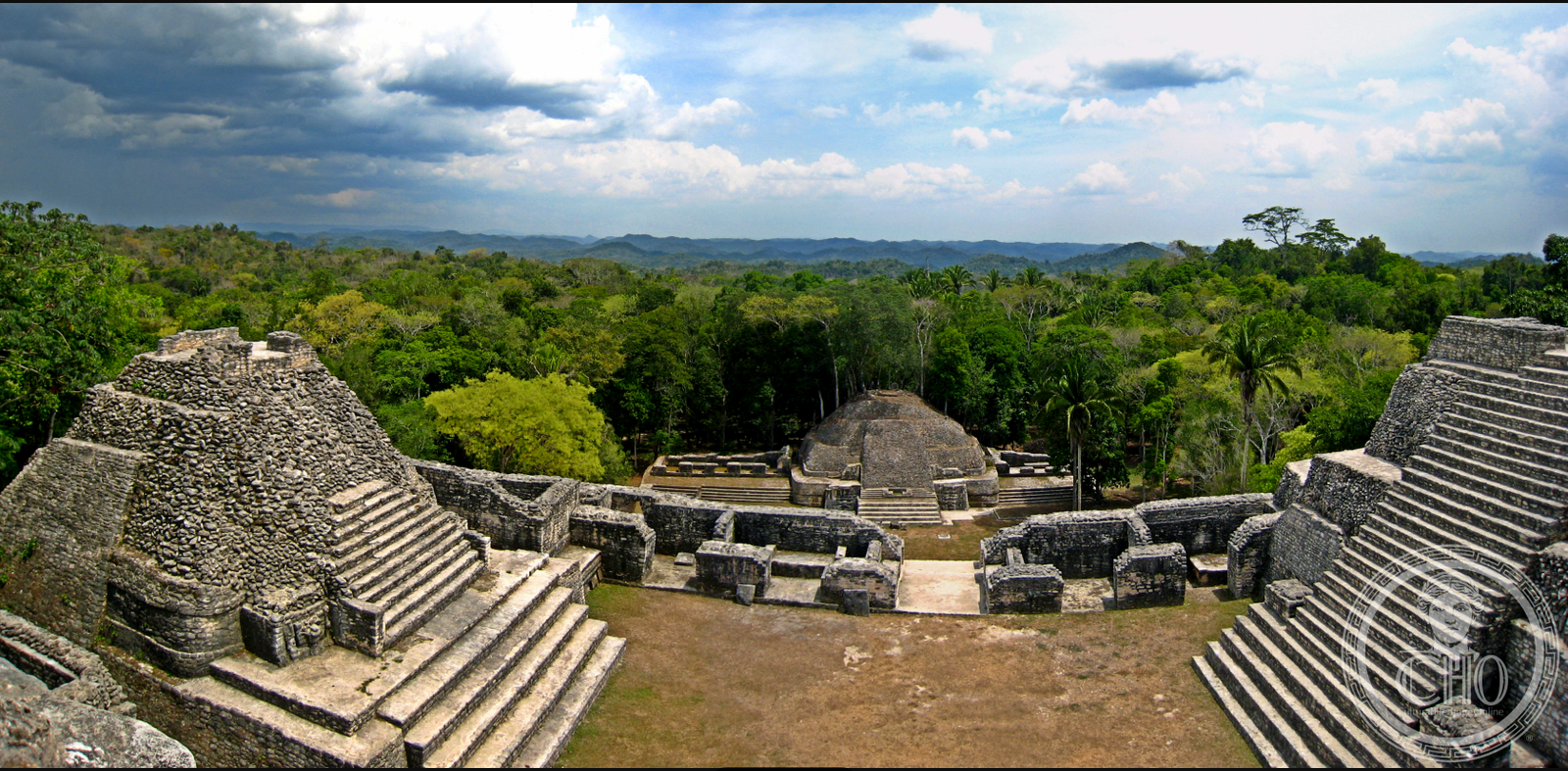
The largest ancient Maya city in Belize and one of the great powers of the Classic Maya world, Caracol defeated the superpower city of Tikal in 562 AD and at its peak housed 100,000 to 150,000 people across a 200 km2 urban landscape crowned by the 45-metre pyramid of Caana.
At a glance
In the Vaca Plateau of western Belize, approximately 50 km south of San Ignacio near the Guatemalan border, Caracol covers an estimated 200 km2 of interconnected residential zones, plazas, temple complexes, and sacbe (white stone road) networks. At its peak in the period 550-700 AD it housed an estimated 100,000 to 150,000 people, making it one of the most extensively populated Classic Maya cities known. Its centrepiece is Caana (Sky Place), a 45-metre pyramid complex that remains the tallest pre-Columbian structure in Belize. Full LIDAR mapping in 2009-2010 revealed the true extent of the city for the first time.
Key facts
- Period: c. 600 BC-900 AD (Preclassic through Terminal Classic Maya)
- Peak population: 100,000-150,000 people (c. 550-700 AD)
- Scale: c. 200 km2; the largest Maya site in Belize
- Caana: 45 m tall — the tallest pre-Columbian structure in Belize
- Key victory: Defeated Tikal 562 AD (recorded on Altar 21)
- Excavation: Systematic work by Arlen and Diane Chase since 1985
- LIDAR mapping: 2009-2010 (University of Central Florida)
History
Caracol was first settled during the Preclassic period around 600 BC and grew through the Early Classic to become a regional power by the 4th century AD. Its political ascent peaked in the 6th century when, allied with Calakmul, it defeated the great city of Tikal in 562 AD — a victory so decisive that Tikal entered what archaeologists call its hiatus, a period of approximately 130 years during which it erected no dated monuments. The defeat of Tikal is recorded on Caracol Altar 21, which records the capture and probable sacrifice of Tikal king Wak Chan Kawil. This victory propelled Caracol into a dominant position across the southern Maya Lowlands for approximately 150 years.
The city continued to grow through the Late Classic period, sustaining a population that modern estimates place between 100,000 and 150,000 at its height — larger than the contemporary Belize City — supported by an intensively terraced agricultural landscape surrounding the urban core. Caracol declined through the Terminal Classic period and was largely abandoned by approximately 900 AD, part of the broader Maya Collapse that affected cities across the region.
Caracol was first reported to archaeology by a chicle harvester who mentioned it to archaeologist A.H. Anderson in 1937. Anderson conducted the first brief examination, and the site received its modern name (Spanish for snail, from the spiral shells found on site). Systematic excavation began under Linton Satterthwaite in 1950 and resumed under Arlen and Diane Chase of the University of Nevada in 1985 — work that continues to the present. Their 2009-2010 airborne LIDAR survey of 200 km2 revealed the true extent of the settlement and transformed understanding of Maya urban landscapes.
What you see
The monumental core of Caracol centres on Caana (Sky Place), a royal palace and pyramid complex reaching 45 metres: four connected summits surmount a massive substructure, and the complex contains multiple vaulted rooms, plazas, and temples that formed the royal residential and ceremonial precinct. At its base, a series of large plazas radiate outward, connected by sacbe — elevated causeways of white limestone — that extend through the city and into the surrounding residential districts. At least three major sacbe have been identified, one extending approximately 10 km.
Throughout the site, hundreds of stelae and altars record dynastic history in carved text and image. Altar 21 — recording the 562 AD victory over Tikal — is among the most politically significant inscribed monuments in Classic Maya archaeology. The residential zones that ring the monumental core extend across hilly terrain, with terraced hillsides, causeways, plazas, and platform structures continuing across the full 200 km2 extent revealed by LIDAR.
Practical information
- Location: 50 km south of San Ignacio, Cayo District, western Belize
- Access road: Chiquibul Road; a 4WD vehicle is recommended (unpaved sections)
- Opening hours: Daily, typically 8am-4pm
- Entry fee: BZD charge; local guides available on site
- Combined visit: Often combined with Xunantunich (accessible near San Ignacio)
- What to bring: Water, sun protection, insect repellent, sturdy footwear
- Note: Howler monkeys are resident; listen for their calls at dawn
Getting there
The nearest town is San Ignacio (Cayo), approximately 50 km north by the Chiquibul Road. San Ignacio is served by buses and shuttles from Belize City (approximately 3 hours). From San Ignacio, Caracol is best reached by 4WD vehicle or organised day tour; the Chiquibul Road passes through forest reserve and is unpaved for much of its length.
Nearby
- Xunantunich — Classic Maya city with a 40-metre pyramid (El Castillo), 12 km from San Ignacio
- Cahal Pech — hilltop Maya site overlooking San Ignacio town
- Tikal (Guatemala) — the city Caracol defeated in 562 AD, approximately 100 km northeast
- Mountain Pine Ridge Forest Reserve — highland pine forest with waterfalls and caves, surrounding the road to Caracol
Sources
- Chase, A.F. and Chase, D.Z. (2001). The Royal Court of Caracol, Belize. Royal Courts of the Ancient Maya. Westview Press.
- Chase, A.F. et al. (2011). Airborne LiDAR, archaeology, and the ancient Maya landscape at Caracol. Journal of Archaeological Science 38(2).
- Martin, S. and Grube, N. (2008). Chronicle of the Maya Kings and Queens. Thames and Hudson.
- Wikipedia contributors, Caracol, Wikipedia (retrieved 2026).
Gallery
Find it on the map
See this place and what’s around it →📷 Become a Cultural Heritage Online photographer
Share your photos of places: they stay published under your name as the author. The more they're seen, the more you get noticed — and soon a contest will reward the most appreciated photos.
Log in or sign up free to add a photo