
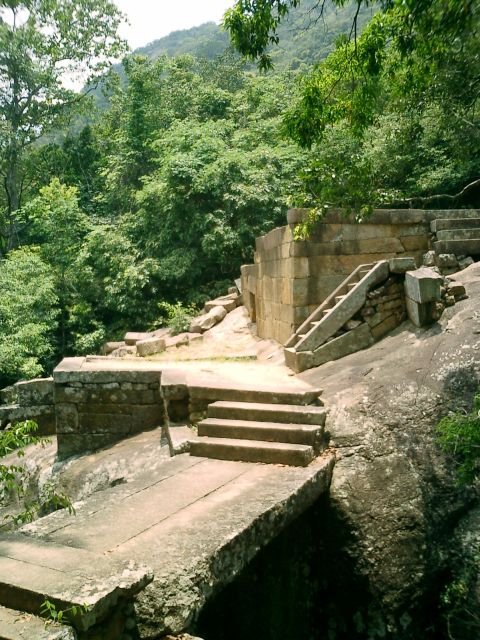
High on an isolated forested mountain in the dry plains of north-central Sri Lanka, the ruins of a pamsukulika — forest-dwelling — Buddhist monastery survive almost entirely hidden beneath jungle, joined by a 2-kilometre raised stone pathway and built with a deliberate restraint found nowhere else in Sri Lankan archaeology.
At a glance
Ritigala rises approximately 766 metres above the surrounding lowlands roughly 30 km northwest of Habarana, in a landscape of dry scrub and paddy fields. The mountain has been a Strict Nature Reserve since 1941, and its ruins — the remains of one of the most austere ancient Buddhist monastic complexes in Asia — are embedded within a forest so ecologically unusual (a rare dry-to-wet transition zone supporting plant species found nowhere else at this elevation) that the archaeology and the environment are inseparable from each other. Unlike any other major monastic complex in Sri Lanka, there are no stupas here, no image houses, no large sculptures — only platforms, pathways, bathing ponds, and the mountain’s own silence.
Key facts
- Period: c. 3rd century BC through 11th–12th century AD, with two major occupation phases separated by abandonment
- Tradition: Pamsukulika — forest-dwelling ascetic monks who rejected the luxury and ritual of the great urban monasteries
- Signature feature: A raised stone walkway approximately 2 km long linking at least 70 double-platform meditation complexes (padhanaghara parivenas)
- No stupas, no sculpture: The only major Sri Lankan monastic complex deliberately built without dedicatory monuments or devotional images
- Forest ecology: One of Sri Lanka’s few dry-zone to wet-zone transition points; anomalous summit microclimate; endemic plant species
- Excavations: 1893 (H.C.P. Bell, Archaeological Survey of Ceylon) and 1980s–1990s (Central Cultural Fund)
- Access: Permit from the Department of Wildlife Conservation required; no private vehicles beyond the forest boundary
History
The earliest records of Ritigala as a place of religious retreat appear in Pali inscriptions and the Mahavamsa chronicle, which record royal donations to forest-dwelling communities here from as early as the 3rd century BC. The pamsukulika tradition — monks who wore robes sewn from rags gathered in charnel grounds, ate only once a day from a single bowl, and refused the gift-giving economy of the urban monasteries — was a recurring reform movement within Sri Lankan Buddhism, periodically attracting royal patronage from rulers who admired the rigour of the forest-dwellers even as they built enormous monasteries for the mainstream Sangha in Anuradhapura and later Polonnaruwa.
The most substantial surviving remains at Ritigala date to the Anuradhapura period (3rd century BC – 10th century AD), with at least one further phase of construction and occupation during the Polonnaruwa period (10th–12th century AD). Inscriptions record donations from multiple named kings. The site was apparently abandoned following the political and military disruptions of the 13th century that ended the Polonnaruwa era; the forest then reclaimed it over subsequent centuries. The 1893 survey by H.C.P. Bell documented the network of platforms and the raised pathway for the first time in the modern record. The 1980s–1990s excavations by the Central Cultural Fund, Sri Lanka, clarified the stratigraphy and identified the spatial organisation of the padhanaghara parivenas.
What you see
The defining structure of Ritigala is its raised stone pathway — approximately 2 km long, running along the mountain’s western slope, paved with flat stones and built on a low embankment that kept it above the seasonal flooding of the surrounding forest floor. Branching off the pathway at regular intervals are at least 70 double-platform complexes. Each consists of two rectangular stone platforms connected by a short stone bridge over an ornamental water feature: archaeologists interpret one platform as the monk’s meditation cell (with a stone bed-slab and drainage channels) and the other as a communal meeting or study area. The platforms are built from the local buff-coloured sandstone in tight dry-stone construction; no decorative carving anywhere. Further elements along the pathway include a large stepped bathing pond (kalapuwa), several smaller cisterns cut into the rock, and what appear to be kitchen platforms. The whole ensemble creates an experience that is less a monument visit than a forest walk through ruins that seem to have grown organically from the mountain itself.
The forest heightens the effect. Because Ritigala sits at the junction of a dry lowland zone and an anomalously wet summit microclimate, the vegetation is denser, taller, and stranger than anything in the surrounding plains: fig trees with aerial root systems colonise the stone platforms, mist gathers around the summit even in the dry season, and the sound of wind in the canopy replaces the silence that presumably surrounded the monks who built here. The biological survey of the reserve has identified plant species found nowhere else in Sri Lanka — Ritigala’s ecology is itself a form of isolation, matching the isolation its inhabitants sought.
Practical information
- Permits: Required from the Department of Wildlife Conservation (DWC), obtainable at the site entrance; foreign visitor fee applies
- Vehicles: No private vehicles permitted beyond the forest boundary; walk from the entrance gate
- Guide: A DWC tracker is assigned at the gate; essential for navigating the trail network
- Time needed: Allow 3–4 hours minimum for the main pathway and principal platforms; serious exploration requires a full day
- Conditions: Trail is uneven and partially overgrown; closed-toe shoes and long trousers recommended; leech socks advisable after rain
- Best season: December to April (dry season); the summit microclimate means the site is visitable year-round but trails become muddy from May onwards
Getting there
Ritigala is located approximately 30 km northwest of Habarana and roughly 43 km from Anuradhapura. The nearest road approach is via the A9 Colombo–Kandy–Jaffna highway, turning off toward Maradankadawala and then Tambuttegama; the reserve entrance is signposted from the A9. Most visitors base themselves in Habarana or Dambulla (both approximately 30–35 km away) and hire a tuk-tuk or private vehicle for the day; there is no public bus service to the reserve entrance. The access road becomes difficult after rain. The site is typically combined with a visit to Anuradhapura or Polonnaruwa as part of the Cultural Triangle circuit.
Nearby
- Anuradhapura — the great urban monastery capital that the forest monks of Ritigala implicitly rejected, 43 km west
- Sigiriya — the 5th-century rock fortress with frescoes and water gardens, 25 km southeast
- Polonnaruwa — the second great Sri Lankan medieval capital, 60 km east
Sources
- Bell, H.C.P. Report on the Kegalle District, Archaeological Survey of Ceylon, 1893 — first systematic documentation of the Ritigala platforms and pathway
- Bandaranayake, Senake. Sinhalese Monastic Architecture, E.J. Brill, 1974 — canonical analysis of the padhanaghara parivena typology
- Central Cultural Fund, Sri Lanka. Ritigala Excavation Reports, 1980s–1990s — stratigraphic evidence for two major occupation phases
- Department of Wildlife Conservation, Sri Lanka. Ritigala Strict Nature Reserve: Biodiversity Assessment — endemic flora documentation
- UNESCO. Ancient City of Sigiriya World Heritage documentation, 1982 — regional cultural landscape context including Ritigala references
Find it on the map
See this place and what’s around it →📷 Become a Cultural Heritage Online photographer
Share your photos of places: they stay published under your name as the author. The more they're seen, the more you get noticed — and soon a contest will reward the most appreciated photos.
Log in or sign up free to add a photo