
More than 25 Upper Paleolithic sites on the Don River bank — the most important concentration of early Homo sapiens evidence in Europe, with finds pushing modern human presence in Russia back to at least 45,000 years ago.
At a glance
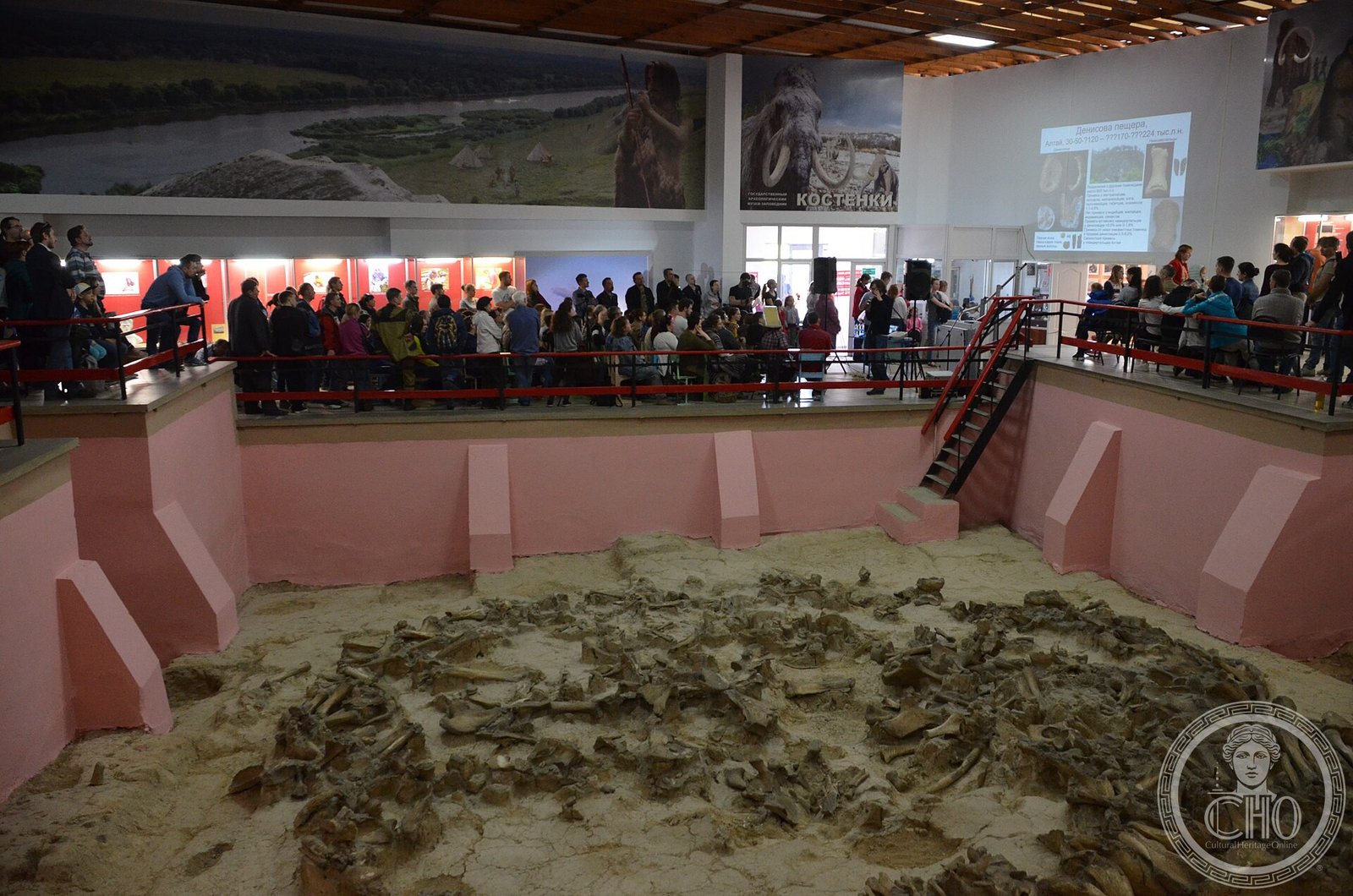
On the west bank of the Don River, 40 km south of Voronezh in central Russia, the Kostёnki-Borshchevo complex occupies a stretch of steppe ravines containing more than 25 Upper Paleolithic sites — a density unmatched anywhere in Europe. Excavated since 1879 and under systematic investigation ever since, the complex has produced evidence that redraws the map of early human migration: modern humans reached the interior of Eurasia at least 45,000 years ago, with a sophistication of material culture — personal ornaments, tailored clothing, planned architecture, representational art — that challenges older narratives of gradual cognitive development. The finds are displayed in an underground museum built directly over the excavated floor of one of the dwellings.
Key facts
- Period: c. 45,000–15,000 BC (Upper Paleolithic)
- Location: West bank of the Don River, Voronezh region, central Russia
- Number of sites: More than 25 distinct Paleolithic sites within a 10 km stretch
- First excavation: 1879; systematic work ongoing since the Soviet era
- Key marker: Campanian Ignimbrite volcanic ash layer (c. 39,000 BP) providing reliable chronology
- Notable finds: Oldest personal ornaments in Europe, mammoth-bone house structures, Venus of Kostёnki figurine
History
The Kostёnki-Borshchevo sites document human presence in central Russia across a span of approximately 30,000 years, from the earliest modern human occupation of Europe around 45,000 BC through successive waves of Upper Paleolithic culture until approximately 15,000 BC. The sites were first noticed by Russian archaeologists in 1879 and have been excavated intermittently ever since, with the most intensive work conducted during the Soviet period from the 1920s onwards. The sheer density of occupation — more than 25 sites within a 10 km stretch of river valley — reflects the exceptional productivity of the Don River ecosystem during the Pleistocene: herds of mammoth, woolly rhinoceros, horse, and bison provided abundant resources, and the loess bluffs of the valley offered natural shelter and excellent conditions for the preservation of organic remains.
The most consequential discovery at Kostёnki has been chronological: a layer of volcanic ash from the Campanian Ignimbrite eruption (approximately 39,000 years ago), one of the largest volcanic events in European prehistory, runs through the sequence at several of the sites. Both above and below this ash layer — which serves as a reliable timestamp across the entire complex — archaeologists have found indisputable evidence of modern human occupation, demonstrating not only that Homo sapiens survived this catastrophic eruption but that they had been present in central Russia for thousands of years before it occurred. Radiocarbon dates from the deepest layers of several sites now push this occupation back to at least 45,000 BP, making Kostёnki one of the oldest modern human sites in all of Europe.
What you see
The centrepiece of the site is the Kostёnki Museum, built underground to preserve and display the excavated floor of Kostёnki 11, one of the best-preserved dwellings on the site. Visitors descend into the museum to walk around the preserved floor level, viewing the ring of mammoth bones — skulls, leg bones, tusks — that formed the structural framework of a circular dwelling approximately 9 metres in diameter. The interlocked mammoth bones served as a foundation and windbreak; the superstructure was presumably of hides supported by wooden poles. The floor surface retains hearth areas, storage pits, and concentrations of flint-working debris that allow archaeologists to reconstruct the spatial organisation of daily life within the dwelling. The experience of standing above a living floor occupied 22,000 years ago, preserved intact by the loess sediments of the steppe, is among the most direct encounters with deep human time available anywhere.
The museum also houses displays of the most significant portable finds from across the Kostёnki-Borshchevo complex: the carved stone and ivory Venus figurines (including the Venus of Kostёnki), perforated shell and stone beads representing the oldest personal ornaments known in Europe, bone needles indicating tailored clothing, and ochre-stained objects associated with symbolic practices. The outdoor site encompasses the ravine landscape where excavations have been conducted, with information panels marking the locations of individual sites.
Practical information
- Museum: State Museum-Reserve Kostenki, open Tuesday–Sunday; check current hours before visiting
- Entry fee: Modest admission; guided tours available and recommended
- Best time to visit: May–September; the site is accessible year-round but winter access to the ravines can be difficult
- Language: Most signage and guides are in Russian; English-language resources limited
- Photography: Permitted in the outdoor area; check museum rules for the underground hall
Getting there
Kostёnki village is 40 km south of Voronezh on the west bank of the Don. From Voronezh, take a local bus or hire a taxi to the village of Kostenki (approximately 1 hour). Voronezh is served by Voronezh International Airport and by direct trains from Moscow (approximately 8–9 hours) and other major Russian cities. No direct international flights serve Voronezh; the most practical approach from abroad is via Moscow’s airports with onward train or bus connection.
Nearby
- Voronezh — regional capital with museums and onward transport connections, 40 km north
- Don River valley — the entire valley contains numerous Paleolithic and later archaeological sites
- Divnogorye — chalk cliff landscape with cave churches (Orthodox) and earlier prehistoric sites, 50 km south
Sources
- Wikipedia — Kostyonki-Borshchyovo
- Anikovich, M.V. et al., Early Upper Paleolithic in Eastern Europe and Implications for the Dispersal of Modern Humans, Science 315, 2007
- Sinitsyn, A.A., A Palaeolithic Pompeii at Kostenki, Russia, Antiquity 77, 2003
- Hoffecker, J.F., A Prehistory of the North: Human Settlement of the Higher Latitudes, Rutgers UP, 2005
- State Museum-Reserve Kostenki — kostenki-museum.ru
Find it on the map
See this place and what’s around it →📷 Become a Cultural Heritage Online photographer
Share your photos of places: they stay published under your name as the author. The more they're seen, the more you get noticed — and soon a contest will reward the most appreciated photos.
Log in or sign up free to add a photo