
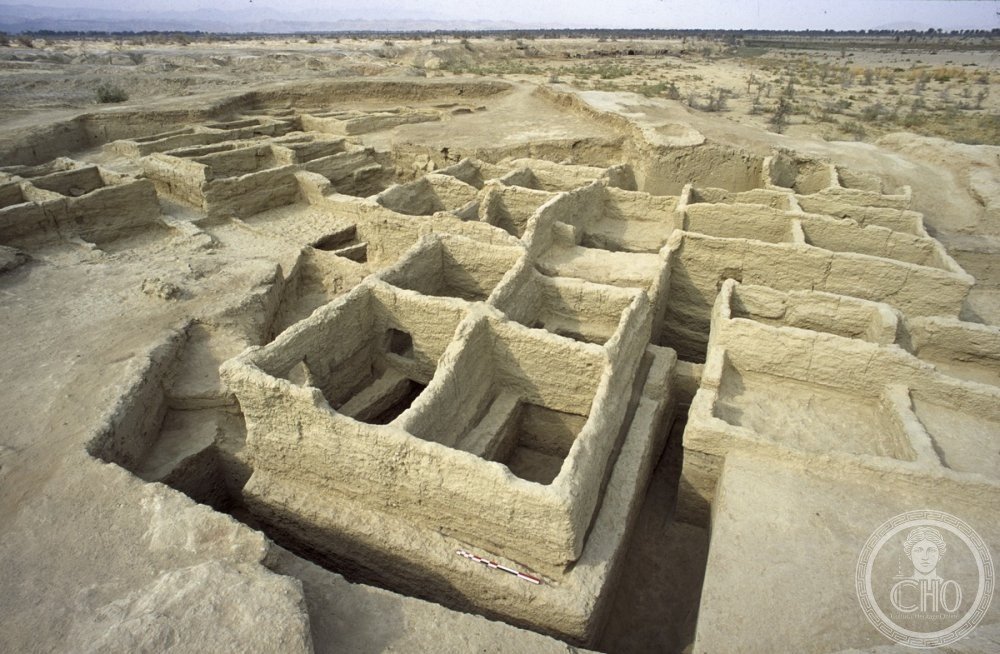
The earliest known farming community in South Asia: a Neolithic settlement near the Bolan Pass in Pakistan active from approximately 7000 BC, with evidence of the world’s oldest intentional dentistry and direct ancestry to the Indus Valley Civilisation.
At a glance
On the Kachi plain of Balochistan province in Pakistan, near the Bolan Pass that links the Iranian plateau to the Indus Valley, the site of Mehrgarh contains the earliest known evidence of farming and settled life in South Asia. A community cultivated wheat and barley and herded cattle, sheep, and goats here from approximately 7000 BC, millennia before the rise of the famous Indus Valley Civilisation at Mohenjo-daro and Harappa, which Mehrgarh and its successors directly preceded and probably influenced. The site also produced the world’s earliest known evidence of intentional dentistry, predating any other known dental intervention by approximately 4,500 years.
Key facts
- Period: c. 7000-2500 BC (Neolithic to early Chalcolithic), spanning 4,500 years of occupation
- Discovery: Excavated by French archaeologist Jean-François Jarrige from 1974 onward
- World’s earliest dentistry: Teeth dated c. 7000-6500 BC show drilled holes apparently made to relieve tooth decay, 4,500 years before any other known dental intervention
- Agriculture: Wheat, barley, and legume cultivation; cattle, sheep, and goat herding from Period I (c. 7000-5500 BC)
- Mother Goddess figurines: Among the earliest known schematic female terracotta figures, reappearing standardised across the Indus Valley 2,000 years later
- Architecture: Mud-brick rectangular houses from the earliest period; increasing complexity across six main phases of occupation
History
Mehrgarh was discovered and excavated beginning in 1974 by Jean-François Jarrige and a team from the French Archaeological Mission in Pakistan, producing a stratigraphic sequence stretching over 4,500 years of continuous occupation. The site’s importance lies in establishing that South Asian civilisation developed independently and progressively from a local Neolithic base, not as a transplant from Mesopotamia or Central Asia — it represents an indigenous origin point for the agricultural and artistic traditions that reached their greatest expression in the Indus Valley Civilisation of 2600-1900 BC.
The earliest inhabitants (Period I, c. 7000-5500 BC) lived in mud-brick rectangular houses, made baskets, and buried their dead with grave goods including turquoise and shell beads and goat meat provisions. The discovery of drilled teeth in individuals from this period constituted one of the most surprising finds in South Asian archaeology: the holes, made with small flint drill bits, appear to have been created to relieve dental decay, predating the next known intentional dental intervention by approximately 4,500 years. Later periods show increasing architectural complexity, the development of wheel-thrown pottery, copper metallurgy, and long-distance trade connections with Central Asia and the Persian Gulf.
What you see
Mehrgarh is an open archaeological site rather than a monument complex: the visible remains are primarily the exposed foundations of mud-brick structures from various periods of occupation, excavation trenches, and site museums interpreting the finds. The site covers several square kilometres of the Kachi plain and is divided into distinct mounds (named MR1 through MR8) corresponding to different phases and functional areas of the ancient settlement. The mud-brick architecture, built without stone in a treeless plain, has left stratified deposits several metres deep.
The artefacts recovered from Mehrgarh — including the drilled teeth, Mother Goddess figurines, early copper tools, elaborate painted pottery, and grave goods — are mostly held at the National Museum of Pakistan in Karachi and the Quetta Museum. The site itself is maintained by the Department of Archaeology and Museums of Pakistan. A visit requires coordination with local authorities and the site is not a standard tourist destination, but the surrounding Kachi plain and Bolan Pass are of considerable landscape interest.
Practical information
- Location: Near Mehrgarh village, Kachi district, Balochistan; approximately 30km from Sibi
- Access: Open archaeological site; visit should be coordinated with the Department of Archaeology and Museums, Quetta
- Key collections: Mehrgarh artefacts displayed at National Museum of Pakistan, Karachi, and Quetta Museum
- Facilities: Minimal on-site facilities; base yourself in Sibi or Quetta
- Security: Check current travel advisories for Balochistan before visiting
Getting there
Mehrgarh is approximately 30km east of Sibi in Balochistan. From Quetta: road journey of approximately 3 hours east via the RCD Highway, then south from Mach towards the Kachi plain. The site is accessible by road from Sibi. Given the remote location and current conditions in Balochistan, independent travel is not recommended; specialist archaeological tour operators or coordination with Pakistani academic institutions is advisable.
Nearby
- Bolan Pass (50km northwest) — the historic mountain pass linking Balochistan to the Indus Valley, used by Bronze Age traders and Alexander the Great
- Mohenjo-daro (430km east) — the best-preserved city of the Indus Valley Civilisation, direct cultural successor to Mehrgarh’s traditions
- Quetta (150km northwest) — capital of Balochistan, with a good regional museum and base for exploring the province
- Pirak (30km) — nearby Bronze Age site of the post-Mehrgarh period, showing the transition towards the Indus Civilisation
Sources
- Jarrige, Jean-François et al. Mehrgarh: Field Reports 1975-1985. Department of Culture, Government of Sindh, 1995.
- Wikipedia: Mehrgarh — archaeological summary with full citations
- Coppa, A. et al. Early Neolithic tradition of dentistry: flint tips were surprisingly effective for drilling human teeth. Nature, 2006.
- Possehl, Gregory L. The Indus Civilization. AltaMira Press, 2002.
- Department of Archaeology and Museums, Pakistan: www.dam.gov.pk
Find it on the map
See this place and what’s around it →📷 Become a Cultural Heritage Online photographer
Share your photos of places: they stay published under your name as the author. The more they're seen, the more you get noticed — and soon a contest will reward the most appreciated photos.
Log in or sign up free to add a photo