
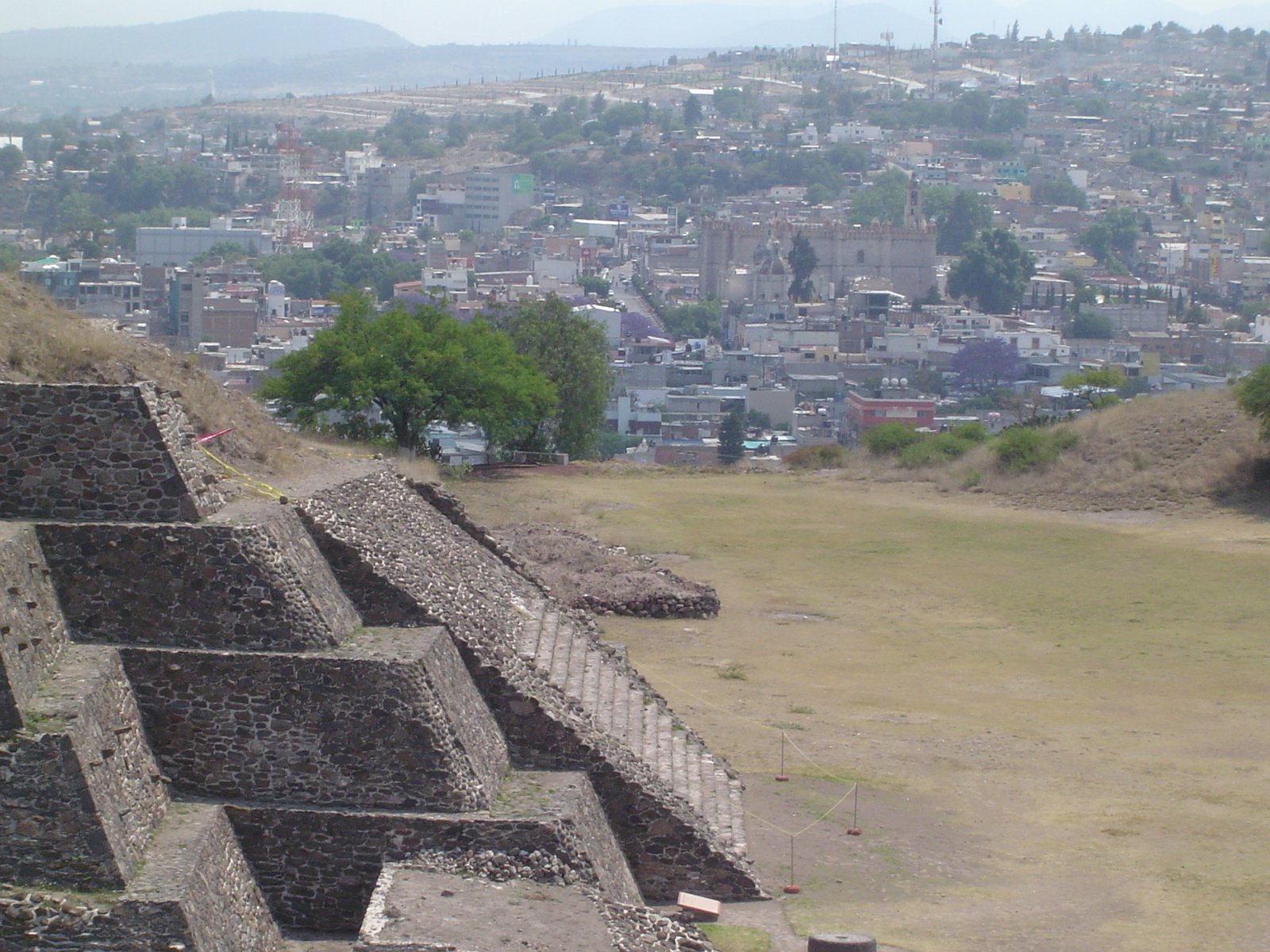
The ancient city of Tula (Tollan) in the state of Hidalgo was the capital of the Toltec civilisation and one of the most powerful cities in pre-Columbian Mexico. Its four colossal Atlante warrior columns — 4.6 metres tall, carved from basalt — are the defining monuments of Toltec culture and the largest known free-standing figurative sculptures in the pre-Columbian world.
At a glance
Located in the state of Hidalgo 65 km north of Mexico City, Tula (known in ancient sources as Tollan) served as the capital of the Toltec civilisation between approximately 700 and 1150 AD. At its peak it was home to perhaps 30,000–60,000 inhabitants — one of the largest cities in Mesoamerica in its era. The Aztec who followed centuries later venerated the Toltec as their cultural predecessors and mythological heroes: “Toltec” became a synonym for “master craftsman,” and Aztec nobility claimed Toltec lineage as the highest genealogical distinction. The site is dominated by Pyramid B and its four colossal Atlante figures: warrior columns that served simultaneously as structural roof supports and as the embodied presence of the god Quetzalcoatl in his warrior form.
Key facts
- Period: c. 700–1150 AD (Toltec civilisation; Early Postclassic period)
- Peak population: Estimated 30,000–60,000 inhabitants
- Atlantes: Four basalt warrior columns, 4.6 m tall; largest known pre-Columbian free-standing figurative sculptures
- Main pyramid: Pyramid B (Temple of Tlahuizcalpantecuhtli, the Morning Star / Venus deity)
- Tula–Chichén Itzá connection: Remarkably close architectural parallels 1,700 km apart; debated as colonisation, migration, or intensive exchange
- Distance from Mexico City: 65 km north; approximately 1 hour 15 minutes by car
- Site area: Approximately 14 km² (urban core); archaeological zone covers the main ceremonial centre
History
Tula rose to prominence after the fall of Teotihuacan (c. 650 AD), filling the political vacuum left by the collapse of the first great Mexican imperial city. By 900–1000 AD, Tula had become the dominant power of central Mexico, controlling trade networks that extended from the American Southwest (turquoise) to the Maya lowlands (cacao, jade). The city’s patron deity was Quetzalcoatl — the Feathered Serpent — and Toltec mythology associates Tula with a semi-divine ruler-priest named Ce Acatl Topiltzin Quetzalcoatl, who, after being driven from the city by political rivals, was said to have sailed east promising to return. The Aztec later confused this legend with the appearance of Hernán Cortés, with consequences that shaped the conquest of Mexico.
Tula was abandoned and largely burned around 1150 AD, apparently through a combination of internal conflict and external pressure from migrating groups. The Aztec, who rose to power in the Valley of Mexico two centuries later, regarded Tula as a paradise of civilisation — a place where maize grew in all colours, cotton grew pre-dyed, and the Toltec were all artists and sages. This idealisation shaped how Aztec culture conceived of its own legitimacy: Aztec emperors traced their genealogy to Toltec royal lines, and “Toltec” became the ultimate descriptor of cultural sophistication in Mesoamerican discourse.
The relationship between Tula and Chichén Itzá in the Yucatán — 1,700 km away — remains one of Mesoamerican archaeology’s most debated questions. The Temple of the Warriors at Chichén Itzá reproduces Tula’s Pyramid B with extraordinary fidelity: the same Atlante columns (smaller scale), the same colonnaded hall, the same chacmool reclining figure at the top of the staircase, the same frieze motifs of jaguars, eagles, and skeletal figures. Whether this reflects Toltec military conquest, Ítza migration from the Gulf Coast, or the diffusion of a shared Postclassic ideological koine across Mesoamerica is still unresolved.
What you see
Pyramid B — the Temple of Tlahuizcalpantecuhtli (the Morning Star, a Venus manifestation) — is a five-tiered stepped pyramid approximately 10 metres tall. Its summit was once covered by a sanctuary whose roof was supported by the four Atlante columns and an array of square pillars carved with warrior imagery. The Atlantes stand approximately 4.6 metres tall, each assembled from four drum-shaped basalt segments. Every figure is a composite of the same warrior: butterfly pectoral (symbol of dead warriors transformed into the rising sun), an atlatl (spearthrower) in one hand and darts in the other, a back mirror of smoking obsidian (the mirror of Tezcatlipoca, god of darkness and night sky), and a star-shaped war helmet. They face south toward the main plaza, standing as both architectural supports and as the petrified presence of the divine warrior.
Alongside Pyramid B, the site includes the Palacio Quemado (Burned Palace) — a columned hall whose carved friezes document Toltec warriors, sacrificed captives, and the Feathered Serpent — the Coatepantli (Serpent Wall), a carved boundary wall whose frieze shows feathered serpents devouring skeletal human figures, and a large ball court. Dozens of carved chacmool figures — reclining figures with a receptacle on the abdomen, probably used for offerings — were found at the site; the form is characteristic of Toltec-era art and appears identically at Chichén Itzá.
Practical information
- Opening hours: Tuesday–Sunday, 09:00–17:00 (last entry 16:30); closed Monday
- Admission: General entrance fee (INAH sites); reduced rate for Mexican nationals; under 13 free
- On-site museum: The site museum houses original carved panels, the chacmool figures, and artefacts from excavations; the Atlantes on the pyramid are reproductions (originals in the museum)
- Duration: Allow 2–3 hours for the archaeological zone and museum
- Physical access: The pyramid summit (and Atlantes) is accessible by climbing the main staircase; the terrain is uneven stone
Getting there
Tula de Allende is 65 km north of Mexico City, approximately 1 hour 15 minutes by car via the Autopista Mexico–Pachuca (MEX-85D). By public transport: take the metro to Autobuses del Norte terminal, then a first-class bus to Tula (several operators; journey c. 1.5 hours). From Tula bus station, the archaeological zone is a 10-minute taxi ride or 40-minute walk. Alternatively, Tula is easily combined with Pachuca (state capital) in a full-day excursion from Mexico City.
Nearby
- Tula de Allende town centre — The convento and church of San José (16th century) built with stones from the Toltec ruins; pleasant zocalo
- Pachuca — State capital of Hidalgo, 60 km north-east; Museo de Mineria and the historic Reloj Monumental clock tower
- Tepotzotlán — 30 km south; magnificent Jesuit church and colonial art museum in a beautifully preserved 17th-century complex
- Teotihuacan — 75 km south-east; the pyramids of the Sun and Moon of the civilisation that preceded and influenced Tula
Sources
- Kristan-Graham, C., and Kowalski, J.K. (eds.) (2007). Twin Tollans: Chichén Itzá, Tula, and the Epiclassic to Early Postclassic Mesoamerican World. Dumbarton Oaks.
- Healan, D.M. (ed.) (1989). Tula of the Toltecs: Excavations and Survey. University of Iowa Press.
- Wikipedia: “Tula, Hidalgo” — en.wikipedia.org
- INAH (Instituto Nacional de Antropología e Historia): official site documentation for Zona Arqueológica Tula
- Coe, M.D. (2008). Mexico: From the Olmecs to the Aztecs, 7th ed. Thames & Hudson.
Find it on the map
See this place and what’s around it →📷 Become a Cultural Heritage Online photographer
Share your photos of places: they stay published under your name as the author. The more they're seen, the more you get noticed — and soon a contest will reward the most appreciated photos.
Log in or sign up free to add a photo