

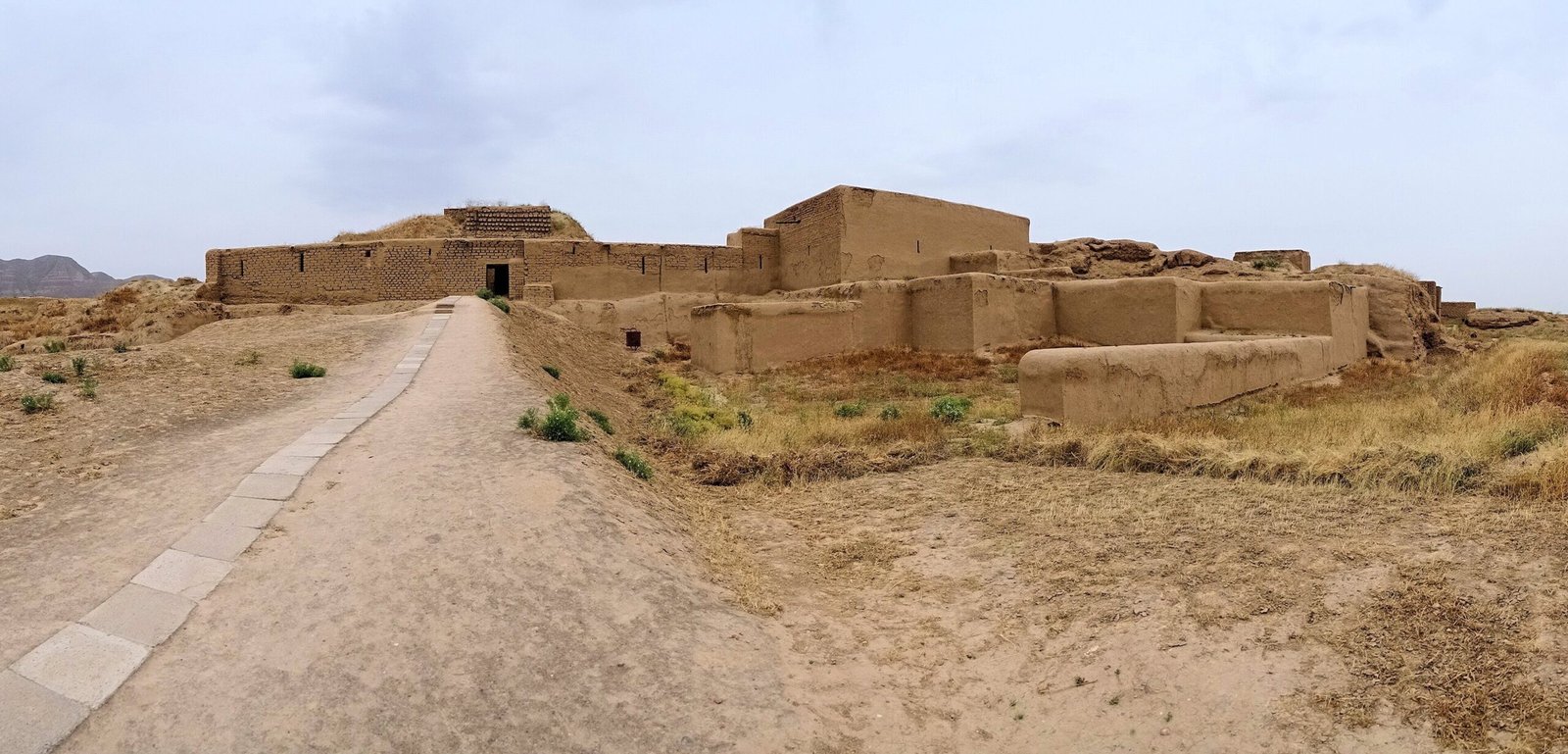
Twelve kilometres west of modern Ashgabat lies the first capital of the Parthian Empire — the vast Iranian power that controlled the Silk Road from Mesopotamia to Bactria for nearly five centuries, defeated three Roman generals, and left behind one of the most extraordinary collections of Hellenistic-Iranian art ever found: forty ivory drinking horns carved with mythological scenes, discovered inside a royal treasury buried for two millennia.
At a glance
Old Nisa — probably called Mithridatkert (“fortress of Mithridates”) by the Parthians — was the dynastic religious site and royal treasury of the Arsacid dynasty, which ruled from 247 BC to 224 AD. The Parthian Empire at its height stretched from the Euphrates to the Indus and was the only power that consistently defeated Rome in the East, killing Marcus Licinius Crassus at Carrhae in 53 BC and capturing Emperor Valerian at the Battle of Edessa in 260 AD. Yet Old Nisa remains almost unknown outside specialist circles, partly because Turkmenistan maintains one of the world’s most restrictive tourist visa regimes. UNESCO inscribed the site in 2007 as part of the Parthian Fortresses of Nisa.
Key facts
- Period: Parthian Empire, c. 247 BC – 224 AD; site possibly used from 3rd century BC
- UNESCO WHS: Inscribed 2007 as “Parthian Fortresses of Nisa”
- Location: 12 km west of Ashgabat, on a low plateau overlooking the Kopet-Dag foothills
- The rhyton treasury: Approximately 40 ivory drinking horns (rhytons), up to 60 cm long, carved with Hellenistic mythological scenes; now in the National Museum of Turkmenistan
- Administrative records: Thousands of ostraca (pottery sherds) written in Aramaic, documenting royal estate management
- Enclosure: Trapezoidal, approximately 14 hectares, mudbrick walls up to 9 metres high with towers at regular intervals
- Access: Extremely restricted; Turkmenistan issues tourist visas to very few nationalities
History
The Parthians were a nomadic Iranian people from the region of Parthia (modern northeastern Iran and southern Turkmenistan) who exploited the collapse of the Seleucid Empire to establish their own dynasty around 247 BC under Arsaces I. Within a century they had seized Media, Mesopotamia, and Persia, creating an empire that rivalled Rome.
Old Nisa served as the dynasty’s original sacred centre — not a civilian city, but a heavily fortified ceremonial complex containing the royal treasury, dynastic shrines, and possibly the tombs of the earliest Arsacid kings. Its probable name, Mithridatkert, honours Mithridates I (r. 171–138 BC), who transformed the Parthian state from a regional power into an empire stretching from the Euphrates to Bactria.
The Parthians practised a remarkable cultural synthesis: their court art was Hellenistic in style (the rhytons are proof), their administration used Aramaic script inherited from the Achaemenid Persians, their religion blended Zoroastrian and local Iranian traditions, and their political organisation drew on both Iranian tribal traditions and Greek city-state models. Old Nisa is a physical record of this hybrid civilisation.
Soviet archaeologists began systematic excavations of Old Nisa in the 1940s, continuing through the 1980s. After Turkmenistan’s independence in 1991, work continued intermittently. The extraordinary finds from the site — rhytons, sculptures, ostraca — are now held primarily in the National Museum of Turkmenistan in Ashgabat and in the Hermitage Museum in St Petersburg.
What you see
Old Nisa is an immense trapezoidal enclosure of approximately 14 hectares, its mudbrick walls rising to 9 metres in places with round towers projecting at regular intervals. The interior has been partially excavated, revealing several major structures:
- The Round Hall (Rotunda): A large circular building interpreted as a dynastic shrine or throne room, with niches possibly once holding statues of Arsacid rulers. Its unusual circular plan has no clear parallels in either Greek or Iranian architecture.
- The Square Hall: A large colonnaded hall used for royal assemblies or religious ceremonies; fragments of Hellenistic-style painted plaster decoration survive.
- The Treasury Building: Where the rhyton collection was found, along with marble and limestone sculptures blending Greek and Iranian iconographic traditions.
- The Wine Storehouses: Documented by the ostraca, which record deliveries of wine, grain, and fruit to the royal estate in quantities suggesting regular ceremonial use.
Practical information
Old Nisa is located approximately 12 km west of central Ashgabat. The site is reachable by taxi from Ashgabat. Turkmenistan maintains one of the world’s most restrictive tourist visa regimes — independent travel is extremely difficult. Most visitors arrive as part of organised tours through specialist agencies. The National Museum of Turkmenistan in Ashgabat (Ruhy Mosque district) holds the major finds from the site, including the rhyton collection.
Getting there
Ashgabat is served by Ashgabat International Airport (ASB) with connections to Istanbul, Moscow, Frankfurt, and several Central Asian cities. From Ashgabat, Old Nisa is reached by taxi (approximately 20 minutes). Due to Turkmenistan’s visa requirements, arrange entry well in advance through a licensed Turkmen tour operator, as independent tourist visas are rarely issued.
Nearby
- New Nisa — The adjacent civilian city and trading settlement, also partially excavated; 1 km from Old Nisa
- Annau Archaeological Site — Neolithic and Bronze Age mound near Ashgabat, one of the earliest farming communities in Central Asia
- Merv (Mary) — Ancient Silk Road metropolis, UNESCO WHS; approximately 350 km east; one of the largest cities of the medieval Islamic world
Sources
- Invernizzi, Antonio. “Nisa partica”. In Encyclopedia Iranica, online edition, 2009.
- Pilipko, V. N. Staraya Nisa: Zdaniye s Kruglym Zalom. Moscow: Nauka, 1996.
- UNESCO World Heritage List. “Parthian Fortresses of Nisa”, inscribed 2007. whc.unesco.org.
- Coloru, Omar & Canepa, Matthew P. “Nisa and the Arsacid Royal Cult.” In The Parthian and Early Sasanian Empires. Oxbow Books, 2017.
Find it on the map
See this place and what’s around it →📷 Become a Cultural Heritage Online photographer
Share your photos of places: they stay published under your name as the author. The more they're seen, the more you get noticed — and soon a contest will reward the most appreciated photos.
Log in or sign up free to add a photo