
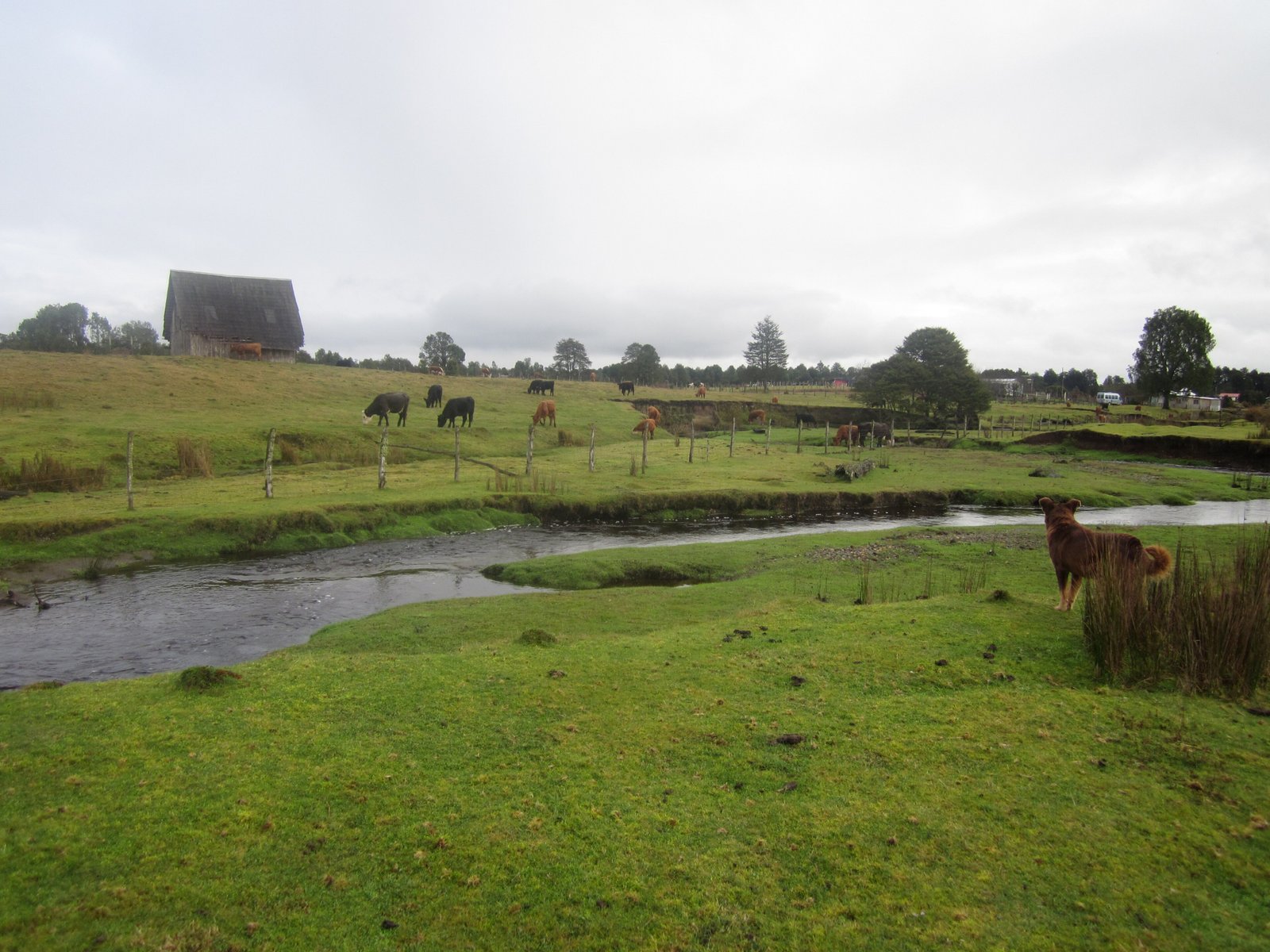
The Site That Broke the Clovis Consensus
In 1977, a veterinary student named Carlos Pino noticed unusual bones eroding from a creek bank near Chinchihuapi Creek, south of Puerto Montt in the Chilean Lake District. The subsequent excavation by Tom Dillehay of Vanderbilt University produced results that no mainstream archaeologist was prepared to accept: human habitation dated to 14,800 years ago — more than 1,500 years before the Clovis culture, which had held for half a century as the agreed first entry of humans into the Americas.
Monte Verde did not just push back a date. It demolished a model. The “Clovis First” hypothesis held that humans crossed the Bering Land Bridge from Siberia around 13,000 BC and spread southward through an ice-free corridor between the Laurentide and Cordilleran ice sheets. For humans to have been at Monte Verde at 14,800 BC — at the far southern tip of South America, 13,000 kilometres from Alaska — that corridor could not have been their route. It was still closed. They must have come earlier, and by a different way: almost certainly by a coastal route, moving in watercraft along the Pacific coast of North and South America.
What the Waterlogged Peat Preserved
Monte Verde’s scientific importance rests not only on its age but on the extraordinary quality of its preservation. The site was buried quickly under peat in a waterlogged environment — conditions that allowed organic materials to survive for nearly fifteen millennia. The excavation found: wooden stakes still in the ground, forming the structural framework of elongated tent structures; associated poles and cordage; fragments of animal hide (probably mastodon), interpreted as the covering of the tents; wooden bowls and mortars; knotted grass and rush matting; the preserved footprint of a child or adolescent, pressed into a soft clay floor and hardened in place.
Food remains were particularly informative: the occupants were eating mastodon, palaeocamelids, small mammals, and — most remarkably — seaweed. The seaweed included nine species, some from the Pacific coast, at least 40 kilometres from the site. The Monte Verde people were not interior forest dwellers or steppe hunters: they were actively using the coast as a resource base, and the presence of marine algae from distant sources suggests either regular coastal journeys or an existing movement network connecting inland and coastal zones.
The Architecture of the Camp
The excavated settlement consists of two main structures: the larger is an elongated structure approximately 20 metres long, subdivided internally into what appear to be individual family spaces; the smaller is a separate wishbone-shaped structure that contained concentrations of medicinal plants and animal bones worked in unusual ways — interpreted as a ritual or shamanic space. Braziers and clay-lined hearths were found in both structures. The settlement was not a transient camp but a winter base, occupied for an extended period — the architectural investment and food storage evidence indicate a group planning to stay.
The assemblage includes approximately 700 stone tools (simpler than Clovis points, not bifacially flaked in the Clovis manner — another argument against a Clovis ancestry), bone tools, wooden digging implements, and botanical remains indicating deliberate plant selection.
The Battle Over Monte Verde
Tom Dillehay published his first Monte Verde volume in 1989 to immediate controversy. Clovis-First defenders argued the dates were contaminated, the artefacts natural (geofacts, not tools), or the stratigraphy confused. Dillehay spent the better part of a decade defending the site against sustained professional scepticism. The resolution came in 1997 when an international review committee of twelve archaeologists — including Clovis-First proponents — visited the site. After three days, the committee published a consensus statement: Monte Verde was genuine, the dating reliable, and the Clovis-First model was falsified.
The shift was rapid after that. Today Monte Verde is universally accepted as the oldest reliably dated human site in the Americas, and coastal migration models have replaced the ice-free corridor model as the primary framework for explaining the first peopling of the Western Hemisphere.
Monte Verde I: The More Contested Layer
Below the Monte Verde II layer (14,800 BP) lies a deeper stratum designated Monte Verde I, with possible evidence of human presence at approximately 18,500 years ago. This layer — represented by charred wood, modified stones, and possible hearths — is far more contested. Many archaeologists accept it provisionally; others remain unconvinced. If genuine, the implications are dramatic: humans would have reached southern South America 18,500 years ago, implying entry into the Americas well before 20,000 BC.
Implications for American Prehistory
The coastal migration model that Monte Verde supports has been strengthened by subsequent discoveries: sites in Oregon, Washington, and California dated to 14,000–15,000 BP; genetic studies showing Native American populations diverged from a Siberian ancestor around 20,000–25,000 BC; and skeletal morphology evidence suggesting at least two distinct migration waves. The picture is of a peopling of the Americas that was earlier, more complex, and more maritime than anyone imagined in 1977.
For archaeology, Monte Verde also functions as an epistemological landmark: it is the site where a fifty-year consensus was overturned by physical evidence after years of institutional resistance. Dillehay’s battle and the 1997 review committee are now taught as a case study in how science handles paradigm shifts.
The Site Today
Monte Verde is not a visitor site in the conventional sense — there is no standing architecture, no monumental art. The original deposits are underground. The site is approximately 35 kilometres north of Puerto Montt in Chile’s Los Lagos Region, accessible by road with minimal infrastructure. The most important materials — wooden artefacts, preserved hides, the botanical collection — are held at the Universidad Austral de Chile in Valdivia. The site received a Chilean National Monument designation in 2008.
Plan Your Visit
The nearest city is Puerto Montt, well-connected by air and by the Ruta 5 Pan-American Highway. From Puerto Montt, follow Ruta 5 north and then inland toward the site — allow half a day. The Universidad Austral de Chile museum in Valdivia is a longer detour but holds the key finds. Guided tours from Puerto Montt can be arranged with specialist operators; the site is rarely busy and requires no advance booking.
Essential Facts
- Period
- c. 14,800 BC (Monte Verde II); possibly c. 18,500 BC (Monte Verde I, contested)
- Significance
- Oldest reliably dated human habitation site in the Americas; falsified the Clovis-First model
- Key finds
- Wooden tent foundations, mastodon remains, Pacific seaweed, stone tools, child’s footprint in clay
- Key excavator
- Tom Dillehay (Vanderbilt University), from 1977; discovery by Carlos Pino
- Validation
- International review committee consensus, 1997
- Location
- ~35 km north of Puerto Montt, Los Lagos Region, Chile
- GPS
- 41.5021°S, 73.2010°W
- Access
- By road from Puerto Montt; minimal visitor infrastructure; key artefacts at Universidad Austral de Chile, Valdivia
Find it on the map
See this place and what’s around it →📷 Become a Cultural Heritage Online photographer
Share your photos of places: they stay published under your name as the author. The more they're seen, the more you get noticed — and soon a contest will reward the most appreciated photos.
Log in or sign up free to add a photo